Get a Free Development Strategy Consultation
Tell us about your project - we'll respond within 24 hours with tailored recommendations.
What Is Custom Software Development, and Why Do Enterprises Choose It?
Custom software development is the process of designing, building, and maintaining software built specifically for your business needs, rather than adapting your operations to fit an off-the-shelf product. For US enterprises in 2026, it's one of the most consequential technology decisions you'll make, and getting it right requires more than choosing a vendor.
This guide is written for decision-makers: CTOs, VPs of Engineering, and operations leaders evaluating whether to build custom, what to look for in a partner, and how to avoid the mistakes that cost enterprises time, budget, and competitive ground.
Custom software development is the end-to-end process of scoping, designing, building, testing, deploying, and maintaining software built specifically around your business workflows, users, and goals. Unlike packaged SaaS tools, nothing is shared, generic, or adapted from a template.
Enterprises choose it when the off-the-shelf alternatives can't match the complexity of their operations, when integration requirements are too deep for standard APIs, or when they're building something that creates a competitive edge no vendor will ever package up and sell to their competitors.
The most common use cases now include internal enterprise application development, customer-facing platforms, workflow automation systems, data and analytics infrastructure, and legacy modernization projects.
If you're evaluating this decision, talking through your requirements with a software development company that works at enterprise scale is a good early step. It helps you quickly separate what's genuinely custom from what could be solved faster with existing tools.
Custom Software vs. Off-the-Shelf: How to Think About the Trade-Off
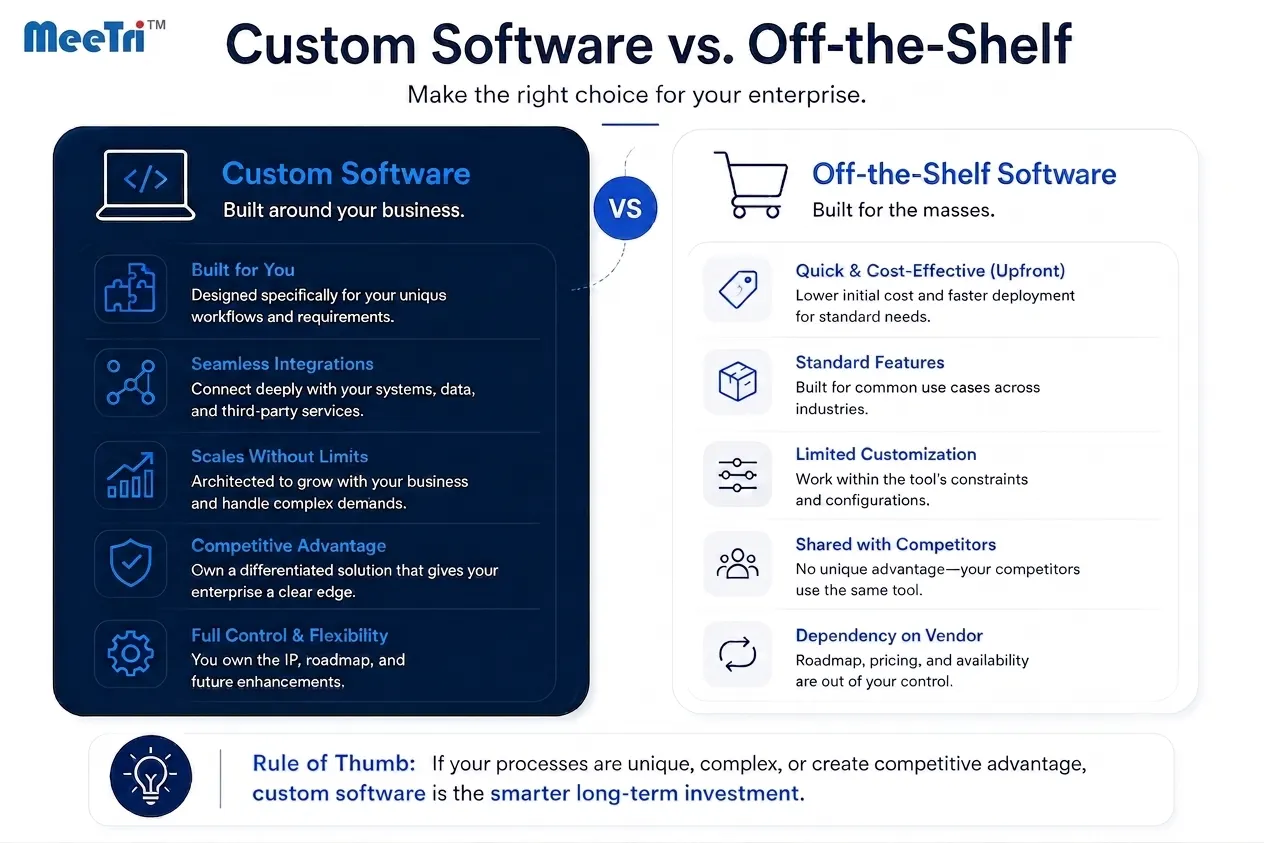
The question isn't always "build or buy." It's "where does off-the-shelf stop working for us?"
Off-the-shelf software wins when your needs match the product's core use case, when the workflow is standard across your industry, and when speed of deployment matters more than precision. It breaks down when you need deep integrations across complex tech stacks, when your data model doesn't fit the vendor's assumptions, or when you're scaling beyond the tool's design.
Here's a practical way to evaluate the boundary:
- Processes that are common across your industry: Consider SaaS first.
- Processes that are genuinely unique to how your business works: Custom is worth evaluating.
- Processes that create competitive advantage: Custom is usually the right answer.
- Processes where off-the-shelf creates workarounds, re-keying, or data gaps: Custom often pays back faster than it appears.
The cost conversation doesn't start with "custom is expensive." It starts with "What's the total cost of the workaround we're currently running?"
How Much Does Custom Software Development Cost for US Enterprises in 2026?
There's no single number, and any partner quoting one without scoping your requirements first should be a red flag.
That said, here's a realistic range for US enterprises in 2026:
- Small to mid-complexity internal tools: $75,000 to $200,000
- Enterprise-grade applications with integrations: $250,000 to $750,000
- Large-scale platforms, data systems, or multi-integration builds: $750,000 and above
Cost drivers include the complexity of your business logic, the number of integrations required, security and compliance requirements, the architecture decisions around cloud deployment and scalability, and whether you need ongoing support post-launch.
Offshore and nearshore custom software development services can reduce rates significantly without compromising quality, particularly when the partner has a structured delivery process and a track record with enterprises of your size. Software development outsourcing is now standard practice for US enterprises, not a compromise.
One cost often underestimated: governance. Enterprises that don't invest in proper project management, documentation, and stakeholder alignment typically spend 20 to 40% more on revisions and rework than those who do.
How Long Does Enterprise Software Development Take?
Timeline depends heavily on scope, but here's a practical benchmark:
- Discovery and architecture planning: 4 to 8 weeks
- MVP or Phase 1 delivery: 3 to 6 months
- Full enterprise-scale build: 6 to 18 months, depending on complexity
Agile software development has changed how timelines work. Most enterprise projects now run in two-week sprints with working software delivered iteratively. This means you're reviewing real outputs within weeks, not waiting a year for a final reveal. It also means problems surface early, when they're cheap to fix.
Agile software development has changed how timelines work. Most enterprise projects now run in two-week sprints with working software delivered iteratively. This means you're reviewing real outputs within weeks, not waiting a year for a final reveal. It also means problems surface early, when they're cheap to fix.
The risk with long timelines isn't usually the development itself. It's scope creep, unclear ownership on the client side, and slow decision-making cycles on approvals and feedback. Enterprises that assign a clear internal product owner and commit to sprint reviews consistently ship faster.
How Custom Software Helps Enterprises Scale and Automate Business Processes
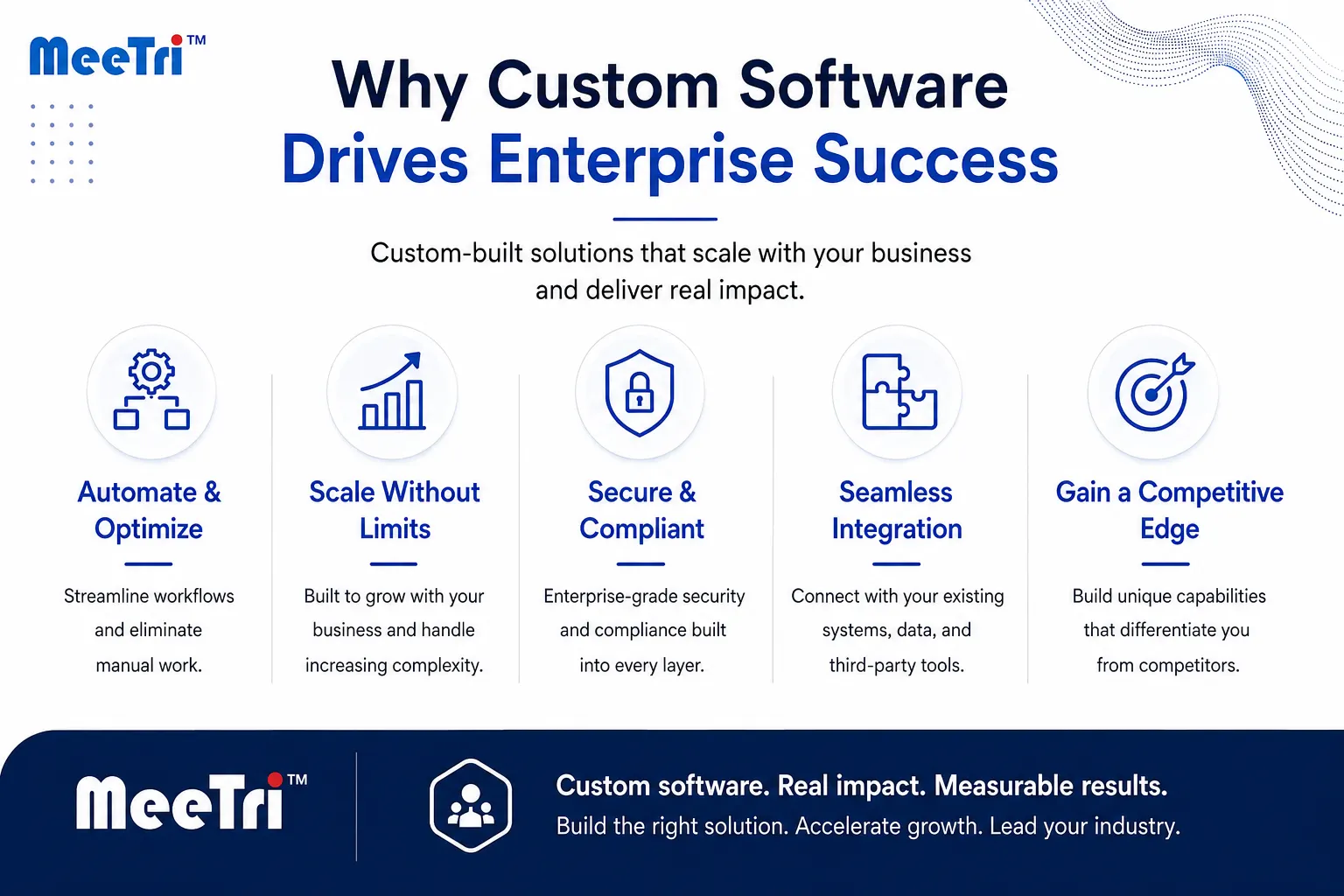
The scalability advantage of bespoke software is architectural. When software is designed around your data model, workflow logic, and user needs, it scales with the business rather than constraining it.
Key capabilities that enterprise software teams build for scale include the following:
- Scalable software architecture that handles increasing transaction volumes without performance degradation.
- API integration with existing ERP, CRM, and third-party systems, eliminating manual data transfer.
- Cloud-based software solutions that flex capacity on demand rather than requiring infrastructure investment.
- Automated workflows that reduce manual processing, error rates, and operational overhead.
- Role-based access and audit trails that scale across large user populations without admin overhead.
Automation ROI is often the clearest case for custom software. If a manual process costs you 20 staff hours per week, and custom automation eliminates 80% of that, the math is straightforward. What's harder to quantify upfront, but equally real, is the compounding value of accurate data, faster decisions, and reduced error correction.
What Security and Compliance Requirements Should Enterprise Software Meet?
For US enterprises, security and compliance aren't features. They're table stakes. Before selecting a partner, confirm they build with the following by default, not as add-ons.
Security requirements:
- Encryption at rest and in transit
- Role-based access control (RBAC)
- Multi-factor authentication
- Secure DevOps pipeline with automated vulnerability scanning
- Penetration testing prior to go-live
Compliance considerations by sector:
- Healthcare: HIPAA
- Finance: SOC 2, PCI-DSS, GLBA
- Federal or government work: FedRAMP
- General enterprise data handling: GDPR (for any EU data subjects), CCPA
A qualified partner will ask about your compliance environment in the discovery phase, not after architecture decisions have been made. If they don't ask early, that's a signal about how they approach risk.
Software modernization services often include a security audit of existing systems before migration. If you're moving from a legacy system, understanding your current exposure before building the new one is critical.
How US Enterprises Choose the Right Custom Software Development Partner
This is where most enterprise decisions go wrong. The evaluation criteria that matter in 2026 aren't the same as five years ago.
What to evaluate:
- Relevant experience: Have they built software in your sector, at your scale? Can they show you working examples, not just case studies?
- Architecture capability: Do they make clear, justified decisions about tech stack, cloud deployment, and scalability? Or do they default to whatever they know best?
- Process transparency: Can they walk you through their agile software development workflow, sprint structure, and how they handle scope changes?
- Communication standards: Who's your day-to-day contact? What does status reporting look like? How are blockers escalated?
- Security posture: What's their approach to secure coding, code reviews, and compliance documentation?
- Post-launch commitment: What does ongoing support look like? Do they offer a dedicated software development team model for long-term products?
A partner worth working with will push back on requirements that don't serve your goals. They'll flag risks you haven't considered. They'll tell you when something should be off-the-shelf rather than custom. That kind of honest engagement is a better signal than any pitch deck.
If you're shortlisting partners, consider requesting a structured discovery session before any commercial commitment. The quality of that session tells you more about how they'll operate on a live project than any RFP response.
What Is the ROI of Custom Software Development?
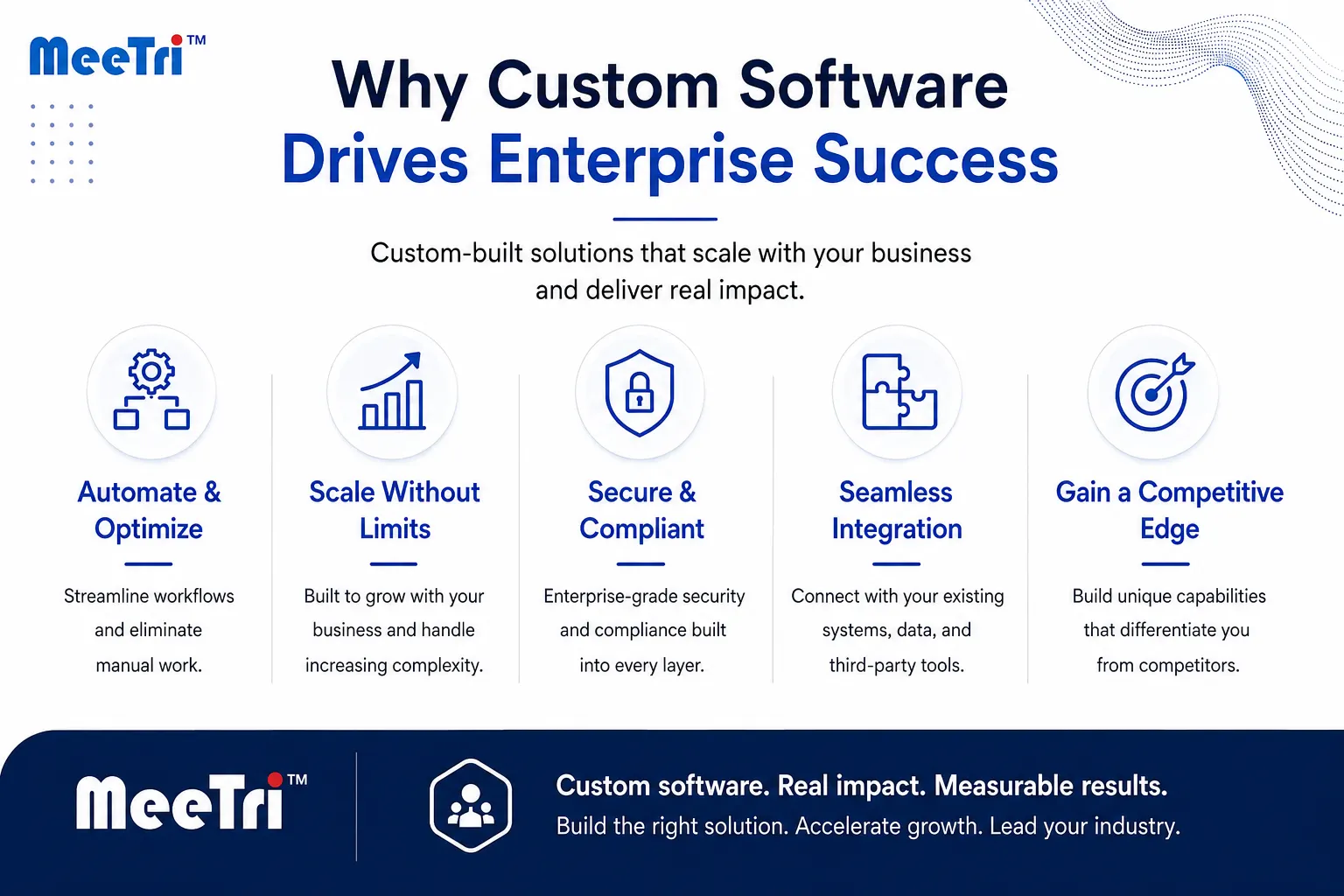
ROI from custom software comes from more than one line item. Some gains show up quickly in licensing and labor savings, while others create long-term operational leverage and strategic flexibility.
Direct financial returns:
- Reduced licensing and subscription costs for tools you're replacing
- Reduced licensing and subscription costs for tools you're replacing
- Faster processing, fewer errors, lower rework costs
Indirect returns:
- Competitive differentiation through unique capabilities
- Faster go-to-market on new product or service lines
- Improved data quality supporting better decisions
- Employee experience improvements reducing attrition and onboarding friction
Long-term value:
- Software you own, not rent. No vendor lock-in, no price increases you can't control.
- A foundation you can extend as your business evolves, rather than migrating to a new platform every three years.
Enterprises that treat custom software as a capital investment, rather than a project cost, tend to get significantly better outcomes. That means building with long-term maintainability in mind from day one and selecting a software development partner who thinks the same way.
For most enterprise builds, ROI becomes clearly positive within 18 to 36 months. For high-volume automation projects, it's often much faster.
Conclusion
Custom software development in 2026 isn't a niche choice for technology companies. It's a mainstream strategic capability for any US enterprise serious about operational efficiency, scalability, and competitive differentiation.
The decision-making process is the same regardless of your sector: understand where off-the-shelf stops serving you, get clarity on scope and budget before you engage a partner, evaluate partners on process quality and honesty rather than just portfolio, and build with security and long-term maintainability as non-negotiables.
If you're in the early stages of evaluating a custom build, a scoping conversation with an experienced team costs nothing and typically clarifies your thinking significantly. Take that conversation before committing to a vendor, a budget, or an architecture.
Frequently Asked Questions
Costs typically range from $75,000 for simpler internal tools to $750,000 or more for complex enterprise platforms with deep integrations. The main drivers are business logic complexity, integrations, compliance requirements, and support scope.
It is the process of building software designed around your specific workflows, data, and goals. Enterprises choose it when packaged tools cannot support their complexity, integrations, or differentiation strategy.
Discovery and planning usually take 4 to 8 weeks. A first production phase often ships in 3 to 6 months. Full enterprise programs commonly run 6 to 18 months depending on scope and complexity.
It aligns directly with your data model and workflows. Automation removes manual processing, integrations reduce data silos, and cloud-based architecture supports increased transaction volume without forcing infrastructure reinvestment too early.
Evaluate sector relevance, architecture capability, process transparency, communication standards, security posture, and post-launch support. A structured discovery session is often one of the best indicators of how the partnership will perform.
Common baseline requirements include encryption at rest and in transit, RBAC, MFA, secure DevOps, automated vulnerability scanning, and penetration testing. Additional requirements vary by sector and may include HIPAA, SOC 2, PCI-DSS, GDPR, or CCPA.
ROI comes from lower licensing spend, automation savings, reduced rework, faster delivery, stronger data quality, and long-term ownership. Many enterprise builds show clearly positive ROI within 18 to 36 months.

Related Articles

Custom Software Development Cost in 2026
Explore the cost drivers, hidden expenses, and planning considerations behind custom software budgets.
How to Choose the Right Software Development Partner in 2026
See how enterprises evaluate process quality, architecture judgment, and delivery transparency before signing a partner.
Offshore Software Development
Understand how enterprises use offshore delivery for cost efficiency, scale, and stronger access to engineering talent.
How to Build Scalable Software Products
Learn how architecture, integrations, and cloud strategy shape long-term scalability for enterprise software.