Get a Free Development Strategy Consultation
Tell us about your project — we'll respond within 24 hours with tailored recommendations.
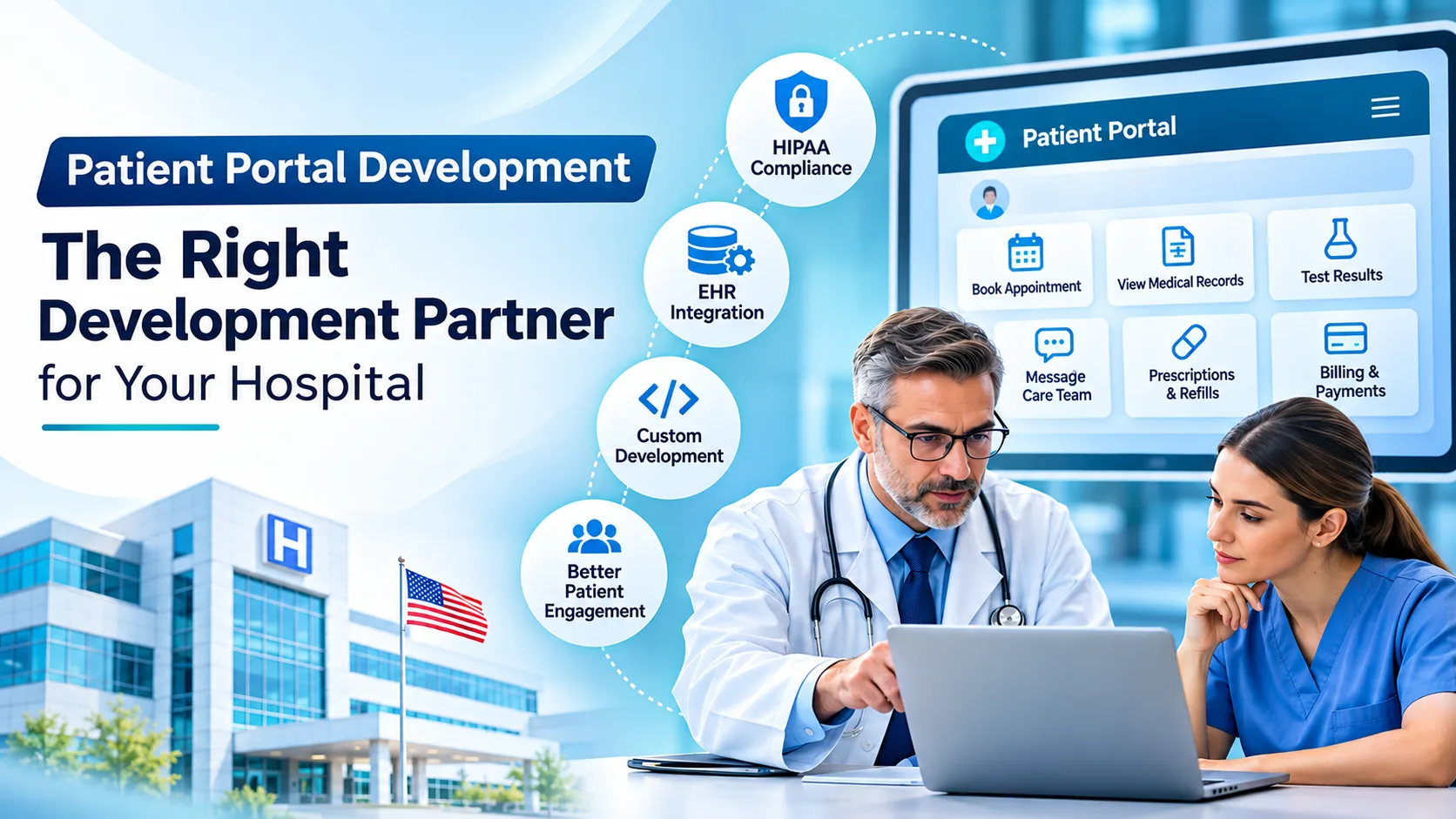
Disconnected healthcare systems, growing administrative workloads and limited patient access to digital services can make hospital operations more complicated than they need to be. For many healthcare organisations, a well-designed patient portal offers a practical way to address these challenges. However, the success of the platform depends heavily on the development partner behind it.
Choosing the right Software Development Company is not simply about finding a team that can build an application. Hospitals need a technology partner that understands clinical workflows, electronic health records, healthcare interoperability, data security and the requirements of patient-facing applications.
A modern patient portal connects patients, healthcare providers and administrative teams through services such as appointment scheduling, secure messaging, medical records access, prescription requests and test results. When these capabilities work together, they can improve access to information and reduce repetitive administrative tasks.
But the wrong development approach can create new problems, including unreliable EHR integrations, security vulnerabilities, poor user adoption and ongoing maintenance difficulties.
So, how do you identify a patient portal development partner that can deliver a secure, scalable and reliable solution? This guide explains the technical capabilities, healthcare expertise, compliance considerations and evaluation criteria hospitals should consider before making that decision.
Quick Answer: How Do You Choose the Right Patient Portal Development Company?
Choose a patient portal development company based on its healthcare software expertise, EHR integration capabilities, HIPAA security practices, technical architecture, user experience, quality assurance and post-launch support.
Before making a decision, confirm that the development team can understand your hospital's workflows, connect existing healthcare systems, protect electronic protected health information and support the platform as requirements change.
The right partner should offer more than application development. It should be capable of delivering a secure, scalable and interoperable healthcare solution aligned with your organisation's operational objectives.
What Should You Look for in a Patient Portal Development Company?
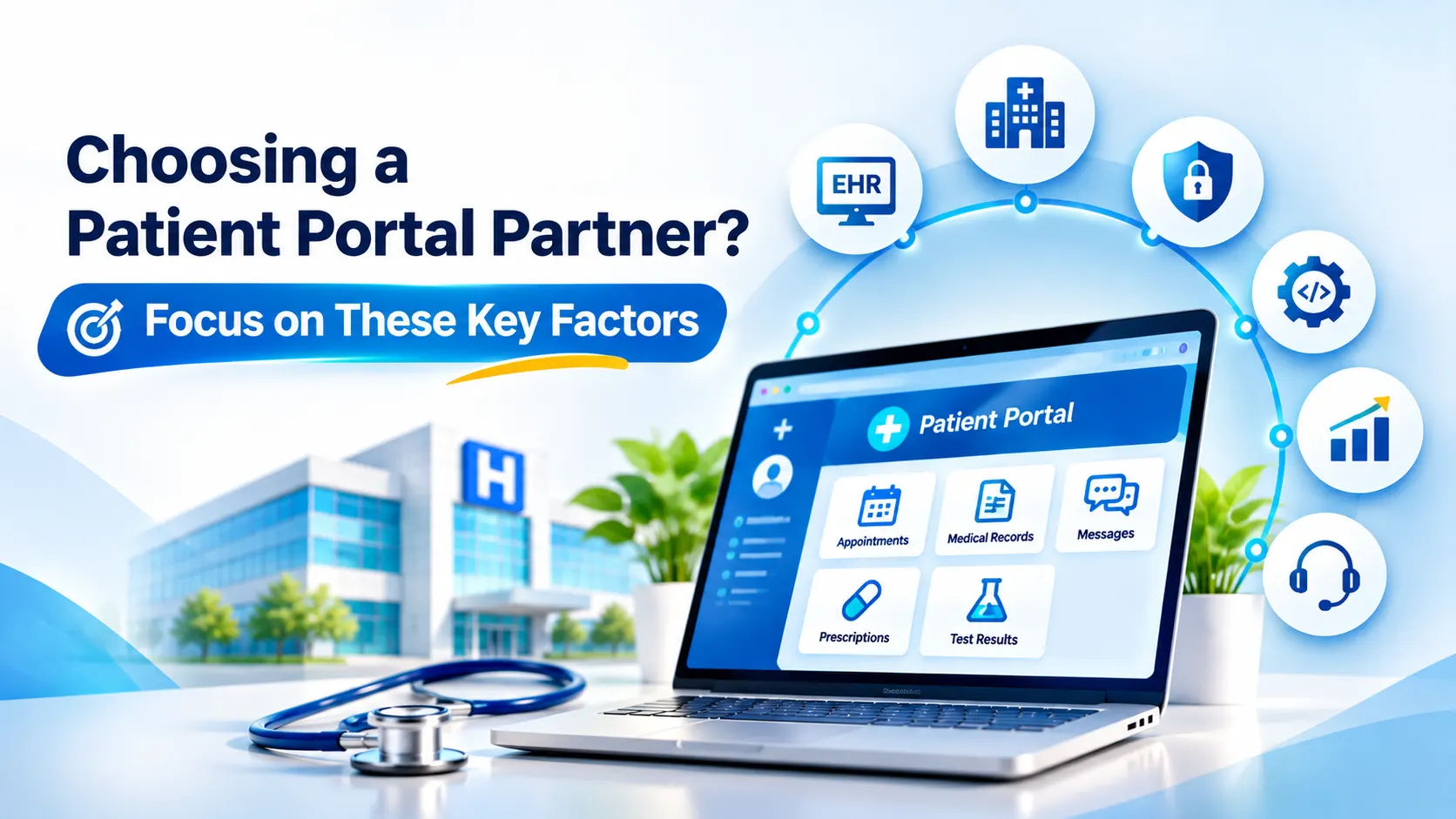
A reliable development partner should demonstrate a combination of healthcare domain knowledge and technical engineering capabilities. A general application development background alone is not enough for a system that handles sensitive patient information.
Evaluate these six areas before selecting a provider:
- Healthcare experience: Understanding of patient workflows, clinical operations and healthcare applications.
- Custom development capabilities: Ability to create features around your organisation's requirements rather than forcing workflows into a standard product.
- EHR integration: Experience connecting patient portals with existing electronic health record systems and healthcare APIs.
- Security and compliance: Knowledge of HIPAA requirements, authentication, encryption and access controls.
- Quality assurance: Structured functional, integration, performance and security testing.
- Ongoing support: Maintenance, monitoring, updates and technical improvements after deployment.
A capable development partner should also explain its development approach, project responsibilities, communication process and quality standards before work begins.
Why Does Healthcare Experience Matter in Patient Portal Software Development?
Healthcare applications have requirements that differ from ordinary business software. They handle sensitive information, support clinical communication and often connect multiple systems used by different departments.
A development partner with relevant healthcare experience can better understand requirements such as:
- Patient registration and identity verification.
- Medical history and clinical document access.
- Appointment scheduling and provider availability.
- Secure communication between patients and care teams.
- Prescription and medication information.
- Integration with billing and laboratory systems.
- Different access permissions for patients, providers and administrators.
This understanding helps prevent a common development problem: building features that work technically but do not fit actual hospital workflows.
When evaluating Patient Portal Software Development, ask potential partners how they gather requirements, validate workflows and handle changes during development. Request examples of relevant healthcare projects where disclosure is permitted, along with details of the team's specific responsibilities.
For hospitals planning broader Digital Transformation in Healthcare, patient portals should connect with existing clinical and administrative systems rather than operate as isolated applications. This requires a development partner that understands healthcare workflows, interoperability and the wider technology environment.
Which Patient Portal Development Services Should Your Hospital Expect?
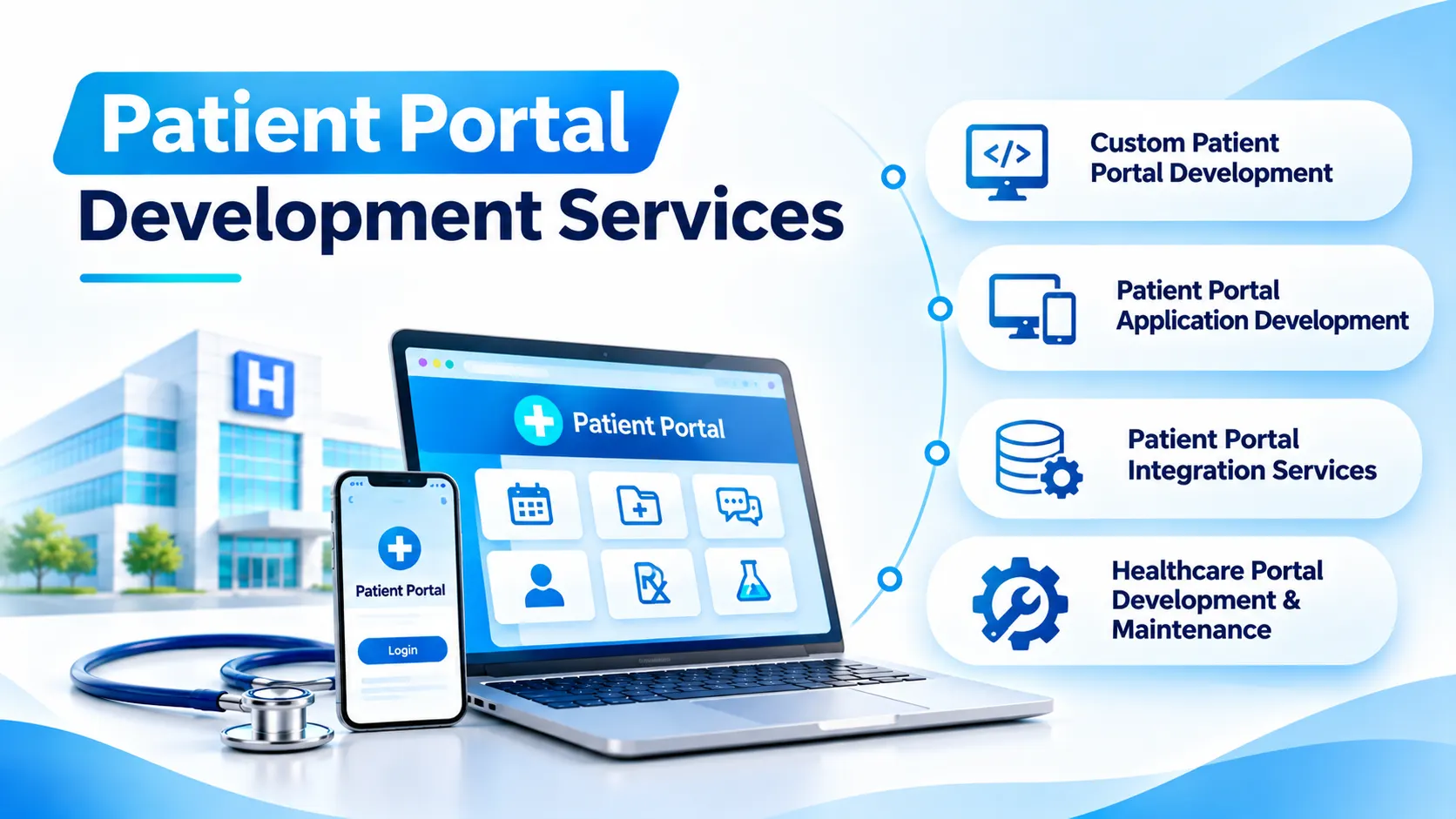
The scope of Patient Portal Development Services should cover the complete application lifecycle, from discovery and design to deployment and ongoing support.
Depending on your organisation's needs, this may include:
Custom Patient Portal Development
Custom development allows hospitals to define portal features, access permissions and workflows around their existing operations. It is particularly useful when standard solutions cannot accommodate specific patient services or integration requirements.
Patient Portal Application Development
A patient portal may need a responsive web application, a mobile application or both. The development team should consider accessibility, device compatibility, navigation and consistent functionality across platforms.
Patient Portal Integration Services
A portal should connect with relevant healthcare systems rather than operate as an isolated application. Integration requirements may include EHR/EMR platforms, appointment scheduling, billing, pharmacy and laboratory systems.
Healthcare Portal Development and Maintenance
The solution should be supported after launch through performance monitoring, security updates, bug fixes, system improvements and technical assistance.
The right Healthcare Software Development Services should support the complete solution lifecycle, including requirement analysis, application architecture, custom development, system integration, quality assurance and ongoing maintenance. This helps hospitals work with a technology partner that understands both software engineering and healthcare-specific requirements.
Discuss Your Patient Portal Project
Talk through your healthcare application requirements with our team.
What Features Should a Modern Patient Portal Include?
The right feature set depends on the hospital's services, patient population and existing infrastructure. However, most healthcare organisations should evaluate the following capabilities.
| Feature | Business and patient value |
|---|---|
| Patient registration | Supports account creation and identity verification |
| Appointment scheduling | Allows patients to request or manage appointments |
| Secure messaging | Supports communication with designated care teams |
| Medical records access | Provides access to available health information |
| Test results | Displays laboratory and diagnostic results |
| Prescription management | Supports medication and refill requests |
| Billing and payments | Provides access to statements and payment workflows |
| Notifications | Communicates appointment and account updates |
Features should be prioritised according to real requirements. For example, a multi-specialty hospital may need more advanced appointment management and department-level access than a small outpatient clinic.
The objective is not to add every available feature. It is to build a portal that patients can use easily and hospital teams can manage reliably.
How Important Are EHR Integration and Healthcare Interoperability?
EHR integration is one of the most important technical considerations when choosing a patient portal development partner. A portal that cannot exchange information reliably with existing systems may create duplicate records, outdated information and additional administrative work.
Healthcare interoperability helps different applications exchange and use information in a consistent way.
A development partner should understand:
- HL7 standards: Used for exchanging healthcare information between systems.
- FHIR: A modern standard for exchanging healthcare data through structured resources and APIs.
- Healthcare APIs: Enable communication between the portal and connected applications.
- Data mapping: Helps ensure information is transferred into the correct fields and formats.
- Integration testing: Identifies missing, duplicated or incorrectly transferred information.
For US healthcare organisations, the Office of the National Coordinator for Health Information Technology provides official resources on interoperability and information blocking requirements.
Integration should be tested across normal operations and failure scenarios. If an external system becomes unavailable, the portal should handle the issue safely, communicate appropriate status information and avoid presenting incomplete data as current.
Plan a Connected Healthcare Application
Discuss your healthcare integration requirements with our team.
How Should a Patient Portal Development Company Handle HIPAA Compliance?
HIPAA compliance should be considered from the beginning of the project, not added as a final development task.
The HIPAA Security Rule establishes requirements for protecting electronic protected health information through administrative, physical and technical safeguards. Hospitals should assess how their development partner supports these requirements throughout the application lifecycle.
Important security capabilities include:
- Role-based access control: Users should access information according to their authorised responsibilities.
- Secure authentication: Account access should include appropriate identity verification and authentication controls.
- Data encryption: Sensitive information should be protected during transmission and storage.
- Audit trails: Relevant system activity should be recorded and available for review.
- Session management: Inactive sessions should be handled securely.
- Security testing: Applications should be assessed for vulnerabilities before and after deployment.
Hospitals should also establish appropriate contractual arrangements with vendors that create, receive, maintain or transmit protected health information on their behalf. Depending on the relationship, a business associate agreement may be required.
Importantly, using a development company that describes its services as HIPAA-compliant does not automatically make the hospital's entire portal compliant. Compliance depends on the organisation's policies, configurations, contracts, people and technology.
Refer to the HHS HIPAA Security Rule for official requirements.
What Development Process Should a Patient Portal Development Partner Follow?
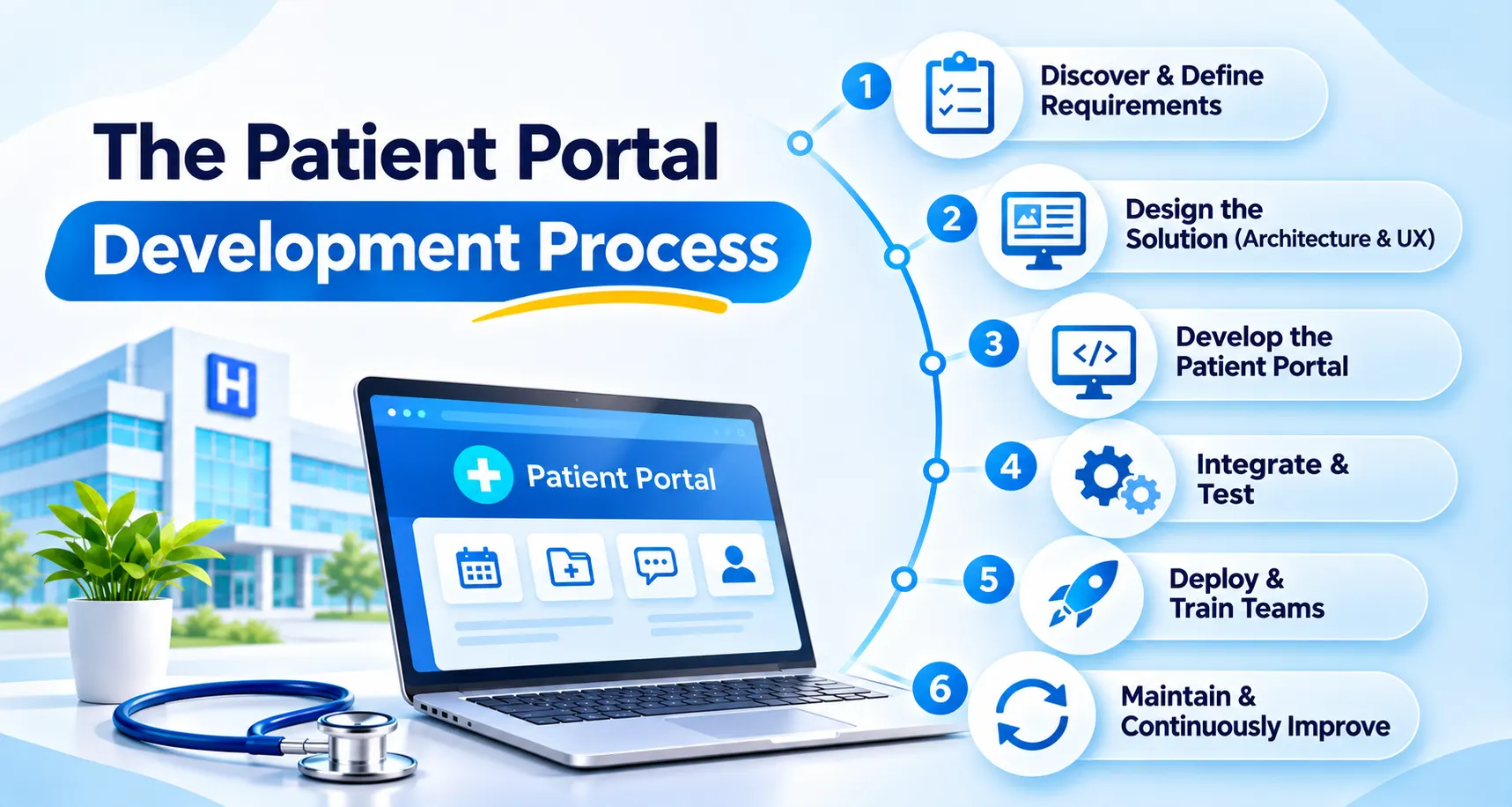
A structured development process helps healthcare organisations control requirements, validate technical decisions and reduce implementation risks.
1. Discovery and Requirement Analysis
The team should understand your hospital's workflows, existing infrastructure, user roles, security needs and business objectives. This stage establishes the scope and priorities.
2. Architecture and UI/UX Design
The development team creates the application architecture, user journeys, wireframes and interface designs. Accessibility and mobile usability should be considered before development begins.
3. Application Development
Frontend and backend components are developed according to the approved requirements. Authentication, data handling, permissions and core portal functionality should be implemented with security in mind.
4. Integration and Testing
The portal is connected with relevant healthcare systems. Functional, integration, performance, usability and security testing should be completed before release.
5. Deployment and Training
The application is configured for production, access permissions are verified and relevant hospital teams receive operational guidance.
6. Maintenance and Continuous Improvement
After launch, the development partner should provide updates, technical monitoring, bug fixes, security improvements and support for changing requirements.
Hospitals requiring Custom Software Development Services should prioritise a structured delivery approach that accounts for existing infrastructure, integration dependencies, security requirements and future enhancements. This is particularly important when multiple healthcare applications need to exchange information reliably.
How Can You Evaluate a Patient Portal Development Company's Technical Capabilities?
Before signing an agreement, ask direct questions about the company's development and delivery capabilities.
| Evaluation area | Questions to ask |
|---|---|
| Healthcare expertise | Has the team delivered healthcare applications with similar workflows? |
| Security | How are authentication, encryption and access permissions implemented? |
| Integration | Can the team work with our existing EHR/EMR and healthcare APIs? |
| Architecture | How will the platform support future growth and additional features? |
| Testing | What functional, security and integration tests are included? |
| Project management | How are milestones, changes and delivery risks managed? |
| Maintenance | What support is available after deployment? |
Also review technical documentation, project responsibilities, communication practices and acceptance criteria. Do not base the decision entirely on a presentation or feature demonstration.
A dependable partner should be transparent about technical limitations, integration dependencies and project risks.
Why Should You Consider Custom Patient Portal Development?
Custom development is worth considering when your hospital has specific workflows, integration requirements or patient services that standard platforms cannot support adequately.
A tailored portal can provide:
- Workflows aligned with your hospital's operations.
- Integration with existing healthcare applications.
- Flexible access permissions and user roles.
- Features designed around specific patient services.
- Greater control over future enhancements.
- Architecture that can evolve with organisational requirements.
However, custom development is not automatically the best option for every organisation. Hospitals should compare existing solutions against their functional requirements, integration limitations, security needs and long-term technology plans.
The right approach is the one that solves the identified operational problems without introducing unnecessary complexity.
Talk with a Healthcare Software Expert
Discuss development options for your healthcare application needs.
How Can You Measure the Success of a Patient Portal?
A successful patient portal should deliver measurable improvements rather than simply generate more user accounts.
Hospitals can track:
- Patient adoption: Percentage of eligible patients who register and actively use the portal.
- Appointment management: Changes in online appointment requests and scheduling activity.
- Administrative workload: Changes in routine calls and manual requests handled by staff.
- Patient communication: Message response and resolution times.
- System reliability: Application availability, error rates and integration performance.
- User experience: Feedback, accessibility issues and task completion rates.
Define baseline measurements before deployment. Review the results after launch to identify which features are delivering value and where improvements are needed.
Hospitals should also evaluate Healthcare Automation ROI by comparing operational performance before and after implementation. Metrics such as reduced manual appointment requests, lower administrative call volumes, faster message handling and improved workflow efficiency can help demonstrate the platform's business value. Results should be measured against an established baseline rather than assumed from portal adoption alone.
Conclusion: Choose a Patient Portal Development Partner That Understands Healthcare
Choosing a patient portal development company requires more than comparing technical features. Hospitals need a partner that understands healthcare workflows, data security, interoperability, accessibility and long-term application support.
The right development approach starts with clear requirements, realistic technical planning and a strong understanding of how patients and healthcare teams will use the platform. Security and integration should be considered throughout the development lifecycle, not treated as final checks.
MeeTri Infotech provides healthcare technology development capabilities covering patient portals, EHR/EMR systems, healthcare applications, API integration, quality assurance and ongoing technical support.
If your organisation is planning a new patient portal, upgrading an existing platform or connecting disconnected healthcare systems, Get in Touch with us to discuss your requirements and explore a suitable development approach with MeeTri's team.
Frequently Asked Questions
A patient portal development company designs, develops, integrates and maintains digital platforms that allow patients to access healthcare information and services. Its work may include appointment scheduling, secure messaging, medical records access, prescription requests and EHR integration.
Evaluate the company's healthcare experience, custom development capabilities, EHR integration expertise, HIPAA security practices, testing process, project management and post-launch support. Ask for relevant project examples and clear technical documentation before making a decision.
Common features include patient registration, appointment scheduling, secure messaging, medical records access, test results, prescription requests, billing information and notifications. The final feature set should reflect the hospital's workflows and patient requirements.
HIPAA requirements apply to covered entities and relevant business associates handling protected health information. Hospitals must ensure that applicable privacy and security requirements are addressed through appropriate safeguards, contracts and operational policies.
EHR integration allows patient portals to exchange relevant information with electronic health record systems. It helps maintain consistent patient information, reduce duplicate data entry and support connected healthcare workflows.
Custom development is useful when hospitals need specific workflows, integrations or functionality that standard products cannot adequately support. Ready-made software may be suitable when existing features meet operational requirements. The decision should follow a structured technical and business assessment.
Hospitals should plan for ongoing maintenance, security updates, performance monitoring, integration support, user feedback and feature improvements. Post-launch ownership is essential for maintaining reliability and adapting to changing healthcare requirements.
