Get a Free Development Strategy Consultation
Tell us about your project — we'll respond within 24 hours with tailored recommendations.
How to Choose a Product Engineering Partner for B2B Enterprises

Your product roadmap is approved. Your budget is allocated. Your leadership team expects faster releases, better product performance, and measurable business growth. Yet, six months into development, delivery is slipping, technical debt is increasing, and your engineering team is spending more time fixing problems than building new capabilities.
The problem may not be your product strategy. It may be the way your product engineering partnership is structured.
For B2B enterprises, choosing a product engineering partner based on hourly rates, developer availability, or an impressive technology stack can be an expensive mistake. A team that can build software is not necessarily a team that can support your product roadmap, manage technical complexity, and deliver sustainable business value.
For VPs of Engineering, CTOs, CIOs, and product leaders, the real question is not simply who can develop the product. It is who can help your business build, scale, maintain, and continuously improve it without creating unnecessary technical or operational risk.
This guide explains how to evaluate a product engineering partner through a business-first lens, including engineering maturity, product strategy, security, scalability, delivery performance, and total cost of ownership.
Get in touch with us
Discuss your product roadmap, engineering needs, and long-term goals with our team.
What Is a Product Engineering Partner?
A product engineering partner works with a business to plan, design, develop, test, deploy, and improve a digital product throughout its lifecycle.
Unlike an engagement focused exclusively on completing a predefined development project, a product engineering partnership can involve ongoing collaboration on product strategy, architecture, technical decisions, and continuous improvement.
Depending on the business requirements, the partnership may include:
- Product discovery and requirements validation
- Product roadmap planning and prioritization
- Software architecture and engineering
- User experience and interface design
- API development and enterprise integration
- Quality assurance and security testing
- Cloud infrastructure and deployment
- Product monitoring and performance optimization
- Maintenance, modernization, and continuous improvement
For enterprise leaders, the objective is to establish an engineering capability that supports business priorities, not simply add more developers to an existing team.
When evaluating a Software Development Company, look beyond its technical capabilities. Assess whether it can understand your business objectives, identify engineering risks, communicate trade-offs, and support product decisions over time.
Why the Wrong Product Engineering Partner Can Become an Enterprise Risk
Selecting a product engineering partner is a business decision with technical, financial, and operational consequences. The impact of a poor choice may not become obvious until the product grows, requirements change, or the business needs to deliver new capabilities quickly.
Your Product Roadmap Can Become Increasingly Difficult to Deliver
A partner that focuses only on completing individual tasks may overlook the dependencies between features, architecture, and long-term product goals.
As a result, every new requirement can become a separate development challenge. Releases take longer, priorities compete for engineering capacity, and leadership loses confidence in delivery forecasts.
A capable partner should connect engineering work to the product roadmap and help stakeholders understand what can be delivered, when, and with which trade-offs.
Technical Debt Can Increase Your Long-Term Costs
Shortcuts that accelerate an initial release can make future development more expensive.
Poor documentation, tightly coupled systems, duplicated code, and insufficient testing can slow down even relatively small product changes. Engineering teams may then spend an increasing proportion of their time maintaining existing functionality instead of delivering new value.
The right partner should explain how it manages technical debt, maintains code quality, and balances immediate delivery requirements with long-term maintainability.
Scaling the Product Can Expose Architectural Weaknesses
An application that performs well during early testing may struggle when user numbers, transaction volumes, integrations, or data requirements increase.
If scalability was not considered during architecture planning, the business may face performance problems, infrastructure cost increases, or expensive redesign work.
A product engineering partner should assess realistic workloads and business growth expectations before recommending an architecture.
Security Gaps Can Create Compliance and Operational Problems
Enterprise products often handle sensitive business information and connect with multiple internal and external systems.
Weak access controls, outdated dependencies, inadequate monitoring, or inconsistent security testing can expose the organisation to unnecessary risk.
Security requirements should therefore influence architecture, development, testing, deployment, and ongoing maintenance.
Your Business Can Become Too Dependent on One Provider
If source code, technical documentation, infrastructure access, or architecture knowledge is controlled by the provider, transitioning to another team can become difficult.
Enterprise leaders should establish ownership and knowledge-transfer expectations before development begins.
A sustainable partnership should strengthen the organisation's engineering capabilities rather than create avoidable vendor dependency.
Seven Criteria for Choosing a Product Engineering Partner
Once you understand the risks, the next step is to assess potential partners against a consistent set of criteria.
Product Strategy and Business Alignment
A product engineering partner should understand why the product exists, who uses it, and what the business expects it to achieve.
Before recommending a solution, the team should ask about your target customers, commercial objectives, existing product challenges, competitive environment, and success metrics.
Evaluate whether the partner can:
- Translate business objectives into technical requirements.
- Identify dependencies and delivery risks.
- Prioritize features according to business value.
- Challenge requirements that add complexity without sufficient benefit.
- Recommend a realistic product roadmap.
- Adapt priorities when customer needs or market conditions change.
Questions to ask:
- How do you validate requirements before development begins?
- How do you prioritize features when budget or engineering capacity is limited?
- How do you connect product milestones with business outcomes?
- How do you respond when requirements change during development?
A strong partner should be able to explain the reasoning behind its recommendations, not simply agree to every request.
Engineering Maturity and Architecture Expertise
A list of programming languages and frameworks does not demonstrate engineering maturity.
You need to understand how the team designs systems, reviews code, tests changes, manages technical debt, and makes architectural decisions.
Assess its approach to:
- Software architecture and design patterns
- Code reviews and coding standards
- Automated testing and continuous integration
- Documentation and knowledge transfer
- Performance monitoring and debugging
- Technical debt assessment
- Release management and rollback procedures
Ask the partner to explain a technically challenging project it has delivered. Focus on the problems encountered, the decisions made, and the outcomes achieved.
You should also establish who is accountable for architecture decisions and how those decisions are documented. This is particularly important when your internal team and external engineers share responsibility for the product.
Enterprise Integration and Modernization Capabilities
Enterprise products rarely operate in isolation. They may need to connect with ERP platforms, CRM systems, payment services, analytics platforms, identity providers, and legacy applications.
A partner without sufficient integration experience can introduce data inconsistencies, security weaknesses, and operational disruption.
Evaluate its experience with:
REST APIs and event-driven architectures
ERP and CRM integrations
Legacy system modernization
Data migration and synchronization
Authentication and identity management
Third-party services and external dependencies
Integration testing and failure recovery
Ask how the team would assess your current technology environment before proposing a solution.
For enterprises that need sustained engineering capacity, a Global Capability Center model may also be worth considering when long-term collaboration and closer integration with internal teams are priorities.
Security, Data Protection, and Compliance
Security should be built into the engineering process rather than treated as a final approval step before launch.
Ask how the partner manages access controls, protects sensitive information, reviews third-party dependencies, identifies vulnerabilities, and responds to incidents.
Important areas to evaluate include:
- Secure coding practices
- Authentication and authorization
- Encryption in transit and at rest
- Dependency and vulnerability scanning
- Security testing and remediation
- Audit logging and access reviews
- Backup and recovery procedures
- Industry-specific compliance requirements
The NIST Secure Software Development Framework provides guidance on integrating security practices into the software development lifecycle.
For products handling protected health information, review the relevant HIPAA Security Rule guidance. Businesses handling consumer information can also consult the US Federal Trade Commission's data security guidance for businesses.
The specific controls required will depend on your product, the data it processes, and the regulations applicable to your organisation.
Delivery Predictability and Communication
A team can have strong technical skills and still underperform if delivery expectations, responsibilities, and communication are unclear.
For a VP of Engineering or CTO, delivery predictability matters because engineering commitments affect product launches, customer expectations, budgets, and other business functions.
Before signing an agreement, establish:
How requirements are documented and approved
How milestones and dependencies are tracked
How frequently working software is demonstrated
How risks and blockers are escalated
How changes to scope are assessed
How quality assurance and release approvals work
Who is accountable for delivery decisions
Ask for a sample project plan or status report. It should clearly show progress, upcoming work, unresolved risks, and decisions required from your organisation.
Avoid evaluating delivery capability solely through promised timelines. Examine how the partner plans to achieve those timelines and what happens when assumptions change.
Scalability and Team Flexibility
Your engineering requirements today may not reflect what your business needs in twelve months.
You may need to support more users, introduce new integrations, modernize infrastructure, or accelerate development of additional product capabilities.
Evaluate whether the partner can support:
- Increasing user numbers and transaction volumes
- Additional product functionality
- Cloud infrastructure optimization
- Performance testing and monitoring
- New engineering specializations
- Changes in team size and delivery capacity
Ask how the partner determines when an architecture needs to change. A credible answer should consider workload, performance data, operational complexity, and cost rather than relying on vague promises of unlimited scalability.
The objective is to build for realistic growth without paying for unnecessary complexity too early.
Post-Launch Support and Product Ownership
The first production release is not the end of the engineering lifecycle.
Software requires maintenance, security updates, defect resolution, performance monitoring, and improvements based on customer feedback and usage data.
Clarify whether the engagement includes:
- Ongoing maintenance and support
- Incident management and response targets
- Security patching and dependency updates
- Application performance monitoring
- Bug fixing and regression testing
- Technical documentation
- Source code and intellectual property ownership
- Knowledge transfer and transition support
Make these responsibilities explicit in the contract.
Your organisation should retain the access, documentation, and ownership rights needed to maintain control of the product, even if the engineering relationship changes in the future.
How to Evaluate a Partner's Product Strategy and Engineering Maturity
A partner may perform well against a general checklist but still lack the ability to support a complex enterprise product. A deeper evaluation helps reveal whether the team can contribute to long-term product performance.
Assess Its Product Discovery Process
Ask how the team would investigate your product requirements before development begins.
A structured discovery process should identify:
- Business objectives and customer needs
- Existing system constraints
- Technical and integration dependencies
- Product risks and assumptions
- Initial priorities and delivery milestones
- Measures of success
If a provider recommends a detailed solution before understanding your business problem, ask what evidence supports that recommendation.
Understand How It Manages Technical Debt
Technical debt is not always avoidable. The important question is whether the team can identify and manage it effectively.
Ask how it distinguishes urgent architectural risks from improvements that can be scheduled later.
A mature partner should explain how technical debt affects release speed, reliability, security, maintenance costs, and the team's ability to introduce new features.
Look for Evidence of Continuous Improvement
A long-term product engineering partner should use real evidence to guide decisions.
Depending on the product, useful indicators may include:
Feature adoption and product usage
Customer feedback and support requests
Application performance and error rates
Release frequency and deployment failures
Defect trends and resolution times
Infrastructure costs and resource utilization
The partner should explain how these signals influence its recommendations and priorities.
This approach helps ensure that engineering effort is directed towards meaningful product improvements rather than simply increasing the number of features released.
Product Engineering Partner Evaluation Scorecard
Use a weighted scorecard to compare shortlisted providers consistently.
Rate each criterion from 1 to 5, where 1 represents weak evidence and 5 represents strong, verifiable capability.
| Evaluation Criterion | Suggested Weight | What to Assess |
|---|---|---|
| Product strategy and roadmap alignment | 15% | Discovery, prioritization, business objectives, and roadmap planning |
| Architecture and engineering maturity | 20% | Technical design, code quality, testing, documentation, and technical debt |
| Integration and modernization | 15% | APIs, legacy systems, data migration, and interoperability |
| Security and compliance | 15% | Secure development, access controls, vulnerability management, and relevant compliance |
| Delivery and communication | 15% | Planning, progress reporting, risk management, and change control |
| Scalability and team flexibility | 10% | Performance planning, infrastructure, and team capacity |
| Post-launch support and ownership | 10% | Maintenance, incident response, documentation, source code, and intellectual property |
| Total | 100% |
Calculate each criterion's weighted contribution based on its rating and assigned weight.
Use the score as a decision aid rather than an automatic selection rule. A provider with a high overall score may still be unsuitable if it cannot meet a critical security requirement, lacks essential integration experience, or offers unacceptable ownership terms.
For enterprise decision-makers, these non-negotiable requirements should be evaluated separately from the overall score.
Need help comparing engineering partners?
Talk through your evaluation criteria, technical risks, and product roadmap priorities with our team.
Common Mistakes to Avoid When Selecting a Product Engineering Partner
Even a structured selection process can fail if the evaluation focuses on the wrong priorities.
Choosing the Lowest-Cost Provider
A low initial quote may exclude testing, documentation, security work, or post-launch support.
Compare the full scope, delivery assumptions, ongoing commitments, and expected maintenance costs before making a decision.
Prioritizing Developer Availability Over Engineering Capability
Adding more developers does not automatically solve delivery problems. If architecture, requirements, or communication are weak, a larger team may introduce additional coordination overhead.
Assess how the partner will improve the engineering process, not just how quickly it can assign people.
Ignoring Product Ownership and Knowledge Transfer
Unclear source code ownership, incomplete documentation, and limited access to infrastructure can create significant switching costs.
Establish ownership, access, documentation, and transition requirements before the engagement begins.
Accepting Unrealistic Delivery Promises
A credible partner should explain the assumptions, dependencies, and risks behind its proposed timeline.
Be cautious of commitments made before the team understands the requirements and technical environment.
Failing to Define Business Outcomes
Completing a list of features does not necessarily mean the product is successful.
Agree on measurable outcomes such as reliability, adoption, performance, release predictability, or operational efficiency. The right metrics will depend on the product's purpose.
Product Engineering Partner vs. Traditional Software Development Vendor
Both engagement models can be useful, but they generally serve different needs.
| Factor | Product Engineering Partner | Traditional Development Vendor |
|---|---|---|
| Primary focus | Product outcomes and continuous improvement | Delivery of an agreed scope |
| Planning | Product roadmap and ongoing prioritization | Requirements and project milestones |
| Engagement | Often long-term and collaborative | Often project-based |
| Technical decisions | May contribute to product strategy and architecture | Usually follows defined specifications |
| Post-launch involvement | May include ongoing product evolution | Depends on the agreed scope |
| Best suited for | Products requiring continuous development and adaptation | Projects with clearly defined deliverables |
When Should You Work With an External Product Engineering Partner?
An external partner may be appropriate when your internal team lacks a specific capability, needs additional delivery capacity, or requires support to modernize an existing product.
It can also help when your business needs to validate a new product idea before committing to permanent hiring.
Consider external engineering support when:
Your product roadmap is expanding faster than your team can deliver.
You need expertise in a specific technology or integration.
Existing architecture is slowing product improvements.
You need stronger testing, deployment, or security practices.
Your organisation requires ongoing engineering capacity without hiring every role internally.
Your product requires continuous development after launch.
Before proceeding, define how the external team will work with internal stakeholders, share knowledge, report progress, and transfer ownership when needed.
For longer-term requirements, Software Product Engineering Services may be relevant when you need ongoing development, dedicated engineering capacity, and lifecycle support rather than a one-time build.
How to Get Started With the Right Product Engineering Partner
Start by documenting your product objectives, existing technical environment, business constraints, and expected outcomes.
Use this information to create a consistent brief for potential partners. It will make proposals easier to compare and help expose differences in assumptions, scope, and delivery approach.
Next, shortlist providers with relevant experience. Assess their capabilities against the same criteria, request evidence of comparable work, and discuss risks openly.
Before signing an agreement, clarify:
- Scope and deliverables
- Delivery milestones and reporting
- Security responsibilities
- Change management
- Pricing and ongoing costs
- Source code and intellectual property ownership
- Documentation and knowledge transfer
- Post-launch support
A clearly defined discovery phase or initial milestone can also help both parties validate the working relationship before committing to a larger engagement.
If you are ready to discuss your requirements, Get in Touch with us to explore an engineering approach aligned with your product goals and business needs.
Final Thoughts
Choosing a product engineering partner is not simply a procurement decision. It is a decision that can influence product quality, delivery predictability, engineering costs, and your organisation's ability to respond to changing market demands.
For CTOs, CIOs, VPs of Engineering, and product leaders, the priority should be finding a team that understands the business problem, makes sound technical decisions, communicates risks clearly, and supports the product beyond its initial release.
Evaluate potential partners against consistent criteria, verify their capabilities with evidence, and establish clear expectations around delivery, security, cost, ownership, and ongoing support.
The right partnership should do more than deliver software. It should help your business build a product that remains secure, maintainable, scalable, and valuable as your organisation grows.
Frequently Asked Questions
Look for relevant technical expertise, strong architecture and testing practices, product strategy capabilities, integration experience, security awareness, transparent communication, and a clear approach to post-launch support.
A product engineering partner typically contributes to product strategy, architecture, delivery, and continuous improvement. A traditional vendor may focus primarily on delivering a defined scope. The actual responsibilities depend on the engagement agreement.
Review comparable projects, architecture decisions, testing practices, code review processes, documentation, and relevant integration experience. Ask the team to explain how it handled real technical challenges instead of relying solely on general claims.
Ask how the team approaches discovery, prioritizes features, manages technical debt, handles security, reports progress, manages scope changes, and supports the product after launch. Clarify source code ownership, intellectual property, documentation, and transition arrangements.
Compare proposals against the same requirements, deliverables, assumptions, milestones, team composition, security obligations, and support terms. Consider the total cost of delivery and maintenance rather than only the initial estimate.
Measure outcomes relevant to the product and business, such as release predictability, defect rates, application performance, user adoption, customer satisfaction, operational efficiency, and maintenance costs. Agree on baseline metrics and review progress regularly.
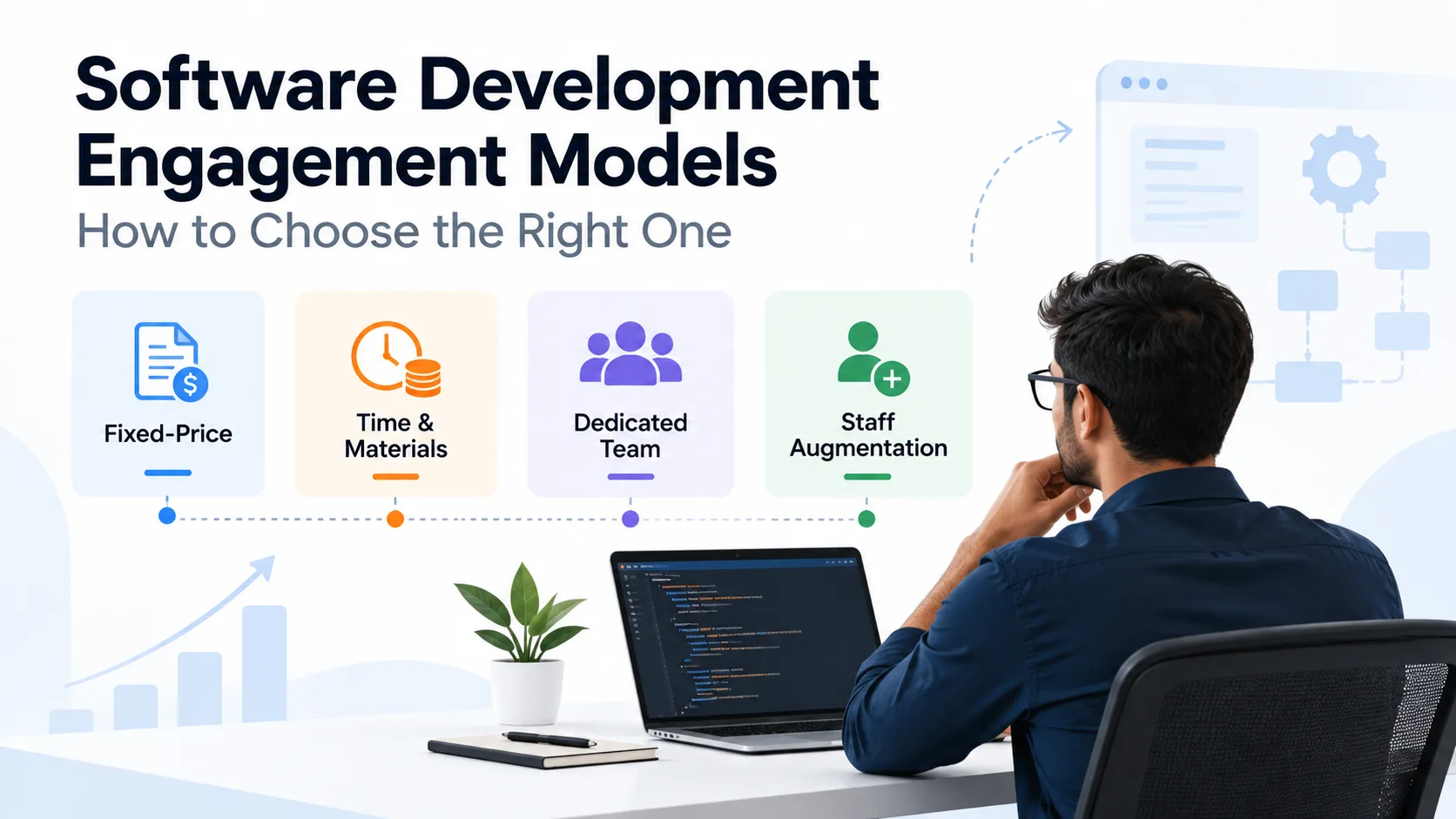
A fixed-price engagement may work when requirements and deliverables are clearly defined. A dedicated team may be more suitable when priorities evolve, continuous product development is expected, or close collaboration with internal teams is required.
Post-launch support helps maintain reliability, address vulnerabilities, resolve defects, monitor performance, and respond to changing business needs. It also ensures that product improvements continue after the initial release.