Get a Free Development Strategy Consultation
Tell us about your project — we'll respond within 24 hours with tailored recommendations.
How to Evaluate a Custom Software Development Proposal: 10 Factors Beyond Price
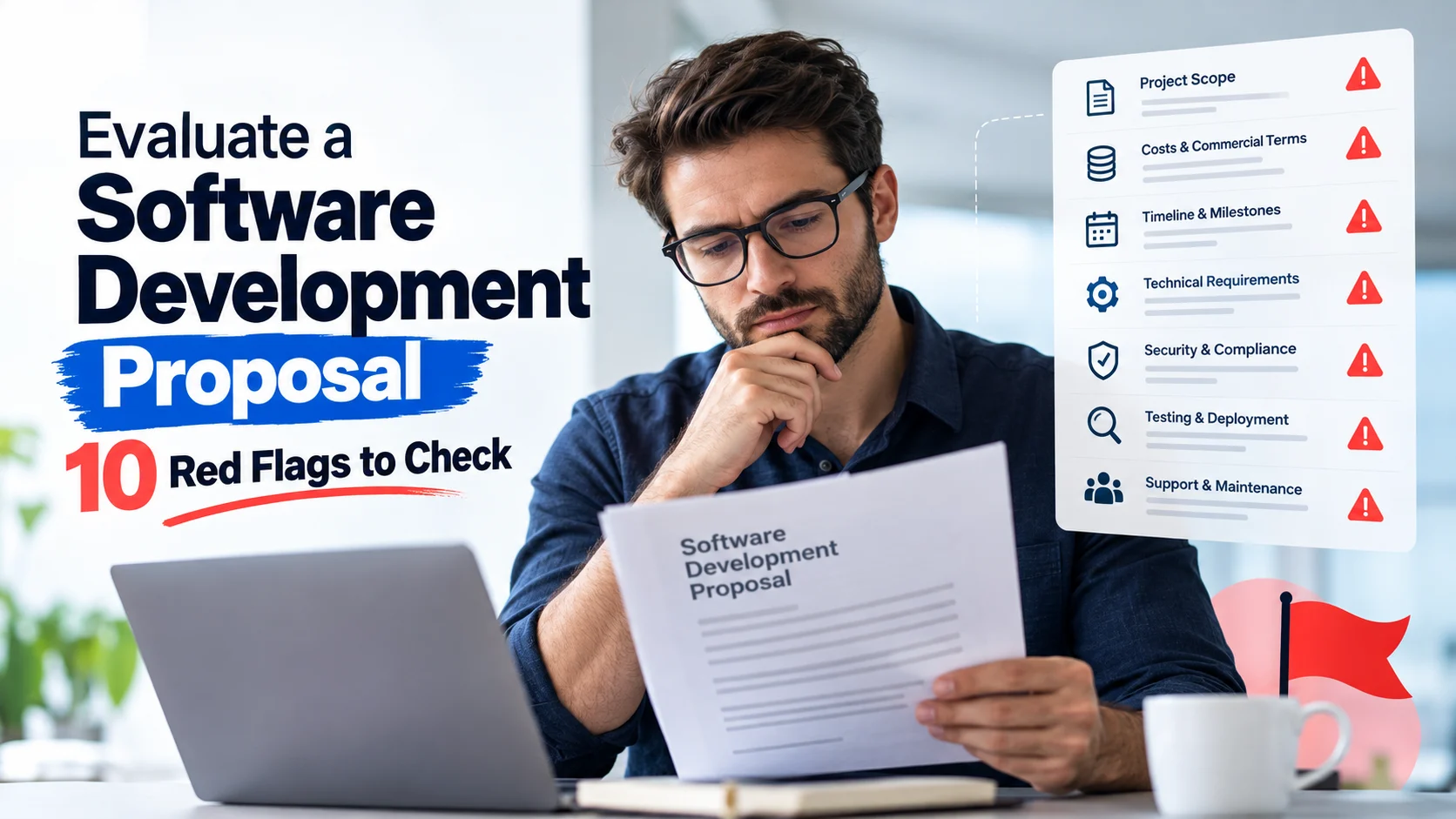
Two companies receive proposals for the same software project. One receives a quote of £40,000, while the other receives a quote of £65,000. Both promise to deliver the application within a similar timeframe. At first glance, choosing the cheaper option seems obvious. However, one proposal includes integration testing, deployment, technical documentation and post-launch support, while the other covers development alone.
This is where a seemingly straightforward purchasing decision can become expensive.
For B2B organisations investing in custom software, the real challenge is understanding what each proposal delivers, which risks remain unresolved, and how the investment will support business objectives over time.
Before approving a custom software development proposal, evaluate its scope, delivery assumptions, technical requirements, commercial terms, risk allocation and long-term operating costs. This approach helps decision-makers compare proposals on business value rather than headline price.
Planning a custom software project? Explore custom software development services to understand how a tailored application can support your operational requirements and product goals.
Why Comparing Software Development Proposals Requires More Than a Price Comparison
A software development proposal is a commercial and technical commitment. It establishes what will be delivered, how the work will be organised, what the client must provide, and which circumstances could change the cost or delivery schedule.
Comparing proposals without examining these details can lead to poor investment decisions.
For example, two vendors might quote different prices because they have made different assumptions about user volumes, third-party integrations, data migration, testing requirements or the number of features included in the first release.
The lower estimate may be reasonable for a limited initial release, while the higher estimate may cover a broader implementation. Neither can be judged fairly without understanding the difference.
A structured evaluation helps businesses:
- Identify missing requirements before signing an agreement.
- Understand the difference between included services and additional costs.
- Assess whether delivery commitments are realistic.
- Identify technical dependencies that could delay implementation.
- Establish accountability for testing, deployment and ongoing maintenance.
- Compare the expected business value of different proposed solutions.
Start With the Business Outcome, Not the Feature List
Before reviewing individual proposals, define what the project must achieve.
A retailer might want to reduce manual order processing. A healthcare organisation might need to improve information exchange between existing systems. A B2B platform might require automated account-specific pricing and order management.
These objectives should influence how proposals are evaluated.
For example, if the main objective is to reduce manual processing, a proposal that automates the entire workflow may deliver greater value than one that simply digitises the existing process.
The evaluation should therefore begin with three questions:
- What business problem are we trying to solve?
- How will we measure whether the solution succeeds?
- Which technical and operational requirements are essential to achieving that outcome?
Need to translate your business requirements into a practical project scope?
Discuss your objectives with a team specialising in custom software development before committing to a delivery approach.
10 Factors to Evaluate Before Approving a Custom Software Development Proposal
1. Scope Completeness and Deliverable Definitions
The first task is to establish whether the proposal covers the complete scope of work required to achieve the intended outcome.
A proposal may describe the main application features without accounting for the supporting work needed to make them operational.
Consider a B2B ordering platform that requires customer-specific pricing, inventory synchronisation, order processing and ERP integration. If the proposal includes the ordering interface but excludes inventory synchronisation, the delivered application may not solve the original business problem.
Review the proposal against a documented requirements list.
Check whether it specifies:
- Functional requirements and business rules.
- User roles and access permissions.
- Integrations with existing systems.
- Data migration and validation requirements.
- Reporting and administrative functionality.
- Testing, deployment and handover deliverables.
- Explicit exclusions and client dependencies.
Ask the provider to identify any requirements that have not been estimated or validated.
It is also important to distinguish between features promised for the initial release and functionality that may be considered later.
Decision rule: Do not approve a proposal while material requirements remain ambiguous or are described only as future possibilities.
2. Technical Assumptions and Architectural Trade-Offs
A proposal should explain how the recommended technical approach supports the business requirements.
Simply listing programming languages, frameworks, databases or cloud platforms is not enough. Decision-makers need to understand why those technologies have been selected and what implications they have for cost, performance, maintenance and future development.
For example, a business application that serves a few internal users may not require the same infrastructure complexity as a customer-facing platform operating across several markets.
An unnecessarily complex architecture can increase development costs and operational overhead. An architecture that is too limited can create expensive constraints as the application grows.
Evaluate the following:
- Why the proposed architecture fits the requirements.
- How application components will communicate.
- How existing systems will exchange information.
- Which third-party services or licences are required.
- How performance and availability requirements will be addressed.
- What documentation will be available to future engineering teams.
- Which technical decisions may need to change as usage increases.
Ask for clarification when the proposal recommends a technology without explaining its practical advantages or limitations.
The objective is not to choose the most advanced technology. It is to select an approach that satisfies current requirements without creating unnecessary future costs.
3. Delivery Timeline and Estimation Assumptions
A proposed completion date is meaningful only when the assumptions behind it are understood.
The timeline may depend on access to existing systems, timely client approvals, the availability of business stakeholders, third-party integrations and the stability of the requirements.
If these dependencies are not documented, even a technically capable delivery team may struggle to meet the agreed deadline.
Review the proposed timeline phase by phase.
| Project phase | What to verify |
|---|---|
| Discovery and planning | Requirements, dependencies and technical uncertainties have been identified. |
| Solution design | Architecture, user journeys and integration requirements are documented. |
| Development | Deliverables and release milestones are defined. |
| Testing | Quality assurance and user acceptance activities are included. |
| Deployment | Migration, configuration, training and release responsibilities are clear. |
| Post-launch | Support arrangements and defect-resolution responsibilities are agreed. |
Ask which milestones depend on your internal team and which depend on external services.
You should also establish how the project will be handled if a requirement changes, an integration proves more complex than expected, or a critical dependency becomes unavailable.
A credible estimate should make uncertainty visible rather than presenting every deadline as guaranteed.
4. Total Cost of Ownership and Commercial Exclusions
The initial development fee is only one component of the investment.
Businesses must also consider the cost of implementation, third-party services, infrastructure, support, maintenance and future enhancements.
A proposal that excludes these expenses may appear cheaper without offering better overall value.
Review these cost categories:
- Discovery, planning and solution design.
- Development and quality assurance.
- Third-party licences and API usage.
- Data migration and system integration.
- Cloud infrastructure and monitoring.
- Deployment, training and documentation.
- Security reviews and remediation.
- Ongoing maintenance and future enhancements.
Request a clear breakdown of one-time and recurring costs.
Where possible, compare the expected expenditure over a consistent period, such as the first three years of operation. Make the assumptions explicit because infrastructure usage, support requirements and future changes can vary considerably.
For additional budgeting guidance, read the custom software development cost guide for 2026.
The key question is not simply how much the application costs to build. It is how much the organisation will need to invest to operate, maintain and evolve it.
5. Pricing Structure and Change-Control Mechanisms
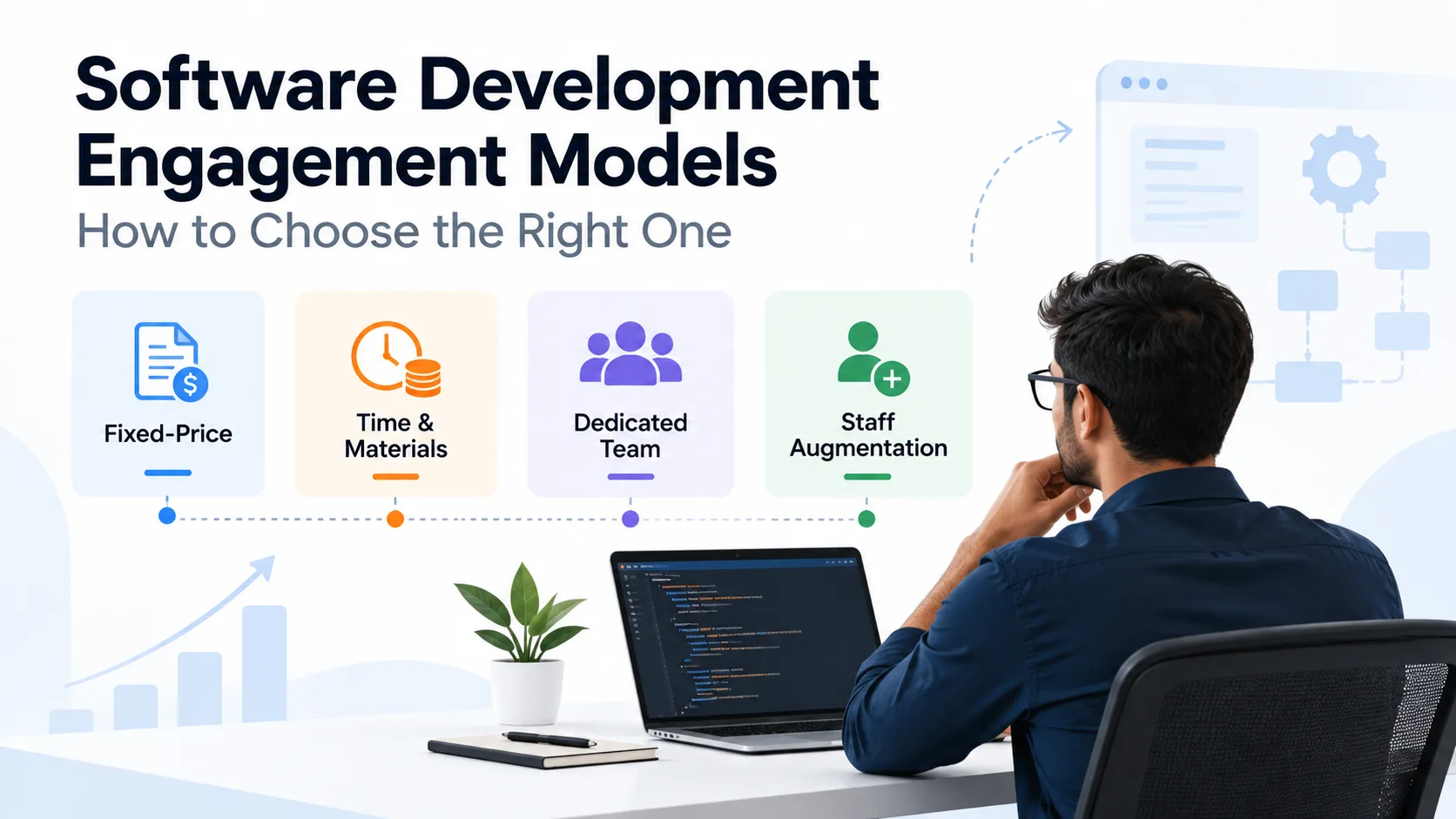
Different pricing models distribute cost uncertainty and responsibility differently.
A fixed-price agreement can provide greater budget predictability when requirements are stable and deliverables are clearly defined. A time-and-materials arrangement can offer greater flexibility when the scope is expected to evolve.
Neither model eliminates risk. The important question is whether the commercial arrangement matches the project's level of uncertainty.
| Consideration | Fixed-price arrangement | Time-and-materials arrangement |
|---|---|---|
| Scope stability | Best suited to clearly defined requirements | Can accommodate evolving requirements |
| Budget management | Total price is agreed for the defined scope | Expenditure depends on rates, effort and work completed |
| Requirement changes | May require formal change requests | Can be incorporated through ongoing prioritisation |
| Cost visibility | Depends on clear deliverables and exclusions | Depends on timesheets, reporting and budget reviews |
| Client involvement | Requires timely approvals and scope control | Usually requires more continuous prioritisation |
Regardless of the pricing model, the proposal should specify how additional work is estimated, approved and documented.
It should also clarify whether changes affect the delivery date, the budget or both.
Read the guide to software development engagement models for additional context on different commercial and delivery arrangements.
6. Security, Privacy and Compliance Responsibilities
Security requirements can significantly affect the architecture, development effort, testing process and ongoing operating costs of an application.
A proposal should explain which security activities are included and which responsibilities remain with the client.
For example, a platform processing sensitive customer information may require stronger access controls, audit logging, encryption, vulnerability testing and documented incident-response procedures.
The precise requirements depend on the information processed, the operating environment and the applicable legal and contractual obligations.
Check whether the proposal addresses:
- Authentication and authorisation.
- Data encryption and secure communications.
- API security and third-party access.
- Logging, monitoring and audit trails.
- Vulnerability assessment and remediation.
- Backup, recovery and incident handling.
- Data retention and deletion.
- Relevant compliance requirements.
Ask who is responsible for implementing, testing and maintaining each control.
Do not assume that security is included merely because the proposal describes the application as secure. The required activities and acceptance criteria should be documented.
7. Integration Complexity and Data Migration
Integrations are a common source of project uncertainty because the complexity often depends on systems outside the immediate development scope.
An application may need to exchange data with an ERP platform, CRM, payment provider, inventory system or internal database. Each connection introduces questions about authentication, data formats, permissions, reliability and error handling.
Data migration presents additional challenges. Existing records may be incomplete, duplicated, inconsistently formatted or structured differently from the new application.
A proposal should explain how these issues will be assessed and managed.
Evaluate:
- The systems that must be integrated.
- Availability and limitations of their APIs.
- Data mapping and transformation requirements.
- Authentication and access permissions.
- Handling of failed or incomplete transactions.
- Data validation and reconciliation.
- Migration testing and rollback procedures.
- Dependencies on third-party providers.
For example, a retailer connecting an ordering platform to an inventory system must ensure that stock updates and order changes are handled consistently. A successful interface alone does not guarantee accurate business data.
Request a separate estimate for integrations whose complexity has not yet been validated.
This makes it easier to distinguish confirmed project costs from assumptions that may need to be revised.
8. Quality Assurance and Acceptance Criteria
A proposal should explain how the business will determine whether the completed application meets its requirements.
Without agreed acceptance criteria, disputes can arise over whether a feature is complete, whether a defect is acceptable, or whether the application is ready for release.
Testing requirements should reflect the application's purpose and risk profile.
Review the proposed approach to:
- Functional and integration testing.
- Performance testing where required.
- Security testing.
- Accessibility and usability checks.
- Regression testing.
- User acceptance testing.
- Defect classification and resolution.
- Release approval and deployment readiness.
For each major deliverable, establish what must be demonstrated before it is accepted.
For example, a financial workflow may require evidence that transaction records reconcile correctly, while a customer portal may need to demonstrate that users can complete key tasks without errors.
Acceptance criteria should be measurable wherever possible.
Also confirm who performs the testing, who approves the results, and how defects discovered before or after release will be handled.
9. Intellectual Property, Documentation and Exit Provisions
The proposal and associated contract should establish what the business will receive when the project is completed and what happens if the engagement ends earlier than expected.
This is particularly important when the application contains proprietary business logic, specialised workflows or intellectual property central to the organisation's products.
Review the provisions relating to:
- Ownership of newly developed code.
- Third-party software licences.
- Source code repository access.
- Technical and operational documentation.
- Deployment scripts and configuration.
- Transfer of credentials and administrative access.
- Data export and handover.
- Transition assistance and exit responsibilities.
For example, an application may work correctly but remain difficult to maintain if the business cannot access its repository, deployment instructions or system documentation.
Clarify these obligations before signing the contract. Do not assume that payment automatically transfers all intellectual property rights.
Where the terms involve material legal or licensing obligations, obtain appropriate legal advice.
10. Post-Launch Operations and Long-Term Maintainability
The cost and complexity of an application do not stop at launch.
Businesses need to plan for bug fixes, security updates, monitoring, infrastructure changes, user support and new functionality.
A proposal should distinguish between the activities included in the initial delivery and the services that require a separate maintenance agreement.
Evaluate the proposed arrangements for:
- Warranty and defect remediation.
- Production monitoring.
- Security patches and dependency updates.
- Backup and recovery.
- Incident response and escalation.
- Service-level commitments where required.
- Ongoing maintenance fees.
- Knowledge transfer and technical documentation.
Also consider how the application will be maintained if the original development team is no longer available.
A maintainable solution should have documented architecture, understandable code, appropriate testing and clearly defined operational procedures.
These elements may not be immediately visible in a demonstration, but they can have a substantial effect on long-term operating costs.
Planning a complex application or integration project? Review the available software development services to understand the technical capabilities relevant to your project.
A Practical Scorecard for Comparing Custom Software Proposals
Once you have assessed the individual components, use a consistent scorecard to compare the proposals.
The following framework provides a starting point for B2B purchasing teams.
| Evaluation area | Suggested weighting | What a strong proposal demonstrates |
|---|---|---|
| Scope and deliverables | 15% | Clear requirements, exclusions and acceptance criteria |
| Technical approach | 12% | Appropriate architecture and documented assumptions |
| Timeline and milestones | 10% | Credible estimates and visible dependencies |
| Total cost and commercial terms | 15% | Transparent pricing and clear change-control procedures |
| Security and compliance | 12% | Defined controls, testing and responsibilities |
| Integrations and data migration | 10% | Validated dependencies and migration planning |
| Quality assurance | 8% | Appropriate testing and measurable acceptance criteria |
| Intellectual property and handover | 8% | Clear ownership, access and documentation provisions |
| Maintenance and operations | 10% | Defined support arrangements and ongoing responsibilities |
| Total | 100% |
These weightings should be adjusted to reflect the nature of the project. A healthcare application, for example, may require greater emphasis on security and compliance, while an integration-heavy platform may require more attention to data migration.
How to Calculate a Weighted Score
Score each area from 1 to 5:
- 1: Major gaps or unacceptable risks.
- 2: Significant information is missing.
- 3: Requirements are adequately addressed.
- 4: The proposal provides clear and credible evidence.
- 5: The approach is comprehensive, well documented and supported by measurable commitments.
Calculate each contribution as:
Weighted contribution = (Criterion score ÷ 5) × Criterion weighting
Add the contributions to obtain the total score out of 100.
For example, a score of 4 out of 5 in an area weighted at 15% contributes 12 points to the final score.
Use the scorecard to identify differences between proposals, not to make the decision automatically. A proposal with a high overall score may still be unsuitable if it contains a critical security gap, unacceptable contractual terms or an unrealistic delivery commitment.
Need help assessing a software proposal?
Review scope, assumptions, risks, and long-term costs with guidance from our team.
Common Mistakes That Lead to Poor Proposal Decisions
Even experienced purchasing teams can overlook important details when comparing proposals under time pressure.
Comparing headline prices instead of equivalent scope
If one proposal includes deployment, documentation and maintenance while another excludes them, the prices are not directly comparable.
Normalise the scope before comparing costs.
Accepting delivery dates without reviewing assumptions
An aggressive deadline may depend on rapid approvals, stable requirements or third-party access that has not been secured.
Ask the provider to document these dependencies.
Treating every proposed feature as equally valuable
Additional features can increase costs without materially improving business outcomes.
Prioritise requirements according to their contribution to the original problem.
Ignoring the cost of ongoing operations
An application may be affordable to build but expensive to maintain.
Evaluate infrastructure, support, licensing and future enhancement costs before approving the investment.
Leaving acceptance criteria until the end
Without clear acceptance criteria, teams may disagree about whether the application is complete.
Define the expected outcomes and approval process before development starts.
Overlooking ownership and transition requirements
Missing documentation, unclear code ownership or limited access can create operational dependency.
Include repository access, documentation, handover and exit provisions in the agreement.
How to Turn Proposal Evaluation Into a Better Investment Decision
The purpose of evaluating proposals is not simply to identify the cheapest or highest-scoring submission. It is to understand which proposed approach offers the best fit for the business objectives, available budget, delivery constraints and long-term operating requirements.
Before approving an investment, bring the technical, commercial and business stakeholders together to review the findings.
The technical team should assess architecture, integrations, security and maintainability. Finance should examine the full cost and commercial assumptions. Business stakeholders should confirm that the proposed deliverables address the original operational problem.
Where important uncertainties remain, request clarification or a revised proposal rather than making assumptions.
You may also need to compare different implementation approaches. For example, a smaller initial release may allow the organisation to validate the solution before committing to additional features.
The guide to 15 examples of customised software applications can help businesses explore potential use cases and consider where tailored applications may address operational requirements.
A sound investment decision should be supported by documented requirements, realistic delivery assumptions, transparent costs and measurable business outcomes.
Final Thoughts
A custom software development proposal should be evaluated as a business investment, not simply a quotation for engineering work.
The most useful proposal is one that makes the scope clear, explains the technical decisions, identifies delivery dependencies, provides transparent commercial terms and establishes how success will be measured.
By comparing proposals against consistent criteria, B2B organisations can identify hidden costs, reduce implementation risks and make better-informed technology investment decisions.
Before committing to a project, ensure that the proposed solution addresses a genuine business problem and that the organisation understands the responsibilities involved in delivering and maintaining it.
Ready to assess your next software initiative?
Discuss your project requirements with the team to explore an implementation approach aligned with your business objectives.
Frequently Asked Questions
A proposal should explain the business objectives, project scope, deliverables, technical approach, timeline, pricing, assumptions, exclusions, testing requirements, security responsibilities, intellectual property terms and post-launch arrangements. The level of detail should be appropriate to the project's complexity and risk.
Provide each bidder with the same requirements and ask them to respond using a consistent structure. Compare equivalent scope, technical assumptions, delivery milestones, total cost, security, testing, ownership and support. Document differences rather than assuming that similar descriptions represent identical deliverables.
Examine the assumptions behind the estimate, including feature complexity, integrations, data migration, testing, dependencies and delivery milestones. Ask which activities are included, which remain uncertain and how changes will affect the price. Estimates should be reviewed alongside the proposed scope and acceptance criteria.
A fixed-price contract establishes a price for an agreed scope, while a time-and-materials arrangement charges according to the agreed rates and work performed. Fixed pricing can offer greater budget predictability for stable requirements. Time-and-materials can offer greater flexibility when priorities are likely to change. Both require clear governance and cost controls.
Total cost of ownership includes the expenses associated with building, deploying, operating, maintaining and improving an application. Considering these costs helps businesses avoid selecting a solution based solely on its initial development fee.
Confirm that the requirements and deliverables are clear, the timeline is realistic, the pricing assumptions are documented, security and testing responsibilities are defined, ownership terms are acceptable, and post-launch support is understood. Resolve material uncertainties before signing the agreement.