Get a Free Development Strategy Consultation
Tell us about your project — we'll respond within 24 hours with tailored recommendations.
Custom Software vs SaaS: Which Saves US Businesses More Money?
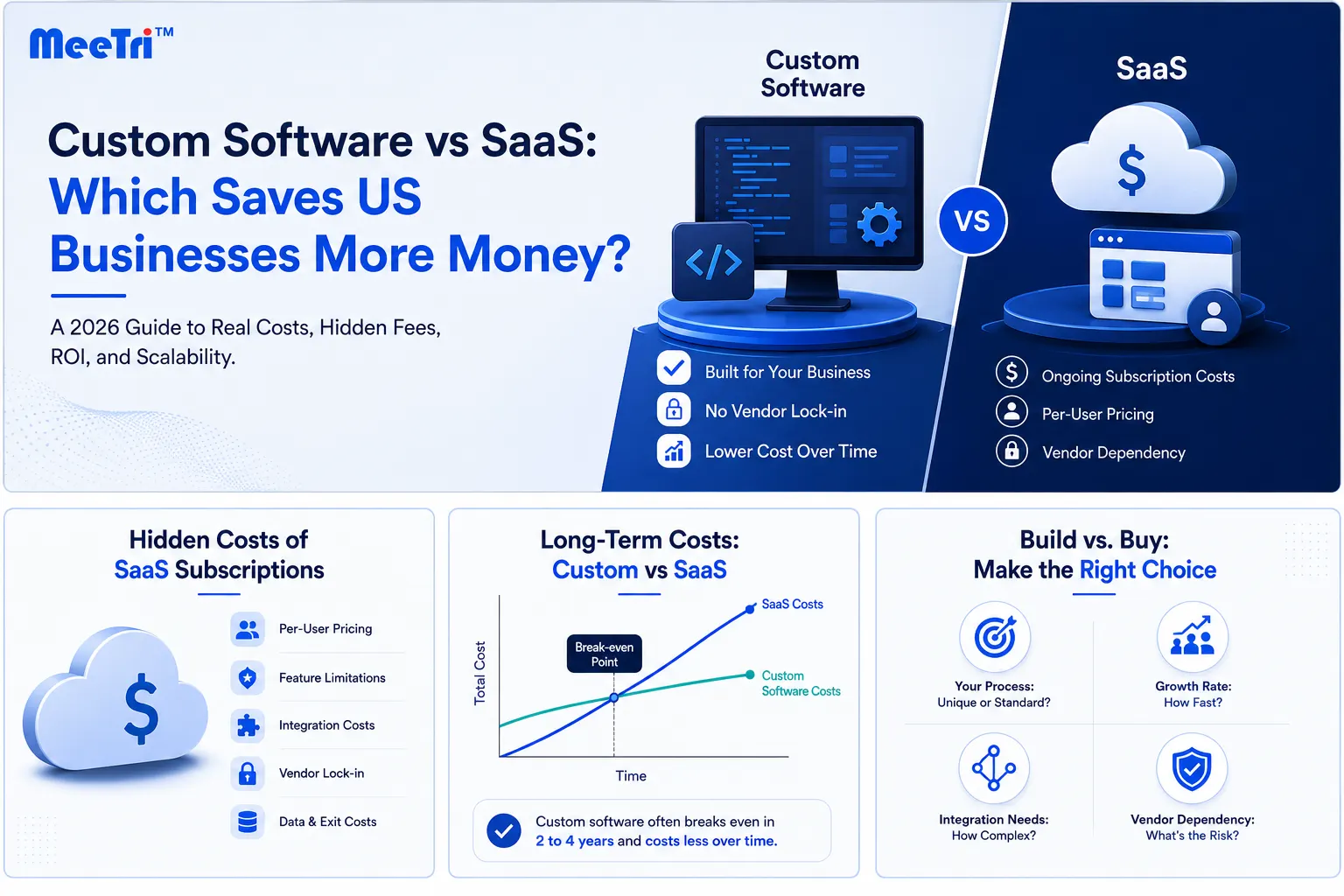
Custom software typically saves more money over time for businesses with complex, scaling, or highly specific needs, while SaaS is more cost-effective for standard processes that don't require deep customization. The right answer depends on your timeline, growth trajectory, and how much your operations differ from a generic workflow.
This guide breaks down the real cost comparison between custom software and SaaS, the hidden expenses most businesses miss, and how to decide which path makes financial sense for your situation in 2026.
Custom Software vs SaaS: The Core Difference
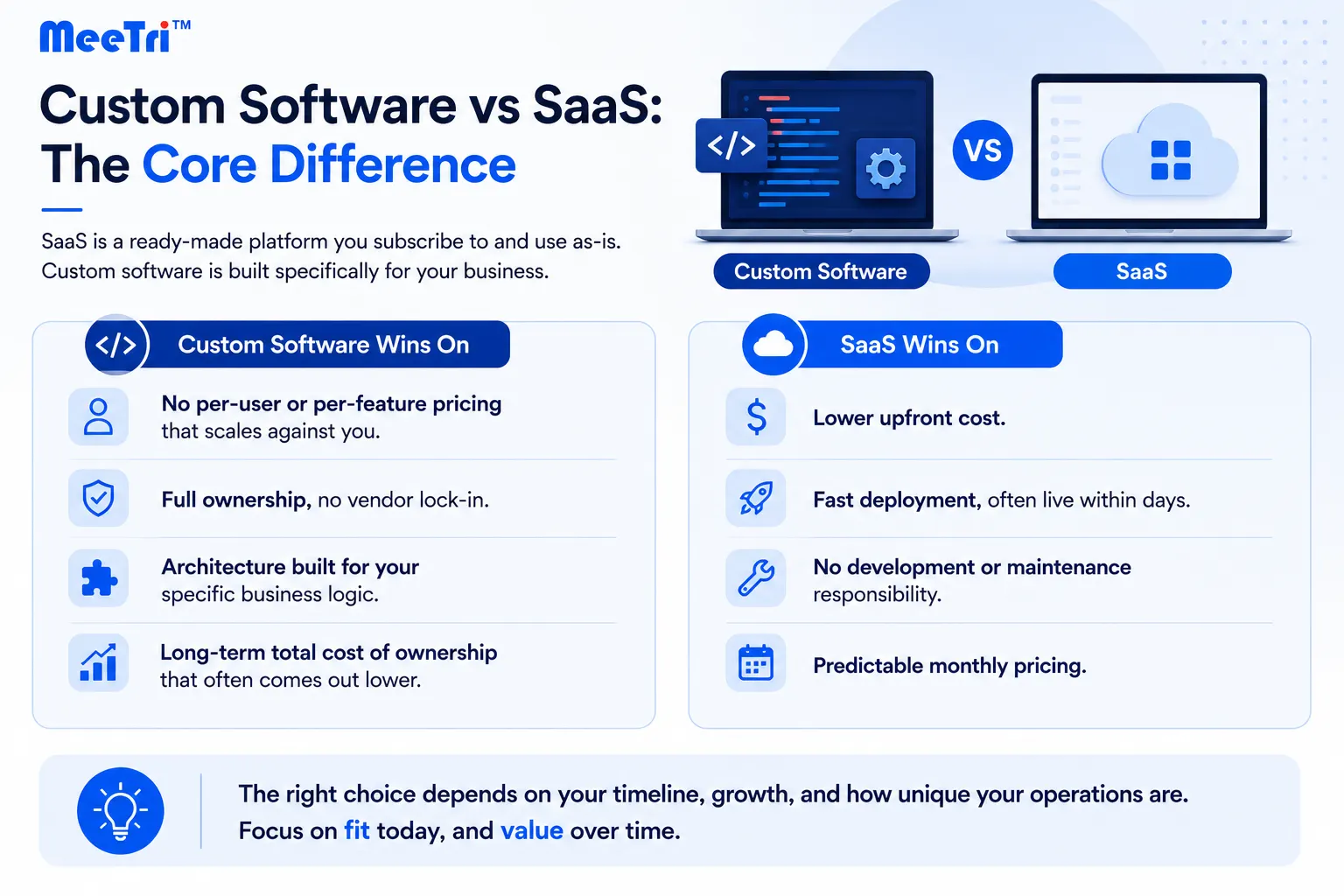
SaaS, or Software as a Service, is a ready-made platform you subscribe to and use as-is, with limited customization. Custom software is built specifically for your business, designed around your workflows, your data, and your goals from the ground up.
The cost comparison isn't as simple as "SaaS is cheaper" or "custom is more expensive." It's a question of timing and fit.
SaaS wins on:
- Lower upfront cost
- Fast deployment, often live within days
- No development or maintenance responsibility
- Predictable monthly pricing
Custom software wins on the following:
- No per-user or per-feature pricing that scales against you
- Full ownership, no vendor lock-in
- Architecture built for your specific business logic
- Long-term total cost of ownership that often comes out lower
If you're trying to make this decision for your US business, talking it through with a software development company US businesses trust for unbiased technical guidance can clarify which model actually fits your situation, rather than which one a vendor wants to sell you.
What Are the Long-Term Costs of Custom Software Compared to SaaS?
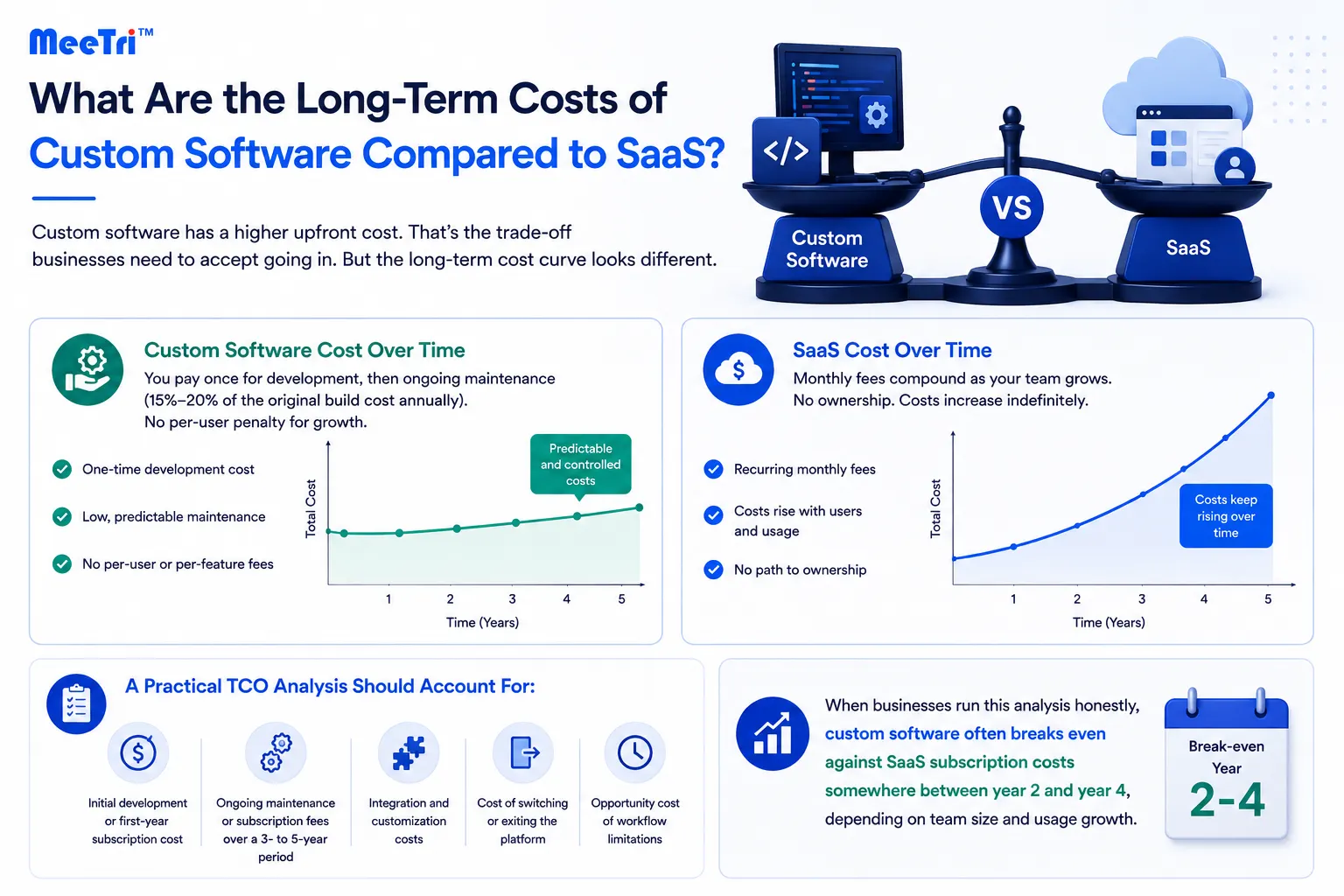
Custom software has a higher upfront cost. That's the trade-off businesses need to accept going in. But the long-term cost curve looks different.
SaaS cost over time: Monthly fees compound. A $50-per-user SaaS tool at 100 users costs $60,000 a year. At 500 users, that's $300,000 a year, indefinitely, with no path to ownership.
Custom software cost over time: You pay once for development, then ongoing maintenance, typically 15 to 20% of the original build cost annually. There's no per-user penalty for growth. The software you own today is the same asset you own in five years, just improved.
A practical TCO analysis should account for:
- Initial development or first-year subscription cost
- Ongoing maintenance or subscription fees over a 3- to 5-year period
- Integration and customization costs
- Cost of switching or exiting the platform
- Opportunity cost of workflow limitations
When businesses run this analysis honestly, custom software often breaks even against SaaS subscription costs somewhere between year two and year four, depending on team size and usage growth.
Build vs. Buy Software: A Practical Decision Framework
The build vs. buy software decision comes down to four questions. Answer these honestly before committing either way.
1. Is this process unique to your business or standard across your industry? Standard processes, like basic accounting or email marketing, are well served by SaaS. Unique processes that create competitive advantage are better served by custom software.
2. How fast are you growing? If your user base or transaction volume is growing quickly, SaaS per-user pricing will become expensive fast. Custom software's flat cost structure becomes more attractive the larger you scale.
3. How many systems does this need to talk to? The more integrations required, the more SaaS's per-connector costs and limitations start to outweigh its convenience. Heavy integration needs usually favor custom solutions.
4. What's your tolerance for vendor dependency? If losing access to a SaaS provider, through a price hike, feature removal, or shutdown, would seriously disrupt your business, that's a strong signal to consider building your own.
Working through this framework with an experienced custom software development services US provider before deciding helps you avoid the most common mistake: choosing based on upfront cost alone, without modeling the next three years.
Does Custom Software Provide a Better ROI Than SaaS?
Custom software ROI depends on the calculation you're running, but for businesses with the right profile, the answer is consistently yes over a multi-year horizon.
Custom App ROI typically improves when:
- User count or transaction volume is high and growing
- The software automates processes that previously required manual labor
- The business needs functionality that doesn't exist in any SaaS product
- Data ownership and security control carry strategic value
- The software becomes a competitive differentiator, not just an operational tool
ROI calculation should include the following:
- Development cost amortized over expected useful life, typically 5 to 7 years
- Labor savings from automation
- Cost avoidance from eliminated SaaS subscriptions
- Revenue impact from improved customer experience or faster operations
- Reduced error and rework costs
Businesses that only measure ROI against the development invoice miss most of the picture. The real comparison is development cost against the multi-year cost of the SaaS alternative, plus the value of capabilities SaaS simply doesn't offer.
Which Is More Scalable: Custom Software or SaaS?
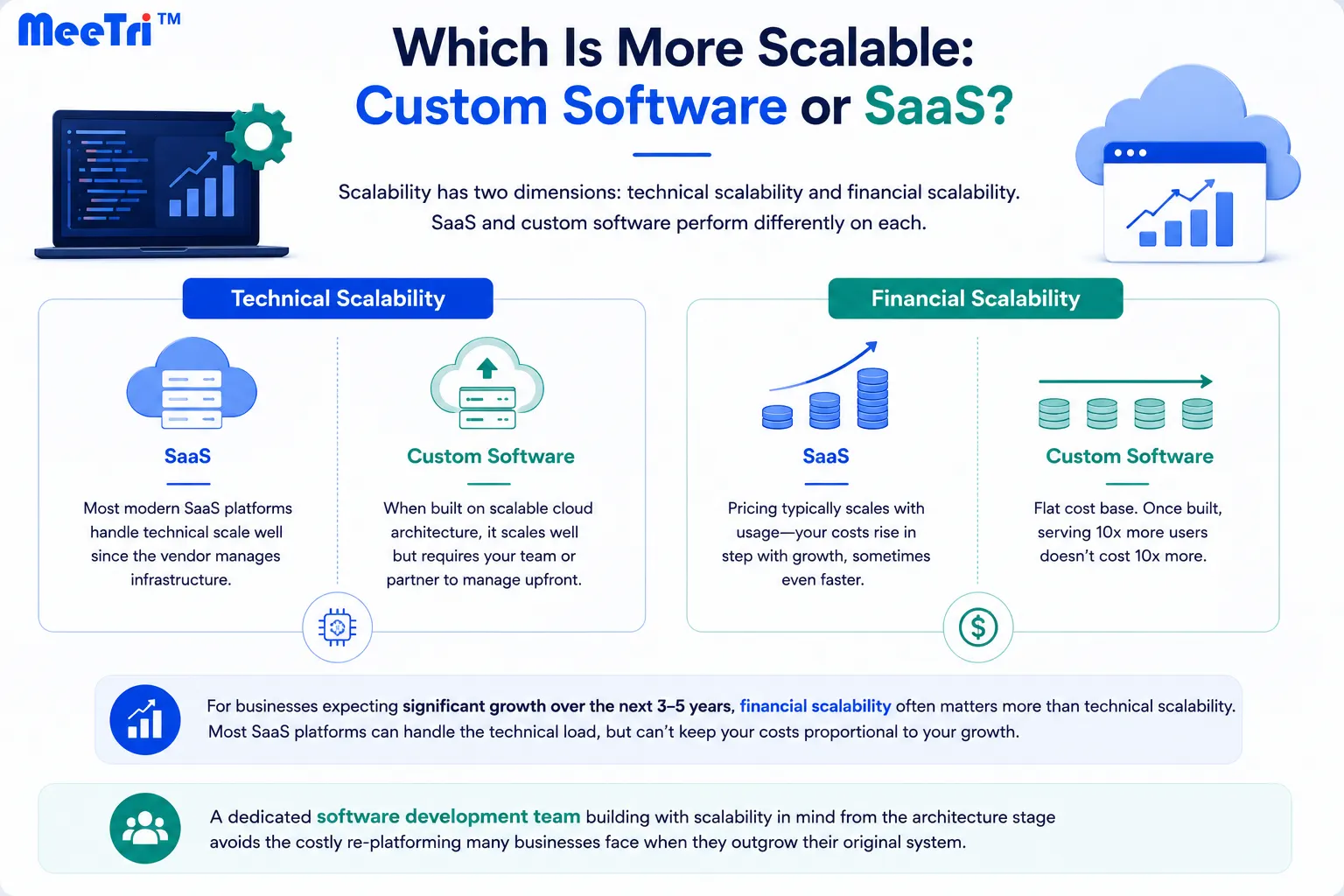
Scalability has two dimensions: technical scalability and financial scalability. SaaS and custom software perform differently on each.
Technical scalability: Most modern SaaS platforms handle technical scale well, since the vendor manages infrastructure. Custom software, when built on scalable cloud-based architecture, also scales well but requires your team or partner to manage that infrastructure decision upfront.
Financial scalability: This is where the scalability gap becomes obvious. SaaS pricing typically scales with usage, meaning your costs rise in step with your growth, sometimes faster. Custom software has a flat cost base. Once built, serving 10 times more users doesn't cost 10 times more.
For businesses expecting significant growth over the next three to five years, financial scalability often matters more than technical scalability, since most SaaS platforms can handle the technical load. What they can't do is keep your costs proportional to your growth.
A dedicated software development team building with scalability in mind from the architecture stage avoids the costly re-platforming many businesses face when they outgrow their original system.
When Should a Business Choose Custom Software Over a SaaS Solution?
Choose custom software when:
- Your core business process is genuinely unique, not just preference-based
- You're already paying for multiple SaaS tools that don't integrate well together
- Your growth trajectory will make per-user SaaS pricing unsustainable within 2 to 3 years
- You need data ownership or security controls SaaS providers can't guarantee
- The software itself is meant to be a competitive advantage, not just operational support
- You've outgrown the customization limits of your current SaaS tools
Choose SaaS when:
- The process is standard and well-served by existing tools
- Speed to deployment matters more than long-term cost optimization
- Your team size and usage are stable or unpredictable
- You don't have the internal capacity to manage a custom-built relationship
Most enterprises end up running a hybrid model. SaaS for standard, commodity functions. Custom software for the processes that differentiate the business. Getting that split right is usually more valuable than picking one model exclusively.
If you're unsure where that line sits for your US business, a conversation with a Software Consulting USA team that isn't trying to sell you a specific product is a useful first step. The goal is an honest assessment, not a pitch.
Conclusion
There's no universal winner in the custom software vs. SaaS debate. SaaS saves money upfront and gets you moving fast. Custom software costs more initially but often saves significantly more over a multi-year horizon, particularly as your team and usage grow.
The businesses that make the best decision here are the ones that run real numbers: the total cost of ownership over three to five years, not just the first invoice. They also evaluate which processes are genuinely unique to their operations versus which ones any standard tool can handle.
If you're weighing this decision for your business right now, mapping out your specific cost comparison before committing either way will save you from an expensive correction later.
Frequently Asked Questions
SaaS is more cost-effective for small US teams running standard processes in the short term. Custom software becomes more cost-effective for growing US businesses once per-user SaaS costs compound, typically past the two- to four-year mark, since custom builds carry no per-seat pricing penalty.
SaaS, or Software as a Service, is a pre-built platform US businesses subscribe to with limited customization. Custom software is built specifically for a company's workflows, data, and compliance needs, giving the business full ownership of the architecture instead of renting it.
Custom software carries higher upfront costs but a flat ongoing cost, typically 15 to 20% of the original build cost annually for maintenance. SaaS costs compound through per-user pricing, often surpassing custom software's total cost for growing US businesses within 2 to 4 years.
A business should choose custom software when its core process is genuinely unique, when growth will push per-user SaaS costs past sustainable levels within 2 to 3 years, when integration needs exceed 3 or more connected systems, or when the software itself drives competitive advantage.
Hidden SaaS costs include per-seat pricing that rises with headcount, features locked behind higher tiers, integration costs for connecting CRM or ERP systems, data migration fees when switching providers, and vendor lock-in. These can add 20 to 40% on top of the advertised subscription price.
Yes, for US businesses with high or growing usage, unique operational needs, or automation opportunities. Custom software ROI typically outperforms SaaS over a 3- to 5-year horizon once labor savings, eliminated subscription costs, and avoided workflow limitations are included in the calculation.
Custom software is generally more financially scalable for growing US businesses, since its cost structure doesn't rise with user count. SaaS is often easier to scale technically since the vendor manages infrastructure, but its per-user pricing model makes scaling expensive as headcount grows.

Related Articles

Custom Software Development Cost in 2026
Explore the cost drivers, hidden expenses, and planning considerations behind custom software budgets.
Custom Software Development for US Enterprises 2026
See how enterprises evaluate budgets, timelines, security, and delivery partners for long-term software investments.
How to Choose the Right Software Development Partner in 2026
Understand how to assess process quality, communication, architecture capability, and delivery confidence.
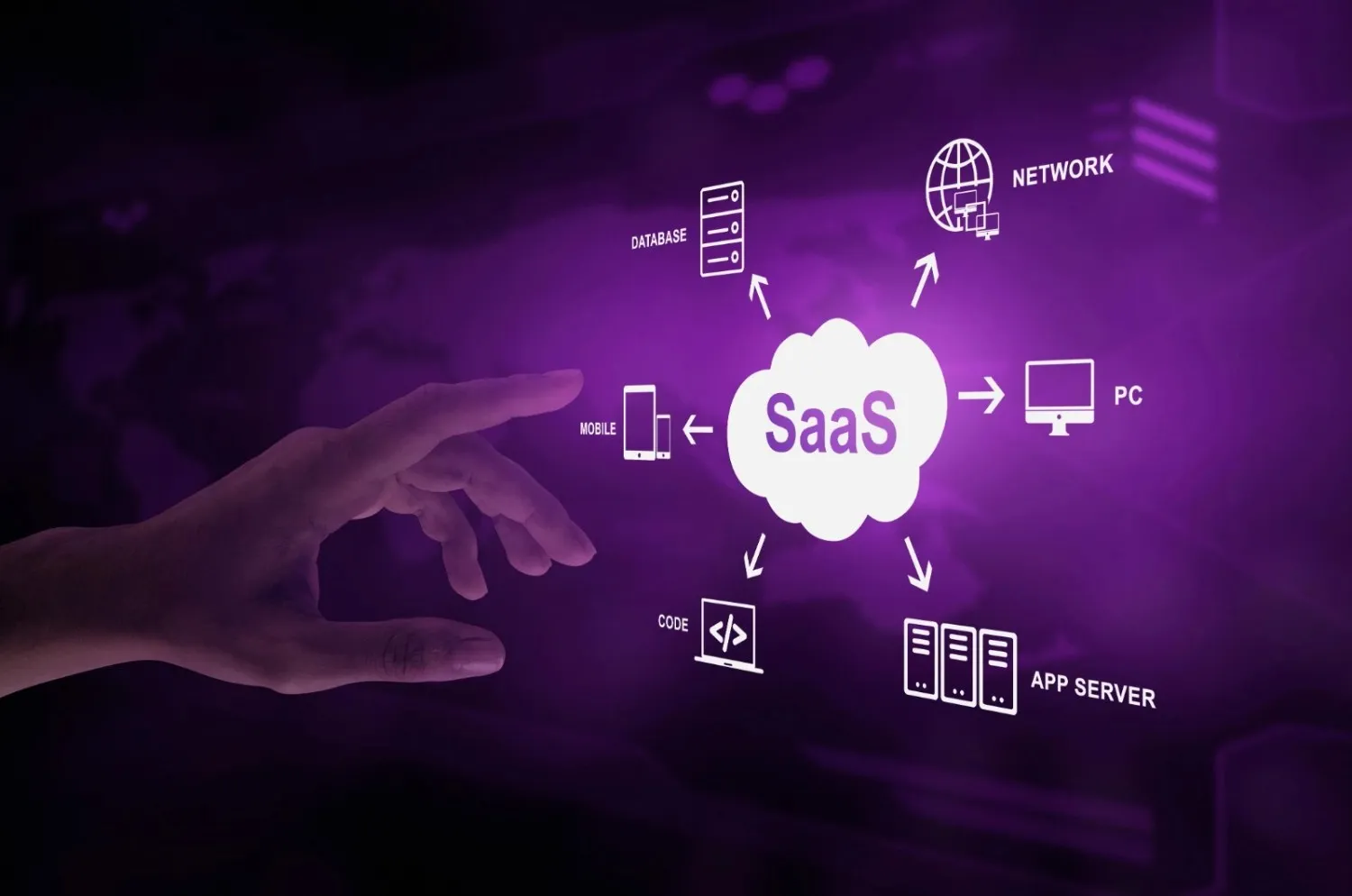
5 Common Challenges in Custom SaaS Development
Learn the most common delivery and integration risks teams face when building custom SaaS products.