Get a Free Development Strategy Consultation
Tell us about your project — we'll respond within 24 hours with tailored recommendations.
Healthcare organisations depend on accurate patient records, connected clinical systems and reliable access to health information. But when existing EHR or EMR software cannot support changing clinical workflows, integration requirements or operational priorities, the technology itself can become a barrier to progress.
Choosing a development partner for an EHR or EMR project is therefore more than a technical decision. You need a team that understands healthcare data, clinical operations, interoperability, security and the challenges of integrating new applications with existing infrastructure.
The right Software Development Company should be able to translate your healthcare requirements into a secure, scalable solution without disrupting essential operations. This guide explains what to evaluate, which technical capabilities matter and how to make a more informed partner selection.
Quick Answer: How Do You Select the Right EHR/EMR Development Partner?
Select an EHR/EMR development partner by assessing its healthcare technology experience, understanding of clinical workflows, integration capabilities, security practices, development process and post-launch support.
Before making a decision, check whether the partner can:
- Demonstrate relevant healthcare software development experience.
- Understand your clinical and administrative workflows.
- Build custom EHR or EMR functionality around defined requirements.
- Support HL7 and FHIR-based interoperability where appropriate.
- Address HIPAA-related security responsibilities and data protection.
- Manage data migration, testing, deployment and ongoing maintenance.
- Explain project ownership, communication and technical documentation.
A capable partner should provide evidence of its approach rather than relying on general claims about healthcare expertise.
Planning an EHR or EMR project? Talk with MeeTri's team to understand how your requirements can be translated into a development roadmap.
Discuss Your EHR/EMR Project with MeeTri
Talk through your clinical, technical and operational requirements with our team.
What Is the Difference Between EHR and EMR Software Development?
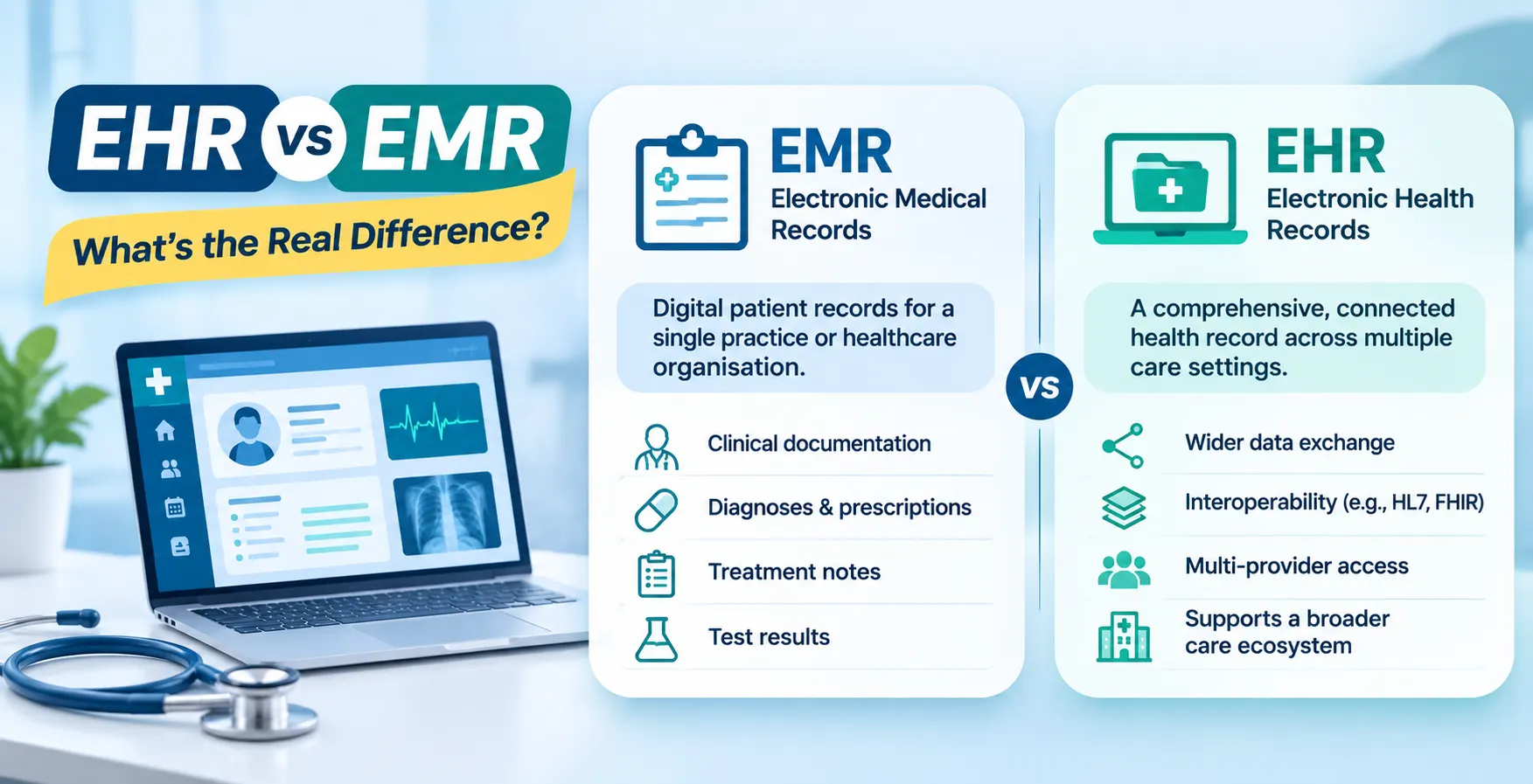
EHR and EMR are related terms, but they are not always interchangeable.
Electronic Medical Records (EMRs) generally refer to digital patient records used within a particular clinical practice or healthcare organisation. They can include medical histories, diagnoses, prescriptions, treatment notes and test results.
Electronic Health Records (EHRs) are generally designed to support a broader view of a patient's health information across different care settings and authorised providers. Interoperability and information exchange are therefore important considerations in EHR development.
For a health system, the distinction matters when defining the project's scope. An EMR application may focus on internal clinical documentation and practice workflows, while an EHR platform may require wider data exchange, external integrations and more complex information-sharing capabilities.
Your development partner should help clarify these requirements before recommending an architecture or development approach.
Why Does Your Health System Need the Right EHR/EMR Software Development Company?
An EHR or EMR system influences how clinical information is recorded, accessed, updated and shared. Poor technical decisions can create workflow disruption, data inconsistencies and integration problems that are difficult to resolve after deployment.
The right EHR/EMR Software Development Company should understand the relationship between software functionality and day-to-day healthcare operations.
For example, a system may need to support patient registration, clinical documentation, appointment management, prescriptions, laboratory results, billing and reporting. These functions must work together rather than operate as disconnected modules.
A development partner should also consider future requirements, including additional facilities, new clinical departments, increased patient volumes and changing interoperability needs.
This is where Digital Transformation in Healthcare becomes more than simply replacing paper records with digital applications. It involves improving how healthcare information moves across teams, applications and care settings.
What Should You Evaluate When Selecting an EHR/EMR Development Partner?
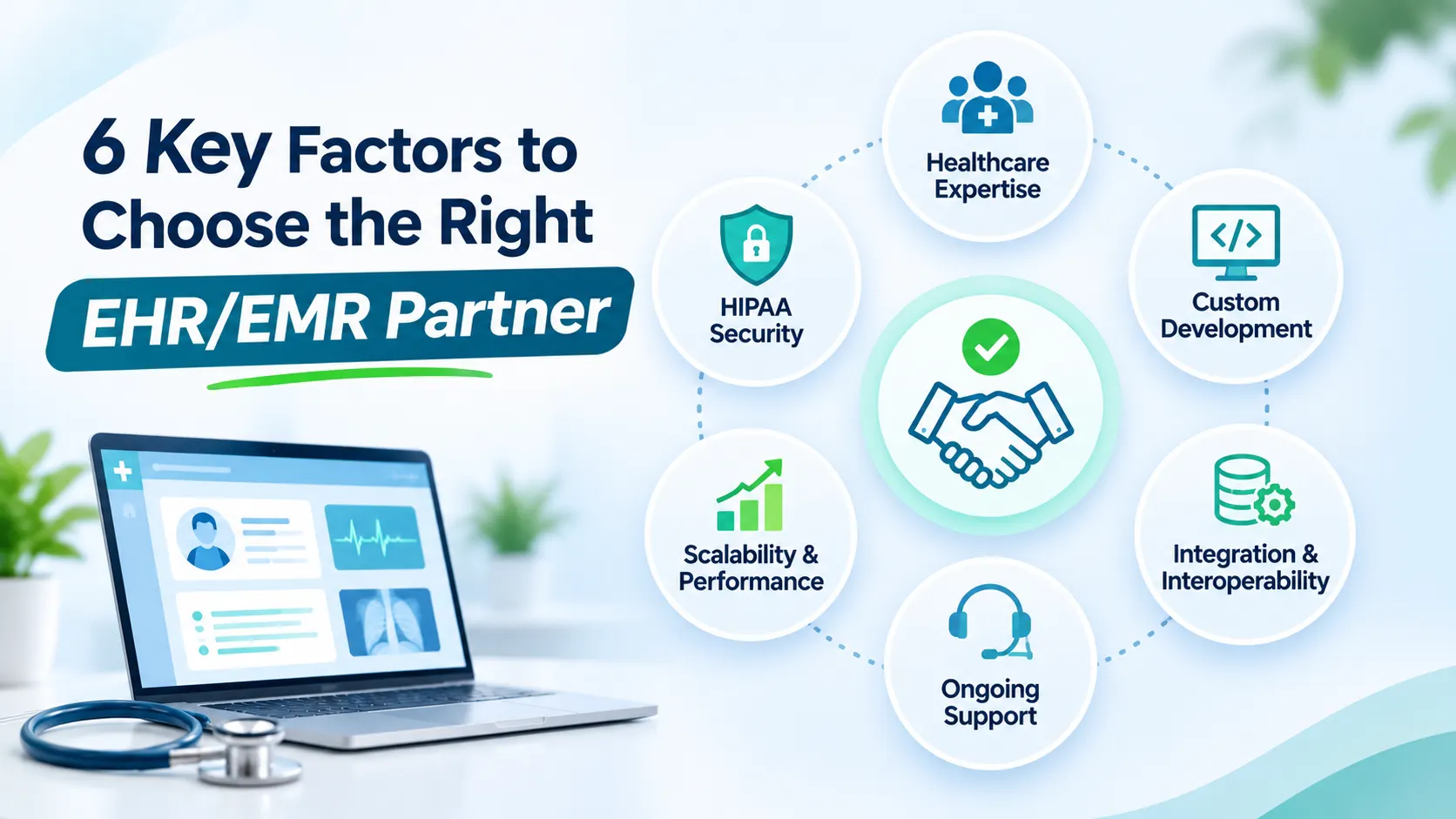
Evaluate a potential partner across six areas. These criteria help you distinguish a team with relevant healthcare engineering capabilities from a general software provider.
1. Healthcare Domain and Clinical Workflow Experience
Healthcare software requires an understanding of how clinical and administrative teams work.
Ask how the development team approaches workflows such as patient registration, clinical documentation, medication management, referrals, laboratory reporting and discharge processes.
The partner should be able to translate these workflows into clear functional requirements. It should also understand different user roles, including clinicians, administrators, billing teams and authorised support staff.
Do not rely on healthcare-related language in a company profile alone. Ask for relevant project examples, technical explanations and evidence of how the team handled healthcare-specific requirements.
2. Custom EHR Software Development Capabilities
Your health system may have workflows that standard software cannot support without significant adjustments.
Custom EHR Software Development can help address specific requirements through tailored modules, interfaces, permissions, reporting and integrations. However, custom development should solve a defined problem. It is not automatically the better option for every organisation.
Ask whether the partner can develop modular applications, configure role-based access, support multiple departments and accommodate future enhancements.
A good partner should also explain which requirements genuinely need custom engineering and which could be addressed through existing systems or integration.
3. EHR Integration and Healthcare Interoperability
An EHR or EMR platform rarely operates independently. It may need to exchange information with laboratory systems, pharmacies, imaging applications, billing platforms, patient portals and other healthcare services.
Review the partner's experience with EHR Integration Services, APIs and healthcare data standards.
HL7 and FHIR are particularly relevant to healthcare interoperability. FHIR provides a standard framework for exchanging health information through modern web-based approaches. The appropriate implementation depends on the systems involved, their supported versions and the specific data exchange requirements.
The US Office of the National Coordinator for Health Information Technology (ONC) provides guidance on interoperability, USCDI and health IT standards. Review its official interoperability resources when defining your integration requirements.
4. HIPAA Security and Patient Data Protection
Security should be considered throughout the development lifecycle, not added as a final testing step.
Your partner should explain how it approaches authentication, role-based access, encryption, audit logging, secure data transmission, vulnerability management, backups and incident response.
The US Department of Health and Human Services (HHS) explains that the HIPAA Security Rule requires appropriate administrative, physical and technical safeguards to protect electronic protected health information.
Review the HHS HIPAA Security Rule guidance and ask the development partner how its proposed architecture and delivery practices support your organisation's security responsibilities.
Importantly, a software provider cannot guarantee that your entire health system is HIPAA compliant simply by building an application. Compliance depends on the organisation's policies, processes, configurations, workforce practices and responsibilities. Where applicable, clarify Business Associate Agreement requirements and subcontractor arrangements before sharing protected health information.
5. Technical Architecture, Quality Assurance and Scalability
The development partner should be able to explain its proposed architecture in practical terms.
Discuss application performance, database design, hosting, API management, data storage, system availability and disaster recovery. Ask how the solution will handle increased users, additional facilities and growing volumes of clinical information.
Quality assurance should cover more than checking whether individual features work. It should include integration testing, security testing, performance testing, usability testing and validation of critical clinical workflows.
Request a clear testing strategy and defined acceptance criteria before development begins.
6. Ongoing Maintenance and Technical Support
An EHR or EMR system requires attention after launch. New integrations, security updates, workflow changes and infrastructure improvements may all affect its long-term performance.
Clarify what support the development partner provides after deployment. Discuss response times, issue escalation, monitoring, maintenance responsibilities, documentation and release management.
A reliable partner should define these responsibilities in the project agreement rather than leaving them open to interpretation.
Which EHR Development Services Should Your Technology Partner Provide?
The required scope depends on your health system's existing infrastructure and project objectives. However, a development partner may need to support several connected service areas.
- Custom EHR Software Development: Building clinical applications, patient records, dashboards and workflows around defined requirements.
- EMR Software Development Services: Developing digital medical record functionality for clinical documentation, diagnoses, prescriptions and treatment history.
- EHR Development Services: Designing and developing broader health record applications, including user roles, reporting and system architecture.
- Custom EMR Development: Creating tailored modules and workflows for specific departments or healthcare operations.
- EHR Integration Services: Connecting the application with relevant healthcare systems through APIs and supported data standards.
- Healthcare Interoperability Solutions: Supporting reliable information exchange between authorised applications and healthcare organisations.
The scope may also include data migration, application modernisation, testing, deployment and ongoing support.
Your chosen Healthcare Software Development Services partner should be able to explain which of these capabilities are relevant to your project, how they fit together and what responsibilities remain with your internal teams.
Need a development approach aligned with your existing healthcare infrastructure? Discuss Your EHR/EMR Project with MeeTri and outline your technical and operational requirements.
Discuss Your EHR/EMR Project
Share your clinical, technical and operational requirements with MeeTri.
How Important Are HL7 and FHIR Standards in EHR/EMR Development?
HL7 and FHIR support the exchange of healthcare information between systems, but they serve different technical purposes and should be selected according to the integration requirements.
HL7 standards include established approaches for exchanging clinical and administrative information. FHIR uses modern web technologies and structured resources to support data exchange through APIs.
When evaluating a development partner, ask:
- Which HL7 messaging standards and FHIR versions has the team implemented?
- How are patient, practitioner, encounter and clinical observation records mapped?
- How are API authentication and authorisation managed?
- How are errors, duplicate records and failed messages handled?
- How will integrations be tested with external systems?
- How will standards and interface changes be maintained?
The ONC Interoperability Standards Platform explains FHIR's role in modern health information exchange. Its resources can help your technical team assess the standards relevant to your architecture.
Do not assume that mentioning FHIR automatically proves interoperability expertise. Ask for implementation details and evidence of successful data exchange.
How Should You Assess Data Migration and System Modernisation?
Data migration is one of the most important areas to discuss before replacing or upgrading an existing EHR or EMR platform.
Historical records may contain different formats, incomplete fields, duplicate entries and inconsistent terminology. Moving this information without proper validation can affect the accuracy and usefulness of the new system.
Your development partner should explain its migration approach, including:
- Assessing existing databases, records and data formats.
- Mapping source fields to the new data model.
- Identifying duplicates, missing values and inconsistent records.
- Defining validation and reconciliation rules.
- Running test migrations before production migration.
- Confirming data integrity and access permissions after transfer.
Ask how the team will handle migration failures and whether a rollback or recovery plan is available.
For larger health systems, a phased migration may reduce disruption, but the approach should be based on system dependencies, operational risk and clinical requirements.
What Questions Should You Ask Before Finalising an EHR/EMR Development Partner?
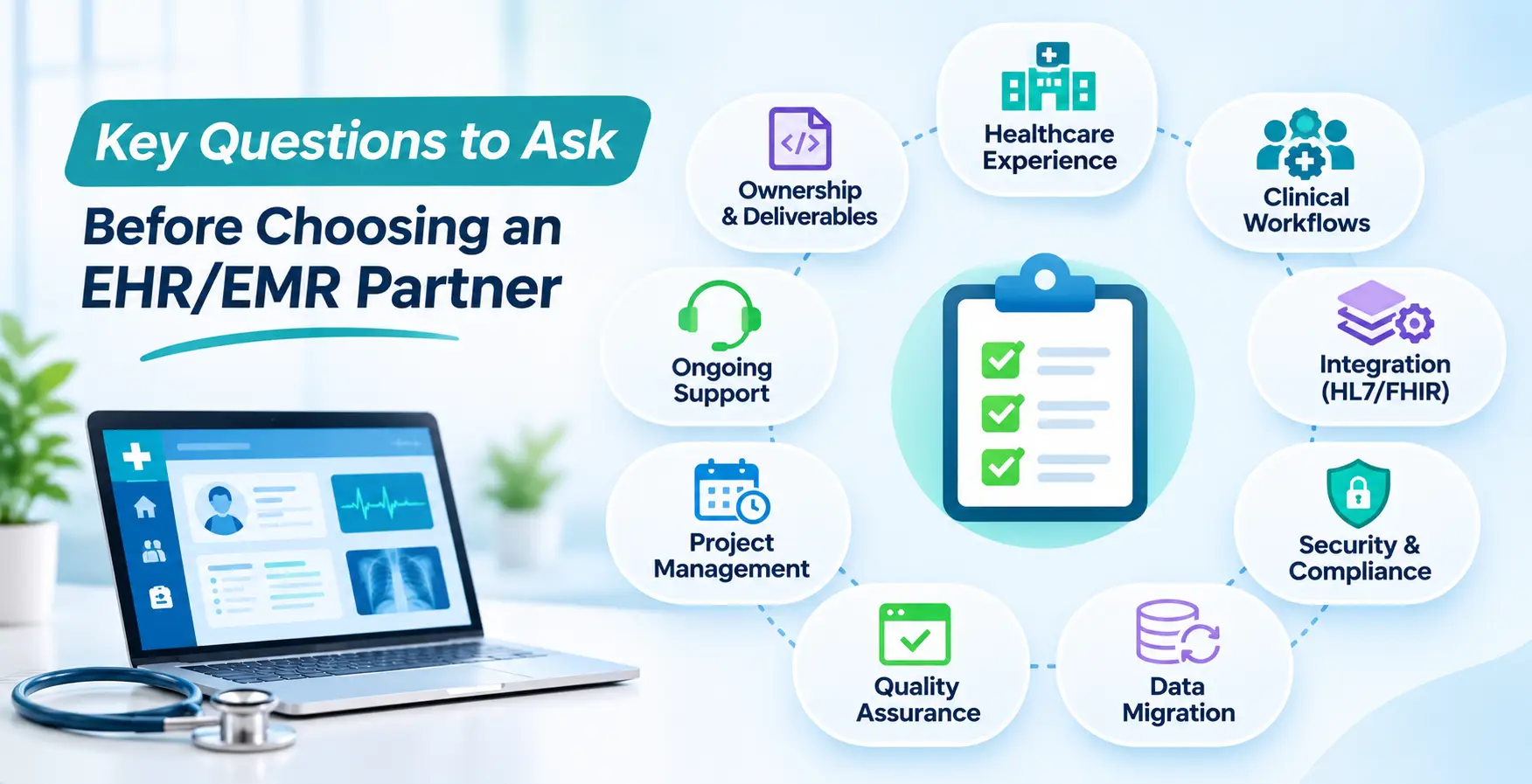
Use the following questions to compare potential partners on evidence rather than sales claims.
| Evaluation area | Questions to ask |
|---|---|
| Healthcare experience | Can you demonstrate relevant EHR or EMR projects and explain your team's role? |
| Clinical workflows | How will you understand and validate our existing workflows? |
| Integration | What HL7, FHIR and API integration experience can you demonstrate? |
| Security | How do you address access control, encryption, audit logging and security testing? |
| Data migration | What is your approach to data mapping, validation and recovery? |
| Quality assurance | Which testing stages and acceptance criteria are included? |
| Project management | How are milestones, changes, risks and communication managed? |
| Support | What maintenance and technical support are available after launch? |
| Ownership | Who owns the source code, documentation and project deliverables? |
A development partner should answer these questions clearly and be willing to discuss limitations. If the answers are vague, treat that as a reason to investigate further.
How Can You Measure the Success and ROI of an EHR/EMR Project?
The success of an EHR or EMR project should be measured through operational and technical outcomes, not simply whether the software has launched.
Before development begins, agree on measurable indicators such as:
- Time required to complete clinical documentation.
- Reduction in duplicate data entry.
- Accuracy and completeness of migrated records.
- Reliability of integrations and data exchange.
- Application availability and response times.
- User adoption across relevant departments.
- Time required to resolve technical issues.
- Support and maintenance workload.
These measurements can help your organisation assess Healthcare Automation ROI and identify where further improvements are needed.
Avoid promising a specific return before establishing a baseline. The actual outcome depends on implementation quality, staff adoption, workflow changes, integration complexity and ongoing operational management.
Why Choose Custom EHR/EMR Development for Your Health System?
Custom development may be appropriate when existing applications cannot support essential workflows, integration requirements or future product objectives.
It can provide greater control over functionality, architecture and system enhancements. It may also help connect legacy applications with newer digital services.
However, custom software brings responsibilities around development, testing, security, maintenance and long-term ownership. Your organisation should compare these requirements with the capabilities and limitations of existing solutions before deciding.
A partner offering Custom Software Development Services should be able to explain the technical trade-offs and recommend an approach based on your actual requirements, not simply promote a custom build.
Talk with a Healthcare Software Expert
Discuss development options for your health system's requirements.
Conclusion: Choose an EHR/EMR Partner That Understands Healthcare Technology
Selecting an EHR/EMR development partner requires more than comparing technical skills or project proposals. You need to evaluate healthcare experience, clinical workflow understanding, interoperability, security, data migration, quality assurance and long-term support together.
The right partner should understand how these elements affect the reliability of your health system and provide a clear delivery approach from initial discovery to ongoing maintenance.
MeeTri Infotech provides custom software engineering capabilities across healthcare applications, API integration, quality assurance and application support. If you are planning an EHR or EMR project, discuss your requirements with a team that can help assess the technical scope and development approach.
If you are assessing a wider modernisation programme, consider how a Patient Portal Development Partner could fit into the same connected healthcare technology roadmap.
Ready to explore your EHR/EMR development requirements? Talk to MeeTri's Healthcare Software Team to discuss your project.
Talk to MeeTri's Healthcare Software Team
Discuss your EHR/EMR development requirements and project scope.
Frequently Asked Questions
An EHR/EMR development partner helps healthcare organisations plan, design, build, integrate, test and maintain electronic health record applications. The scope may include clinical workflows, patient records, APIs, data migration, security controls and ongoing technical support.
Look for healthcare domain experience, clinical workflow knowledge, HL7 and FHIR integration capabilities, security practices, data migration expertise, quality assurance and post-launch support. Ask for relevant project evidence and a clear explanation of the proposed delivery process.
EMR development generally focuses on digital medical records used within a particular practice or organisation. EHR development typically supports a broader patient health record and may involve information exchange across multiple care settings. The exact scope depends on the organisation's requirements and system architecture.
HIPAA requirements apply to covered entities and business associates as defined by the regulations. EHR/EMR applications that create, receive, maintain or transmit electronic protected health information must be designed and operated with appropriate safeguards. Compliance involves organisational policies and processes as well as technical controls.
HL7 and FHIR support structured healthcare information exchange. They can help EHR applications communicate with other authorised systems, such as laboratories, pharmacies and patient-facing applications. The appropriate standard and implementation depend on the systems and use cases involved.
There is no reliable universal timeline. Delivery depends on the number of modules, integration requirements, data migration complexity, security needs, testing scope and stakeholder availability. A development partner should provide a phased estimate after reviewing the requirements.
Common challenges include complex clinical workflows, legacy system integration, data migration, interoperability, security, user adoption and ongoing maintenance. Early discovery, realistic scope definition and structured testing help reduce these risks.
Yes, where the existing applications provide suitable interfaces, APIs or supported integration methods. The development team must assess data formats, authentication, permissions, interface limitations and error handling before confirming the integration approach.
