Get a Free Development Strategy Consultation
Tell us about your project - we'll respond within 24 hours with tailored recommendations.
GDPR Compliant Custom Software: What UK Businesses Must Build in 2026
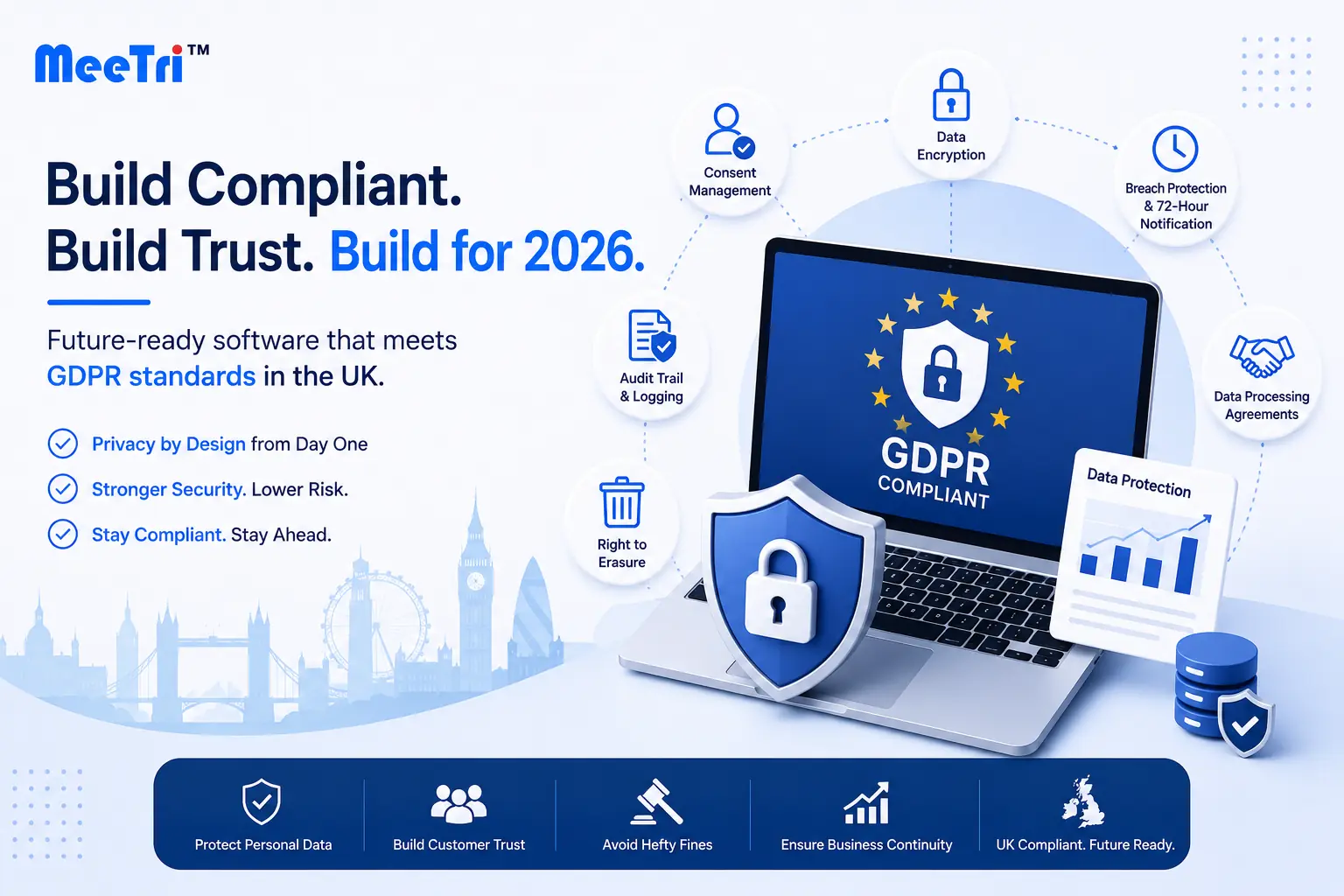
GDPR compliant custom software for UK businesses in 2026 means encryption at rest and in transit, documented consent management, breach detection that can notify the ICO within 72 hours, a tamper resistant audit trail, genuine right to erasure, and signed Data Processing Agreements with every processor, all built in from the design stage rather than added after launch. This guide covers what changed under the Data (Use and Access) Act 2025, what the ICO expects under Articles 25 and 32, and the working checklist UK businesses and their software development partners should build from this year.
What UK Businesses Need to Build for GDPR Compliance in 2026
If you are commissioning GDPR software development UK teams to build or rebuild systems this year, three things need to be true before launch. Personal data must be encrypted at rest and in transit. Consent management and an audit trail must live inside your data model, not in a shared drive. And your engineering team must be able to detect a breach and notify the ICO within 72 hours of becoming aware of it. The sections below explain how to get there.
Key takeaways
- GDPR compliant custom software in 2026 needs encryption, consent management, breach detection, an audit trail, right to erasure, and signed processor agreements built in from the design stage, not added after launch.
- Four of the largest UK GDPR fines on record landed in 2025, all following cyber attacks tied to weak technical measures rather than paperwork gaps.
- The Data (Use and Access) Act 2025 raised UK cookie and consent fines to GDPR levels and gave the ICO power to compel technical reports.
- The ICO updated its privacy by design guidance in February 2026 to add specific duties for products likely to be accessed by children.
- A data controller remains responsible for every third party processor's compliance, so a signed Data Processing Agreement is required for each one.
Why This Has Stopped Being a Legal Problem
For a long time, GDPR sat with the legal team and software just needed to avoid getting in the way. That separation is no longer safe. Four of the largest UK GDPR penalties on record landed in 2025, and every one followed a cyber attack rather than a paperwork failure. Capita was fined £14 million in October 2025 after ransomware exposed personal data through inadequate technical security. 23andMe was fined £2.31 million in June 2025 after credential stuffing exploited accounts with no multi factor authentication, and LastPass UK was fined £1.2 million in November 2025, with the ICO refusing to treat its 14 hour breach notification as a mitigating factor. Timely notification is now a baseline expectation, not a bonus.
The first half of 2025 alone produced six fines totaling £5.6 million, already more than double the £2.7 million issued across all 18 fines in 2024. That is a software engineering trend, not a legal one, and it is understandably unsettling if you assumed your existing build was already covered.
Privacy by Design: The Standard the ICO Now Expects
Privacy by design software is not a checkbox you tick during a legal review. Under Article 25 of the ICO's accountability framework, every data controller must build data protection into a system from the design stage, not retrofit it once live. Article 32 lists pseudonymisation, replacing directly identifying fields with a token your systems can reverse only with a separately held key, as one of the specific technical measures the ICO expects you to consider alongside encryption. The ICO updated its design guidance in February 2026, adding a duty around higher protection for children's data. Any product likely to be accessed by minors now needs age appropriate design and a documented impact assessment completed before launch, not after a complaint.
In practice, this means asking, at the schema level, whether a field needs to exist before you collect it, and giving every table holding personal data a documented purpose and retention period.
What Changed Under the Data (Use and Access) Act 2025
The Data (Use and Access) Act 2025 is the most significant amendment to UK data law since GDPR itself, and it is where UK GDPR compliance now diverges from the EU version. Fines under the Privacy and Electronic Communications Regulations, which govern cookies and consent banners, were raised from a £500,000 cap to align with GDPR's £17.5 million or four percent of global turnover, turning consent management into an engineering requirement rather than a marketing nicety. The Act also introduced a "stop the clock" mechanism for subject access requests and gave the ICO power to compel technical reports during an investigation. As of June 2026, organizations must also operate a formal, documented complaints handling procedure, a logged and auditable workflow rather than an inbox.
The GDPR Software Checklist for 2026
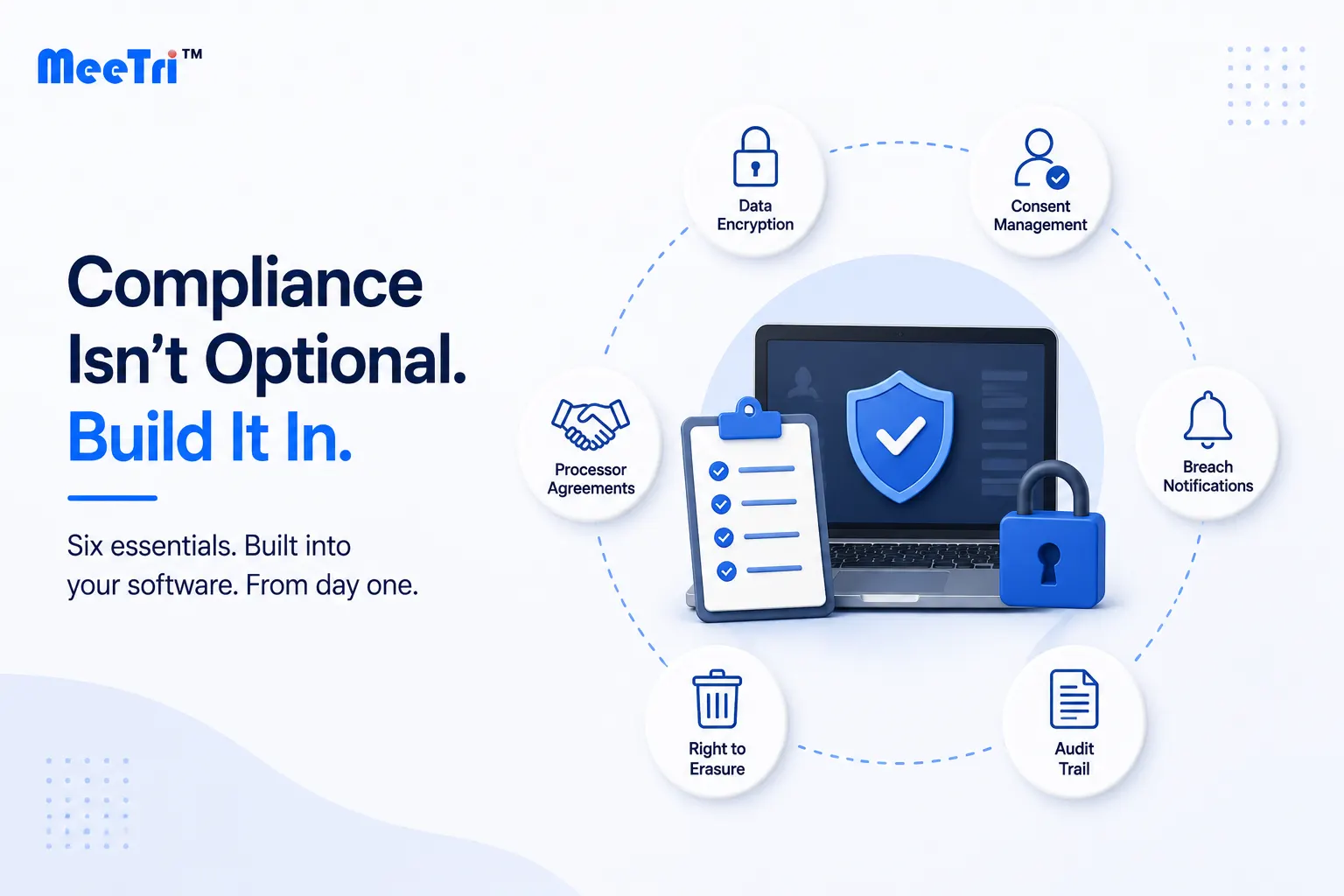
In short, GDPR compliant custom software in 2026 needs six things built in before launch: strong encryption at rest and in transit, a documented and evidenced consent management system, breach detection capable of notifying the ICO within 72 hours, a tamper resistant audit trail showing who accessed personal data and when, genuine hard delete functionality that satisfies the right to erasure across live systems, backups, and third party processors, and a signed Data Processing Agreement with every processor that touches personal data on your behalf. The table below translates these ICO guidelines software teams must follow into exactly where each requirement needs to live in your codebase.
| Requirement | What the ICO Expects | Where It Lives in Your Software |
|---|---|---|
| Encryption | Strong encryption at rest and in transit under Article 32 | Database level plus field level encryption, keys held separately |
| Consent management | Clear, granular, evidenced consent under the raised PECR fine regime | A timestamped consent record tied to the user |
| Breach notification | Detection and ICO notification within 72 hours, with no credit for merely meeting the deadline | Structured auth and access logging with automated alerting |
| Audit trail | Evidence of who accessed what personal data, and when | Tamper resistant, append only logs held separately from application code |
| Right to erasure | Genuine deletion across live systems, backups, and processors | Hard delete with cascading logic and a documented backup purge process |
| Processor agreements | A signed Data Processing Agreement with every third party that handles personal data for you | A maintained inventory of processors with DPA status and deletion confirmations logged |
Data Compliance Software UK: Build, Buy, or Blend
Most UK businesses do not need to build every piece of data compliance software UK teams rely on from scratch. Consent platforms, key management services, and audit logging tools are mature and well tested. What genuinely needs custom engineering is the connective layer: cascading deletion that satisfies the right to erasure, breach detection tuned to your traffic patterns, access control mapped to your real organizational roles, and a maintained record of Data Processing Agreements with every processor in your stack. As the data controller, you remain accountable for their compliance even when the processing itself happens on someone else's infrastructure.
This is where software outsourcing UK has become standard rather than a compromise. Bringing in specialists who have already built secure software UK regulators recognize as sound is usually faster and cheaper than learning Article 32 on your project's budget, provided compliance is stated as a requirement from the first discovery call.
Choosing a Software Development Partner Who Builds Compliance In
The clearest signal of a capable software development company is what they ask before any code is written. A genuine software development partner asks what personal data you hold, why, and who else touches it, before discussing frameworks or timelines, and treats the checklist above as a specification with an owner for each row. If a proposal for custom software development services skips data flows or breach detection until the contract stage, raise it directly.
Conclusion
None of this changes what your business does. It changes how defensible your software is if something goes wrong, and increasingly, whether the ICO ever needs to ask. The businesses handling this well in 2026 are the ones who treated encryption, consent, deletion, and breach detection as engineering specifications from the first sprint, with a software development partner who raised these questions before being asked.
Frequently Asked Questions
Not as an absolute mandate, but Article 32 requires security appropriate to the risk, and ICO enforcement now makes encryption at rest and in transit effectively required for software handling personal data online.
At minimum: encryption, documented consent management, structured breach detection logging, a tamper resistant audit trail, and hard delete functionality cascading through backups and processors.
Core requirements match, but the Data (Use and Access) Act 2025 raised UK PECR fines to GDPR levels, added a lawful basis called recognised legitimate interests, and gave the ICO power to compel technical reports.
Up to £17.5 million or four percent of global turnover, whichever is higher. Four of the largest fines in UK GDPR history landed in 2025, all following cyber attacks linked to weak technical measures.
Yes. Article 25 requires data protection by design and by default, and the ICO's guidance, updated in February 2026, now covers products likely to be accessed by children.
Only certain organizations must appoint one, mainly public authorities and businesses carrying out large scale monitoring or processing sensitive data. Most software companies do not need a DPO but should have someone accountable for the checklist above.

Related Articles
Custom Software Development UK: The 2026 Business Guide
Explore planning, cost, compliance, and partner considerations for a custom software build.
How to Choose the Right Software Development Partner
Learn which questions reveal a partner's process and technical judgment.