Get a Free Development Strategy Consultation
Tell us about your project — we'll respond within 24 hours with tailored recommendations.
What British Startups Need to Weigh in Offshore vs UK Software

Three things decide whether offshore, nearshore, or UK development is right for you.
- Product stability: offshore rewards a clear, unchanging specification and punishes a product still finding its shape.
- The time zone gap: a blocker raised at 5pm in the UK will not get resolved until the next morning if your team is in India or the Philippines.
- Exposure if it goes wrong: IP protection, data handling, and contract enforcement are all easier when your provider sits inside UK law.
Why Day Rates Don't Tell the Real Story
The headline cost saving is real. UK developer day rates on marketplaces like YunoJuno averaged £438 in 2026, with the top decile of contractors billing around £654. Offshore rates in South Asia and Southeast Asia typically run £170 to £400 a day, and a UK vs India software comparison often shows the widest gap of all, sometimes 60 to 70 percent cheaper on paper. Deloitte's 2024 Global Outsourcing Survey found that over 70 percent of organizations now outsource critical technology functions, so the model is mainstream. What gets missed is that the day rate is the price of code being typed, not the price of a working product.
Offshore vs UK Software: A Day Rate Comparison
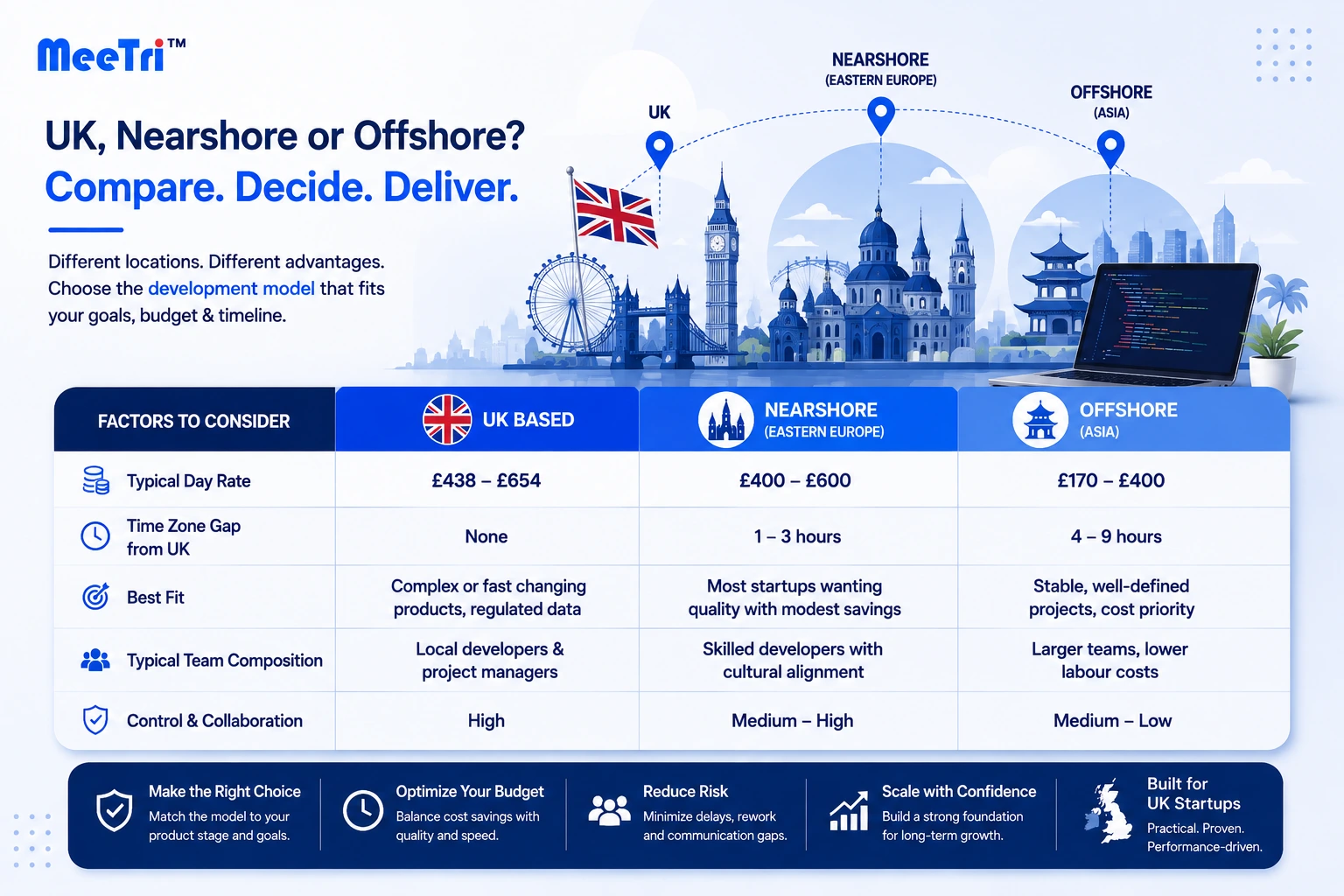
Here is how the three models compare once time zone and typical fit are factored in alongside the headline day rate, which is the honest starting point for any software outsourcing comparison.

| Model | Typical Day Rate | Time Zone Gap from UK | Best Fit |
|---|---|---|---|
| UK based | £438 to £654 | None | Complex or fast changing products, regulated data |
| Nearshore (Eastern Europe) | £400 to £600 | 1 to 3 hours | Most startups wanting quality with modest savings |
| Offshore (South Asia, Southeast Asia) | £170 to £400 | 4 to 9 hours | Stable, well specified, non urgent work |
The Total Cost of Ownership Once Hidden Costs Are Added
Take a project scoped at £100,000 on a UK day rate basis. A nearshore team quoting against the £400 to £600 band would likely land the same scope at roughly £55,000 to £65,000 on headline cost, and an offshore team on the £170 to £400 band would likely quote roughly £25,000 to £40,000. Add management overhead of 15 to 25 percent and rework of 15 to 50 percent depending on how well specified the work is, and the totals move much closer together than the day rate alone suggests. A nearshore quote can end up landing at £75,000 to £90,000 once overhead and modest rework are included, and an offshore quote can land anywhere from £45,000 to £75,000 depending on how disciplined the specification and review process is. The cost saving is still real. It is just smaller, and less certain, than the headline day rate implies.
When Offshore Development Works for British Startups
Offshore genuinely earns its cost advantage in specific situations. Well defined, stable technical work, such as adding a documented feature to an existing codebase, writing automated tests, or building a scoped integration against a published API, plays to offshore's strengths because there is little room for the specification to be misread. Scaling engineering capacity quickly is another good fit. If you need eight developers next month and the UK hiring market cannot deliver them in time, offshore or nearshore staff augmentation is a pragmatic way to grow capacity, provided a UK based lead still owns architecture and code standards. Ongoing maintenance of a well documented, stable system, covering bug fixes, security patches, and minor feature work, is a good offshore use case too, because the domain knowledge already lives in documentation rather than in someone's head.
When Offshore Development Goes Wrong
The pattern is just as clear in reverse. Early stage product development, where requirements shift weekly based on user feedback, is the worst fit for offshore, because the slow feedback loop and heavy specification burden make iteration expensive exactly when you need it to be fast and cheap. Products with deep domain knowledge requirements, such as fintech, healthtech, or regulated legal tech, need developers who can absorb nuanced business logic quickly, and that context rarely transfers well across a remote, asynchronous relationship. And tight deadlines, whether a funding milestone, a regulatory submission, or a launch event, are genuinely riskier offshore, since a blocker discovered at 5pm UK time will not be resolved until the next morning, removing your ability to course correct in the moment you need it most.
Outsourcing Risks UK Startups Actually Face
Beyond cost, three risks matter most. Cultural fit affects how reliably "yes, understood" actually means understood, and research from outsourcing analysts DECODE found that 60 percent of outsourced projects fail specifically due to poor cultural compatibility, more than any other single cause. IP protection is genuinely harder to enforce across borders, since pursuing a breach through a foreign jurisdiction is slower and more expensive than resolving the same dispute under UK law with a UK based provider. And if your offshore team will touch UK personal data, the transfer needs a lawful basis under the UK's post DUAA international transfer test, which the ICO updated its guidance on in February 2026, exactly where GDPR software development UK requirements intersect with your outsourcing decision. There is also a quieter UK specific cost. From April 2026, IR35 small company thresholds rose to £15 million turnover and £7.5 million balance sheet, reclassifying roughly 14,000 UK businesses and shifting IR35 status responsibility onto their contractors, which changes the real cost of any UK contractor engagement you are comparing against offshore.
Nearshore Software UK: The Middle Ground
Nearshore software UK teams, mostly based in Poland, Romania, and the Baltics, sit 1 to 3 hours from UK time rather than 4 to 9, keeping a real overlap window open for daily standups and same day answers. Rates run £400 to £600 a day, only modestly below UK contractor rates, but the cost saving shows up in fewer misunderstandings and less rework rather than the invoice alone. For most British startups past the earliest prototype stage, a nearshore team gives a better balance of cost and control than pure offshore, particularly where cultural fit and quality assurance matter as much as price.
The Hybrid Model: UK Leadership, Offshore Execution
The pattern that tends to work best for growing British startups is a hybrid: a small UK based team, usually a tech lead plus a product owner, setting architecture, coding standards, and priorities, while an offshore or nearshore team executes clearly scoped tasks. A UK tech lead at senior contractor rates, paired with three to five offshore or nearshore developers executing defined work, often lands 30 to 40 percent below an equivalent all UK team, while avoiding most of the specification burden and communication gap that sink pure offshore engagements. It works because the UK lead sits in your time zone and culture, translates product decisions into tasks the wider team can execute without ambiguity, and maintains code quality through direct review rather than trusting it to a distant project manager.
How to Evaluate Any Software Development Partner
The same questions apply whether you are evaluating a UK agency, a nearshore team, or an offshore provider, and a partner who answers them clearly is usually the safer choice regardless of location.
- Who specifically will work on your project, and can you see their profiles and availability directly?
- What happens to the timeline and cost when requirements change mid project?
- Can you speak with two or three previous clients working on a similar kind of product?
- What is the team's developer turnover rate, and how do they handle a departure mid project?
- Who owns the IP on delivery, and what does the contract say if a dispute arises?
- How do they handle code review and quality assurance, and can they show you their process rather than just describe it?
The right software development partner asks about your product stage before quoting a day rate. A software development company confident in offshore delivery explains exactly how it handles specification, time zone overlap, and code review, not just price. If you are evaluating custom software development services for a product that still changes weekly, ask how the partner protects your IP and data, and whether their delivery model matches your pace of change rather than your budget alone.
Need help evaluating your shortlist? Get a free 30-minute consultation with our UK-focused team.
Talk to an Expert
Conclusion
Offshore vs UK software is not a question with one right answer. It depends on how settled your product is, how much the time zone gap will cost you in lost days, and how much risk you are willing to carry on IP and data. The businesses that get software outsourcing UK right tend to start with an honest answer to those three questions, not the cheapest quote.
Frequently Asked Questions
On day rate, yes, typically 50 to 70 percent cheaper. Once rework, communication overhead, and specification time are added, the real gap is usually much narrower, and for fast changing products offshore can end up costing more overall.
Offshore teams sit in distant time zones such as India or the Philippines, with a 4 to 9 hour gap from the UK. Nearshore teams sit in Eastern Europe, 1 to 3 hours from UK time, at a smaller discount but with far less communication friction.
Rework from requirement misunderstandings, weaker IP enforcement across borders, slower blocker resolution due to the time zone gap, and, where personal data is involved, meeting UK GDPR's international transfer requirements.
It works best for stable, well specified, non urgent work. Early stage products where requirements change weekly are the hardest fit for offshore, since the slow feedback loop makes iteration expensive precisely when speed matters most.
For most startups past the earliest prototype, yes. Nearshore software UK teams cost only modestly more than offshore but cut the time zone gap to 1 to 3 hours, which meaningfully reduces rework and missed context.
A small UK based team sets architecture and priorities while an offshore or nearshore team executes defined tasks. It typically costs 30 to 40 percent less than an all UK team while avoiding most of the communication and specification problems that affect pure offshore engagements.
Start with the headline day rate, then add management overhead of 15 to 25 percent and rework of 15 to 50 percent depending on how well specified the work is. For a £100,000 UK scoped project, this usually brings a nearshore or offshore quote much closer to the UK price than the initial day rate comparison suggests.

Related Articles

In-House vs Remote Software Developers in the UK
Compare in-house and remote developer models for UK businesses, including costs, ROI, and delivery trade-offs.
Cost of Hiring Software Developers in the UK
Understand UK developer day rates, pricing models, hidden costs, and offshore savings for 2026.

Offshore Software Development: Maximise ROI & Quality
Explore offshore development benefits, challenges, and best practices for cost-effective delivery.

GDPR Software Development UK: What to Build in 2026
See what the ICO expects for GDPR compliant custom software and how privacy by design affects your build.