Get a Free Development Strategy Consultation
Tell us about your project — we'll respond within 24 hours with tailored recommendations.
How to Scale SaaS Product Development in Dubai Without Expanding Your In-House Engineering Team
Scaling a SaaS product is not simply about adding more developers. As your customer base grows, your platform must handle more users, support new features, integrate with other systems, and maintain reliable performance. At the same time, your business needs to manage development costs, protect customer data, and keep its product roadmap moving.
For many growing businesses, working with an experienced Software Development Company can provide the additional engineering capacity and technical expertise needed to achieve these goals without continuously expanding an internal team.
The challenge is choosing an approach that supports long-term product growth, not just short-term development requirements. This guide explains how to scale SaaS product development, which engineering model to consider, what technical areas to prioritise, and how to evaluate an external development partner.
Quick Answer: How Can You Scale SaaS Product Development Without Hiring More Developers?
You can scale SaaS product development by extending your existing engineering capabilities through an external product engineering team. This team can support architecture, application development, cloud infrastructure, quality assurance, DevOps, integrations, and ongoing maintenance.
The most effective approach combines:
- A clear product roadmap linked to business priorities.
- Scalable, modular SaaS architecture.
- A dedicated external engineering team with defined responsibilities.
- Automated testing and deployment processes.
- Cloud infrastructure and performance monitoring.
- Strong security, data governance, and technical documentation.
- Regular measurement of delivery and product performance.
This model allows your business to increase development capacity while keeping product ownership, strategic decisions, and customer relationships under internal control.
Why Do Growing SaaS Businesses Need to Scale Product Development?
SaaS businesses often reach a point where their existing engineering team cannot comfortably manage every new requirement. Customer expectations increase, product features become more complex, and the platform needs to support a larger volume of activity.
Simply asking the existing team to work faster is not a sustainable solution.
Common challenges include:
- Growing product backlogs: New customer requests and business priorities compete for limited development capacity.
- Increasing technical complexity: New features create dependencies across APIs, databases, applications, and infrastructure.
- Slower release cycles: Manual testing, deployment approvals, and outdated development processes delay releases.
- Performance pressure: More users and transactions can expose weaknesses in application architecture.
- Limited specialist expertise: The business may need additional experience in cloud engineering, DevOps, cybersecurity, or integrations.
- Rising operational costs: Permanent recruitment, onboarding, training, and employee retention increase the cost of maintaining an internal team.
These challenges are particularly important for SaaS companies operating in competitive markets such as Dubai, where businesses need to respond to customer expectations without allowing development costs to grow at the same rate as product demand.
The objective should not be to replace your internal team. It should be to give that team the capacity and expertise to deliver more effectively.
7 Practical Ways to Scale SaaS Product Development Without Expanding Your In-House Team
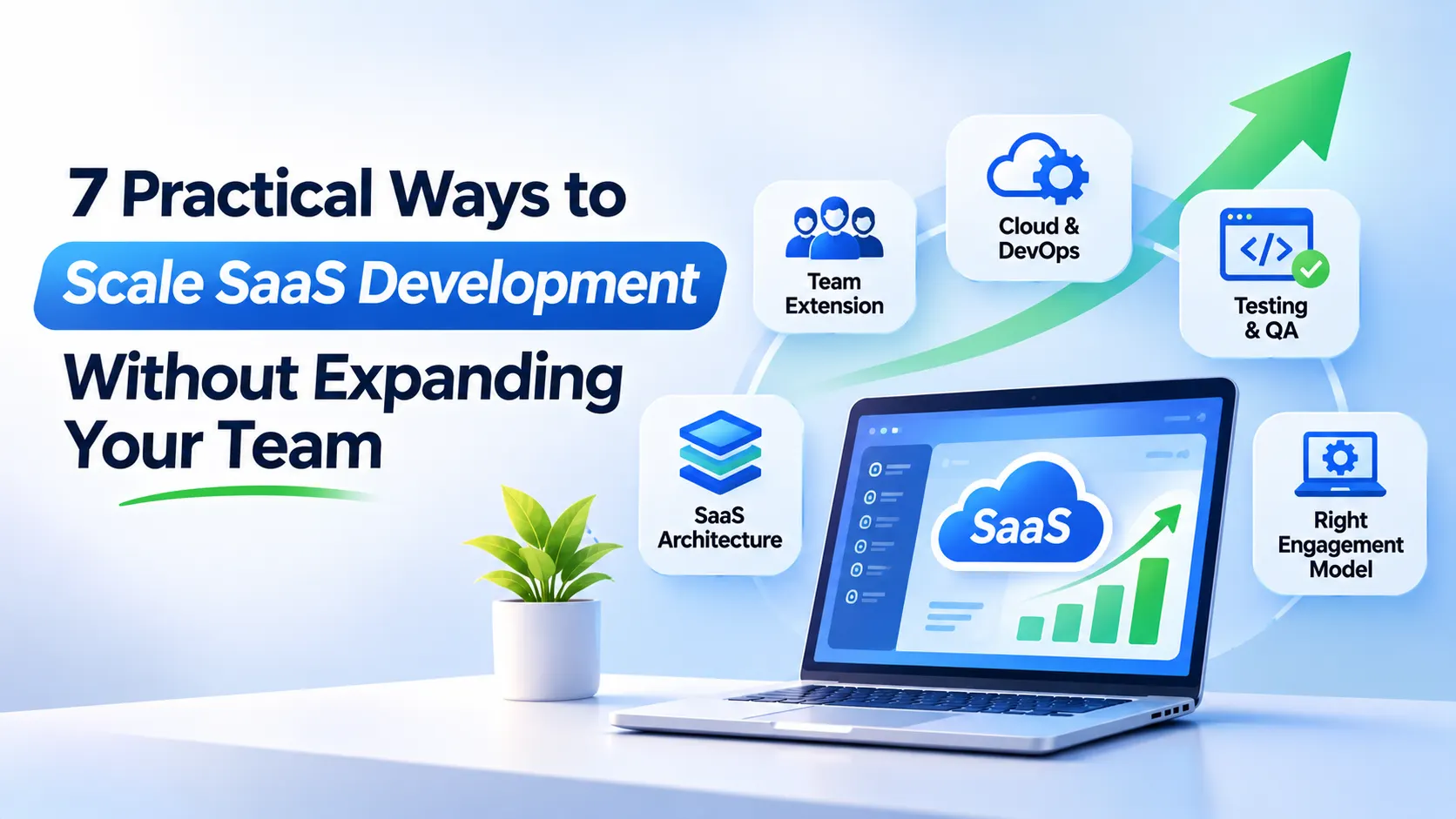
Scaling successfully requires more than outsourcing individual development tasks. Your business needs a structured approach that connects engineering capacity with product strategy.
1. Extend Your Existing Engineering Team With External Specialists
One practical way to increase development capacity is to work with an external team that complements your existing engineers.
For example, your internal product manager can continue managing priorities while external specialists support backend development, frontend engineering, API integration, testing, and cloud infrastructure.
This approach is useful when your business has an established product and understands its roadmap but needs additional capacity to deliver it.
Before starting, define:
- Which responsibilities remain with your internal team.
- Which development activities the external team will manage.
- Who approves architecture and technical decisions.
- How code reviews and quality checks will work.
- How progress, risks, and dependencies will be reported.
A clear division of responsibility prevents duplicated work and keeps product ownership within your business.
Explore MeeTri's Product Engineering & Development Services
Discuss your SaaS roadmap and engineering capacity with our team.
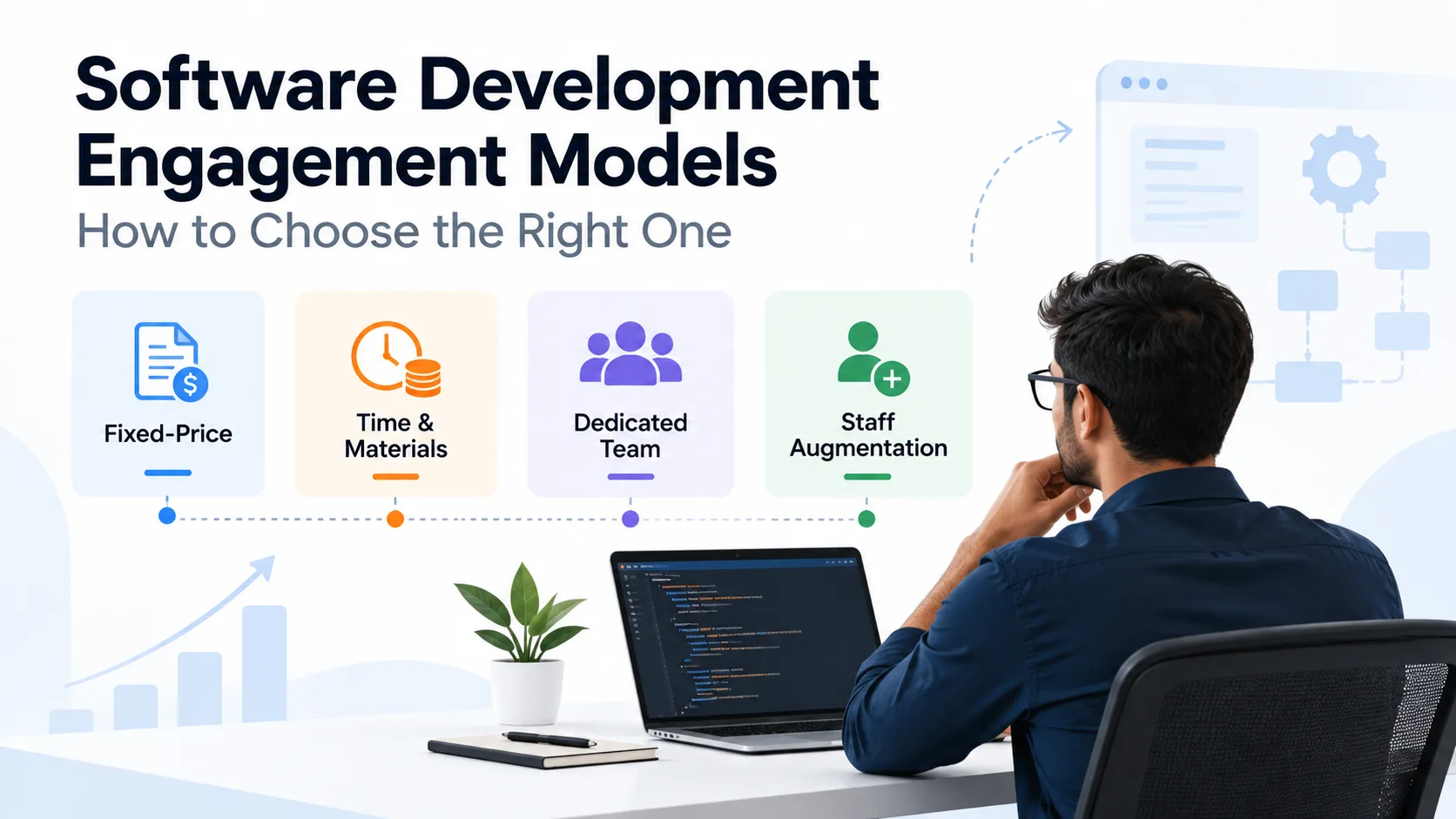
2. Choose the Right SaaS Development Engagement Model
Not every SaaS business needs the same type of external engineering support. Your engagement model should reflect the product's maturity, development roadmap, and level of ongoing work.
| Engagement model | How it works | Best suited for |
|---|---|---|
| Dedicated team | A cross-functional team works on your product over an ongoing period. | Continuous product development and long-term scaling. |
| Project-based development | An external team delivers an agreed scope of work. | Defined features, modules, or product upgrades. |
| Team extension | External specialists work alongside your existing engineers. | Filling specific technical or capacity gaps. |
A dedicated team can provide continuity when your product roadmap involves regular releases, ongoing maintenance, and multiple development priorities. Project-based development may be more appropriate when requirements are clearly defined.
The important point is to avoid selecting a model based only on its initial price. Consider how well it supports collaboration, knowledge retention, technical accountability, and future product changes.
3. Improve Your SaaS Architecture Before Increasing Development Capacity
Adding more developers will not automatically make a poorly structured SaaS platform easier to scale.
If the application has tightly coupled components, limited test coverage, or database bottlenecks, additional development capacity may simply increase the amount of work needed to maintain it.
Review the architecture before introducing major new features. Important areas include:
- Multi-tenant architecture: Determine how the platform separates customer data, permissions, configurations, and workloads.
- API design: Use consistent interfaces to support integrations and communication between application components.
- Database performance: Review query efficiency, indexing, data access patterns, and backup processes.
- Modular development: Structure components so that teams can improve individual features without unnecessarily affecting the entire platform.
- Caching and load management: Identify opportunities to reduce repeated processing and improve response times.
- Scalability testing: Test how the application behaves under expected and peak workloads.
A modular architecture can make development easier to distribute across internal and external teams. However, microservices or other complex architectural patterns should only be introduced when they solve a real operational problem. Complexity without a clear benefit can increase maintenance overhead.
4. Use Cloud Computing and DevOps to Improve Delivery Efficiency
Cloud infrastructure and DevOps practices help SaaS businesses manage changing workloads and release software more consistently.
A well-planned cloud environment can support infrastructure flexibility, application availability, and resource management. DevOps practices help connect development, testing, deployment, and monitoring.
Your engineering team should consider:
- Automated build and deployment pipelines.
- Separate development, testing, staging, and production environments.
- Infrastructure configuration managed through version control.
- Automated backups and recovery procedures.
- Application and infrastructure monitoring.
- Deployment rollback procedures.
- Regular dependency and vulnerability checks.
Cloud spending also needs active management. Scaling infrastructure without monitoring resource consumption can increase operating costs unnecessarily.
Track infrastructure expenditure alongside usage, application performance, and customer growth. This gives your business a clearer view of whether additional cloud resources are creating measurable value.
5. Automate Software Testing and Quality Assurance
As a SaaS product grows, manual testing alone can become a bottleneck. Every new release may affect existing features, integrations, permissions, or customer workflows.
A structured quality assurance process reduces the likelihood of defects reaching production. A useful testing strategy includes:
- Unit testing for individual components.
- Integration testing for connected services and APIs.
- End-to-end testing for important user journeys.
- Regression testing after code changes.
- Load and performance testing.
- Security testing and dependency reviews.
- User acceptance testing before major releases.
Automation should focus on frequently repeated and business-critical tests. Human review remains important for usability, complex workflows, and decisions that require business context.
When internal and external engineers share the same testing standards, release quality becomes easier to maintain as development capacity increases.
6. Prioritise SaaS Security, Data Protection, and Operational Governance
Security should be part of the development process from the beginning, not a final check before launch.
SaaS platforms may process customer information, employee records, payment-related data, and other sensitive business information. A security weakness can affect customer trust and business continuity.
For businesses operating in the UAE, it is important to assess which data protection and cybersecurity requirements apply to their specific activities, customers, data, and operating structure.
Relevant official resources include:
- UAE Federal Decree-Law No. 45 of 2021 on the Protection of Personal Data. Review the applicable scope and requirements rather than assuming that one law applies identically to every organisation.
- UAE Information Assurance Regulation, which includes information security controls for cloud environments.
- UAE National Data Exchange Security Policy, covering areas such as access control, cryptography, risk management, and security monitoring.
Your SaaS engineering programme should address:
- Role-based access controls and least-privilege permissions.
- Encryption for data in transit and at rest.
- Secure API authentication and authorisation.
- Logging, monitoring, and incident response.
- Backup, recovery, and business continuity.
- Secure development and code review practices.
- Clear contractual responsibilities for data access and processing.
The correct controls depend on the product and its regulatory obligations. Obtain appropriate legal and security advice where necessary. An engineering provider can support implementation, but the business remains responsible for understanding its compliance obligations.
7. Establish Clear Product Governance and Performance Metrics
An external team can increase delivery capacity, but your business still needs visibility into product decisions and engineering performance.
Set up a governance process that includes regular roadmap reviews, sprint planning, demonstrations, technical reviews, and risk reporting.
Measure outcomes rather than relying only on the number of tasks completed. Useful indicators include:
| Metric | What it helps you understand |
|---|---|
| Deployment frequency | How often the team releases changes. |
| Lead time for changes | How long approved work takes to reach production. |
| Change failure rate | How often releases cause problems requiring intervention. |
| Mean time to restore | How quickly the team recovers from production incidents. |
| Defect rate | The quality and stability of delivered changes. |
| Application response time | How quickly users receive application responses. |
| Infrastructure cost per customer or workload | Whether platform costs are scaling efficiently. |
Use these metrics together. For example, increasing deployment frequency is not necessarily an improvement if production failures also rise.
The goal is a more predictable engineering process that supports customer satisfaction and sustainable product growth.
How to Choose a SaaS Product Engineering Partner in Dubai
The right partner should contribute more than additional development resources. They should understand your product objectives, work within your engineering processes, and help you make sound technical decisions.
When evaluating a potential Product Engineering Partner for B2B Enterprises, consider the following areas:
- SaaS product experience: Can the team demonstrate relevant experience with application development, platform improvements, integrations, and ongoing product support?
- Architecture capabilities: Can they assess your existing platform and explain how they would address scalability, maintainability, and performance?
- Cross-functional expertise: Can they provide the required development, QA, cloud, and DevOps capabilities?
- Delivery transparency: Do they offer clear milestones, progress reporting, technical documentation, and regular demonstrations?
- Security practices: Can they explain how they manage access, code security, testing, and sensitive information?
- Knowledge continuity: Will your internal team retain access to source code, documentation, architecture decisions, and development history?
- Long-term support: Can they support the product after launch, including maintenance, optimisation, and future releases?
Ask potential partners to explain how they would approach a real challenge in your product. Their questions, assumptions, and proposed trade-offs can reveal more than a general capability presentation.
Discuss Your SaaS Product Engineering Requirements
Share your product goals and engineering requirements with our team.
What Does It Cost to Scale SaaS Product Development Without Hiring?
There is no reliable single price for scaling a SaaS engineering programme. The overall Software Development Cost depends on the amount and complexity of work, team composition, engagement model, infrastructure requirements, and level of ongoing support.
Typical cost factors include:
- Number and experience of developers and specialists.
- Product architecture and existing technical debt.
- New features and integration requirements.
- Testing, security, and compliance needs.
- Cloud infrastructure and third-party services.
- Project management and technical leadership.
- Maintenance and post-release support.
A dedicated team may involve a recurring engagement cost, while project-based work is generally scoped around defined deliverables. Team extension can be suitable when you only need particular skills or additional capacity.
Compare the total cost of delivery, not just developer rates. Include recruitment, onboarding, management, infrastructure, rework, and long-term maintenance when assessing whether an external model offers better value.
MeeTri supports businesses with Custom Software Development Services and product engineering cacpabilities designed around their technical and business requirements.
How MeeTri Supports SaaS Product Development and Scaling
MeeTri Infotech provides product engineering and software development capabilities covering the product lifecycle, from discovery and design through development, testing, deployment, and maintenance.
Its approach includes understanding business requirements, assessing technical feasibility, planning user experiences, and developing software through iterative engineering practices.
For SaaS businesses, relevant areas of support include:
- Product discovery and technical planning.
- Web and application development.
- Modular architecture and API integration.
- Cloud-ready software development.
- Agile engineering and quality assurance.
- Automated deployment and ongoing maintenance.
- Product improvements based on performance and user feedback.
The engagement should be shaped around your existing team, product maturity, and roadmap. The aim is to strengthen your engineering capabilities while keeping business priorities and product ownership clear.
Explore Software Product Engineering Services
Discuss the product engineering support that fits your roadmap.
Conclusion: Scale Your SaaS Product Without Increasing Permanent Team Overheads
Scaling SaaS product development requires a balance between engineering capacity, platform performance, security, and business priorities. Hiring more developers is one option, but it is not the only way to deliver a larger product roadmap.
An external engineering team can help your business access specialist expertise, improve release processes, address technical challenges, and maintain development momentum without continuously increasing permanent headcount.
The key is to choose an engagement model that fits your product, establish clear responsibilities, and measure engineering outcomes over time.
If your business is planning its next stage of SaaS growth, Get in Touch with us to discuss how MeeTri can support your product engineering requirements.
Frequently Asked Questions
A SaaS company can scale product development by extending its existing engineering capabilities through a dedicated external team, project-based development, or specialist team extension. This provides additional capacity for development, testing, cloud infrastructure, and maintenance while internal teams retain control of product strategy and priorities.
The best model depends on the product roadmap. A dedicated engineering team is suitable for continuous development and long-term support. Project-based development works well for clearly defined deliverables, while team extension helps fill specific technical or capacity gaps within an existing team.
Scaling a SaaS application involves reviewing application architecture, database performance, API design, cloud infrastructure, caching, and workload management. Businesses should also conduct load testing and monitor application performance to identify bottlenecks before they affect customers.
Businesses should evaluate the provider's SaaS experience, architecture capabilities, development processes, security practices, communication, documentation, and long-term support. They should also define product ownership, intellectual property arrangements, access permissions, and delivery responsibilities before development begins.
A dedicated team is generally more suitable for ongoing product development that requires continuity across multiple functions. Staff augmentation is useful when an existing team needs specific skills or additional capacity. The right choice depends on how much ownership, coordination, and long-term support the product requires.
The cost depends on team size, specialist skills, product complexity, engagement model, infrastructure, testing, and maintenance requirements. Businesses should compare the total cost of delivery, including recruitment, onboarding, management, cloud resources, and rework, rather than comparing hourly rates alone.
They should use role-based access, least-privilege permissions, secure development practices, code reviews, encryption, controlled environments, and documented incident procedures. Contracts should also define confidentiality, intellectual property, data access, and processing responsibilities.
A SaaS business should consider external product engineering support when its internal team cannot meet roadmap commitments, needs specialist technical expertise, faces growing maintenance demands, or requires additional capacity for new features and integrations. External support is most effective when business objectives and responsibilities are clearly defined.