Get a Free Development Strategy Consultation
Tell us about your project — we'll respond within 24 hours with tailored recommendations.
Custom Software Cost USA: The Real Numbers for 2026
There's no single price tag for custom software, but startups can plan around realistic ranges based on project type.
2026 cost ranges by project type:
- Simple MVP or single-feature app: $40,000 to $80,000
- Mid-complexity product with 2 to 3 integrations: $80,000 to $150,000
- Full-featured platform with multiple integrations and advanced logic: $150,000 to $250,000+
- Enterprise-grade systems with compliance requirements: $250,000 and up.
These numbers assume a US-based development cycle of 3 to 9 months, with the price scaling alongside scope, the number of user roles, and the complexity of your data model.
If you're early in scoping your project, getting an estimate from a software development company US founders trust for transparent quoting can save you from underbudgeting before you've even started.
What Factors Affect Custom Software Development Costs?
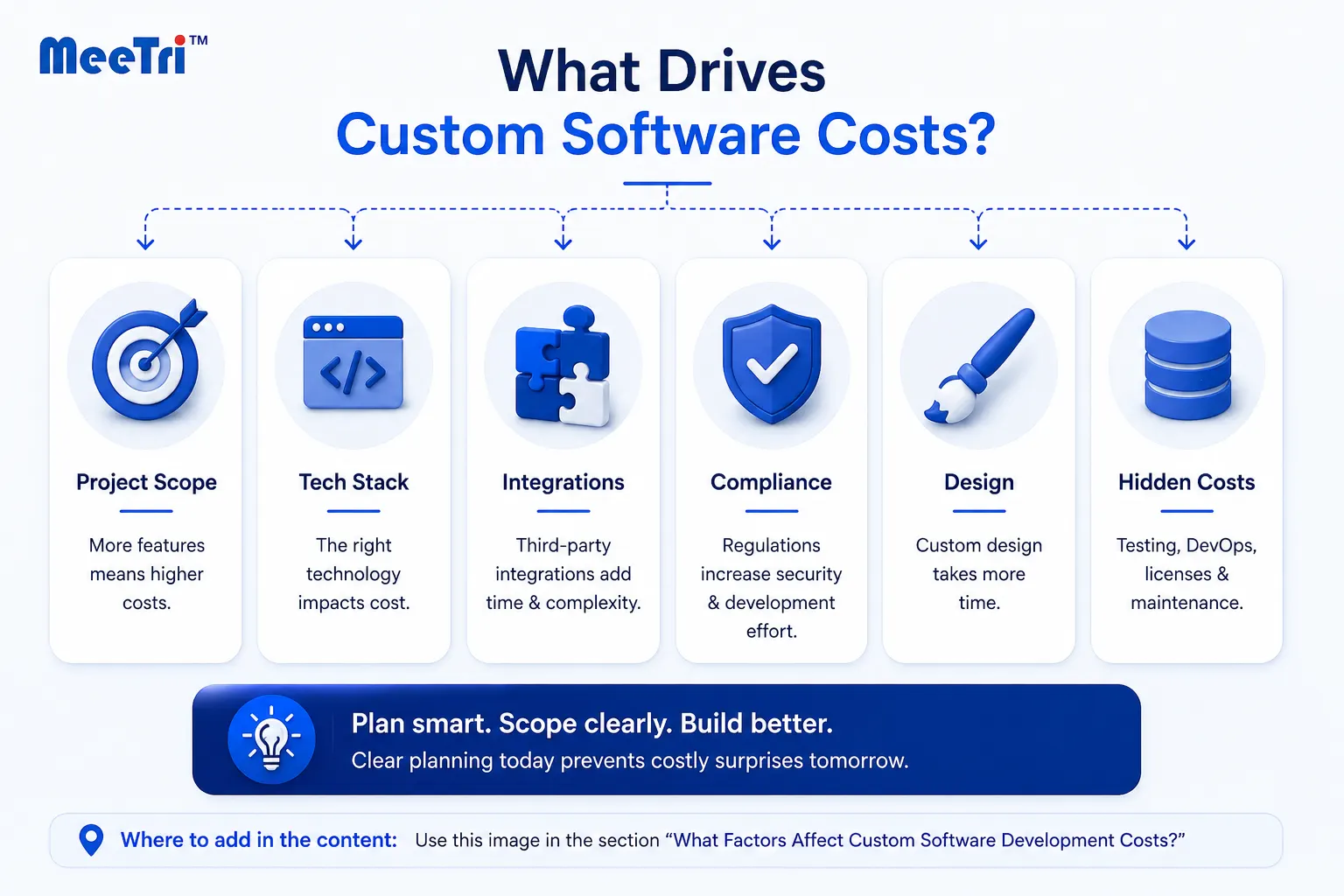
The cost isn't random. A handful of variables drive almost all of the variation you'll see between quotes.
The main cost drivers include:
- Project scope. The number of features, screens, and user flows is the single biggest cost factor. A clearly defined scope keeps costs predictable. A vague one almost always leads to overruns.
- Tech stack choice. Some frameworks and languages cost more to build and maintain than others, particularly if your team needs specialized skills.
- Integration requirements. Connecting to payment processors, CRMs, or third-party APIs adds development time, and each integration has its own learning curve and testing overhead.
- Compliance needs. If you're handling health, financial, or personal data, building to HIPAA, SOC 2, or similar standards adds cost upfront but avoids expensive rework later.
- Design complexity. Custom UI and UX work takes longer than using existing component libraries, especially for products with multiple user types.
- Hidden costs. Things like QA testing, DevOps setup, third-party licensing, and post-launch bug fixes are often left out of initial quotes. Ask for these explicitly before you sign anything.
Founders who scope their project clearly before approaching a vendor typically get quotes that are 20 to 30% more accurate than those who go in with only a rough idea.
Learn More:- Custom Software Development for US Enterprises: The 2026 Complete Guide
How Much Does It Cost to Build an MVP for a Startup?
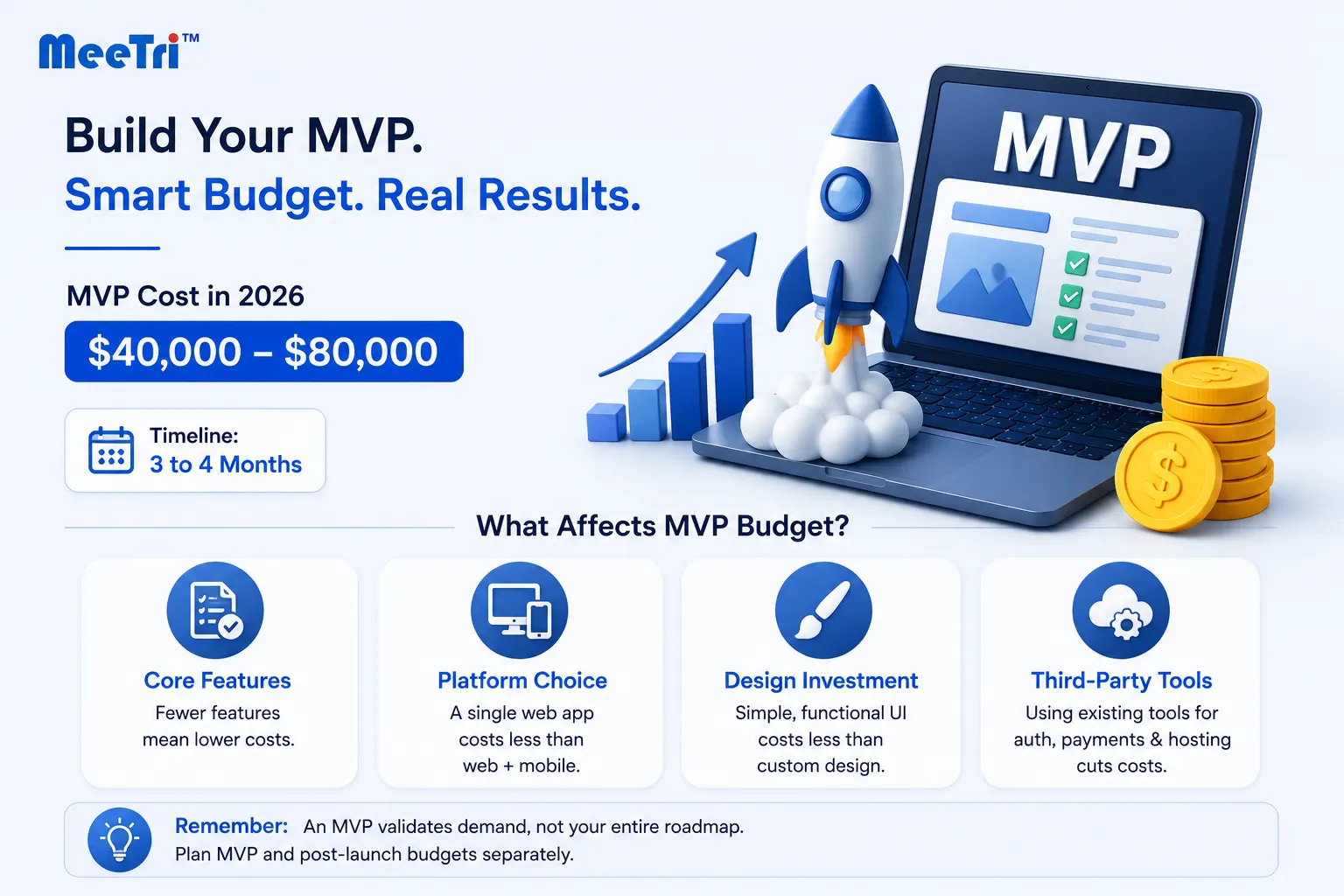
An MVP, or minimum viable product, typically costs $40,000 to $80,000 for US startups in 2026, assuming a focused feature set and a 3 to 4 month build timeline.
What affects MVP budget specifically:
- Core feature count. The fewer features, the lower the cost. A true MVP tests one core hypothesis, not your entire product vision.
- Platform choice. A single web app is cheaper than building simultaneously for web and mobile.
- Design investment. A functional, simple UI costs less than a fully branded, polished design system, and for an MVP, that's usually the right trade-off.
- Third-party tools. Using existing authentication, payment, or hosting services instead of building them from scratch can cut MVP costs significantly.
The mistake many startups make is treating the MVP budget as the final product budget. An MVP is meant to validate demand cheaply, not deliver every feature on your roadmap. Budgeting separately for MVP and post-launch iteration keeps early-stage spending under control.
Software Development Pricing Models Explained
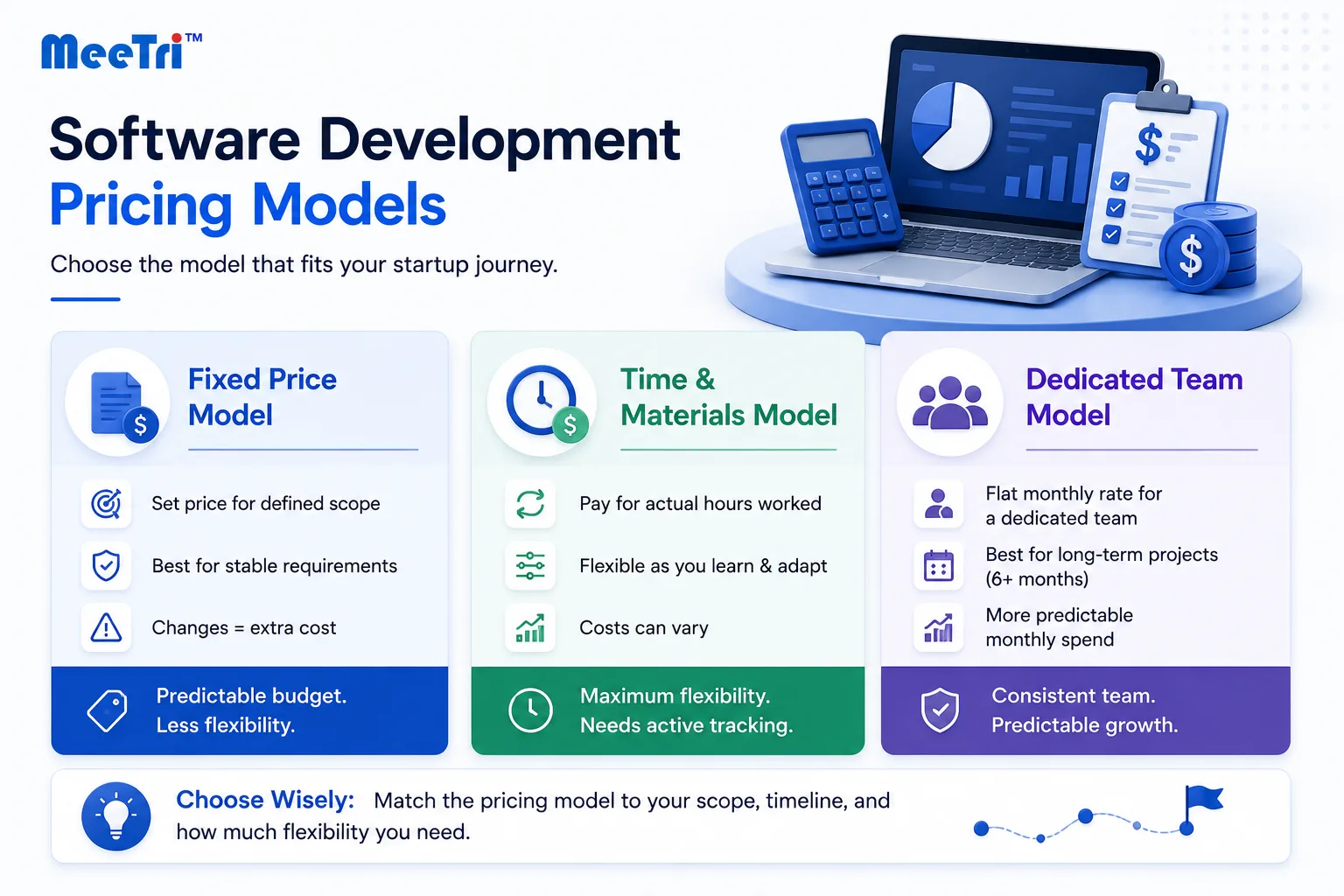
How you're billed affects both your budget predictability and your flexibility to adjust scope mid-project.
Fixed price model: You agree on a set price for a defined scope. Works well when requirements are stable and well-documented. Risk: any scope change usually triggers a change order and additional cost.
Time and materials model: You pay for actual hours worked. Offers flexibility to adjust scope as you learn, which suits early-stage startups still validating their product. Risk: costs can run higher than expected without active budget tracking.
Dedicated team model: You pay a flat monthly rate for a committed team working exclusively on your project. Best for startups planning continuous development over 6+ months. A dedicated software development team model also gives you more predictable monthly cash flow than hourly billing.
There's no universally "best" model. The right choice depends on how settled your requirements are and how much flexibility you need as you go.
What Is the Average Software Developer Hourly Rate in the US?
US-based software developer rates in 2026 typically range from $75 to $200 per hour, depending on seniority, specialization, and location within the country.
Typical hourly rate ranges:
- Junior developers: $75 to $100 per hour
- Mid-level developers: $100 to $150 per hour
- Senior developers and specialists: $150 to $200+ per hour
- Offshore or nearshore teams: $30 to $80 per hour, with quality varying significantly by vendor
Rates alone don't tell the full story. A senior developer at $180 per hour who writes clean, well-tested code and avoids costly rework is often cheaper overall than a junior developer at $80 per hour who needs more oversight and produces more bugs.
Should Startups Outsource Software Development or Hire In-House Developers?
The right answer depends on your timeline, budget, and how long you'll need the team.
Outsourcing makes sense when:
- You need to launch quickly without a lengthy hiring process.
- Your project has a defined endpoint rather than ongoing development needs.
- You want access to a broader range of specialized skills without full-time salaries.
- You're working with limited runway and need cost predictability.
In-house hiring makes sense when:
- Software is core to your long-term product, not a one-time build.
- You need tight, daily collaboration between product and engineering.
- You have the runway to support recruiting, salaries, and benefits.
- You're planning continuous iteration over multiple years.
Many startups use a hybrid approach, building the initial product with custom software development services based in the US, then transitioning select roles in-house as the company scales and the product stabilizes.
How Can Startups Reduce Software Development Costs?
Cutting costs without cutting quality comes down to a handful of disciplined decisions.
Practical ways to control cost:
- Scope tightly before you start. Every undefined requirement becomes a costly mid-project decision. Write a clear specification before requesting quotes.
- Use existing tools where it makes sense. Don't custom-build authentication, payments, or hosting if reliable existing services solve the problem.
- Phase your roadmap. Build the core product first, then add features based on real user feedback rather than upfront assumptions.
- Choose the right pricing model. Time and materials suit early uncertainty. Fixed price suits locked-down requirements.
- Compare custom software vs. SaaS for non-core processes. If a function isn't part of your competitive advantage, a SaaS tool is often cheaper than building it yourself.
- Avoid frequent scope changes. Each change order adds cost and timeline risk. Validate decisions internally before passing them to your development team.
Read More:- Custom Software vs SaaS: Which Saves US Businesses More Money?
The startups that control costs best aren't the ones who pay the lowest hourly rate. They're the ones who scope clearly and avoid expensive mid-project pivots.
What Is the ROI of Custom Software for Startups?
ROI on custom software comes from multiple places, not just the product itself.
Direct ROI drivers:
- Faster time-to-market compared to building features manually with internal staff.
- Reduced reliance on multiple disconnected SaaS subscriptions.
- A product asset you own outright, with no recurring licensing costs.
Indirect ROI drivers:
- Investor confidence from having a functioning, demonstrable product.
- Faster user feedback cycles that improve product-market fit decisions.
- A scalable foundation that doesn't require a costly rebuild as you grow.
If you're trying to validate whether a custom build is the right call before committing a budget, a conversation with a software consulting USA team that isn't selling you a fixed package is a useful gut check. It costs you nothing and often reframes the decision entirely.
For most startups, the real ROI question isn't "how much does this cost" but "what does it cost us not to have this in six months."
Conclusion
Custom software costs for US startups in 2026 typically range from $40,000 for a focused MVP to $250,000 or more for a fully featured platform, with the biggest cost drivers being scope clarity, integration complexity, and compliance requirements.
The startups that budget well aren't necessarily the ones who negotiate the lowest rate. They're the ones who scope tightly, choose the right pricing model, and separate MVP spend from long-term product spend.
If you're at the stage of putting numbers behind your product plan, getting a real, scoped estimate before you commit a budget will save you from the most common and most expensive startup mistake: underestimating cost based on a vague idea rather than a defined plan.
Frequently Asked Questions
Custom software typically costs $40,000 to $80,000 for a simple MVP and $150,000 to $250,000 or more for a fully featured platform. The exact figure depends on scope, integrations, and compliance requirements.
The biggest cost drivers are project scope, tech stack choice, number of integrations, compliance requirements, and design complexity. Hidden costs like QA testing and post-launch support can add 15 to 25% beyond the initial development quote.
An MVP typically costs $40,000 to $80,000 and takes 3 to 4 months to build. Cost depends on core feature count, whether the MVP targets web only or web and mobile, and how much custom design work is required.
A simple MVP typically takes 3 to 4 months. Mid-complexity products take 4 to 7 months, and full-featured platforms with multiple integrations typically take 7 to 12 months from initial scoping to launch.
Outsourcing suits startups needing fast launches with defined project scope and limited runway. In-house hiring suits startups where software is a core, ongoing product requiring daily collaboration. Many startups outsource the initial build, then hire in-house as they scale.
US developer rates in 2026 range from $75 to $100 per hour for junior developers, $100 to $150 for mid-level, and $150 to $200 or more for senior specialists. Offshore teams typically range from $30 to $80 per hour.
Startups reduce costs by scoping requirements tightly before requesting quotes, using existing tools instead of custom-building standard functions, phasing the roadmap into smaller releases, and avoiding frequent mid-project scope changes, which can add 20% or more to total cost.

Related Articles
Custom Software Development for US Enterprises 2026
Planning a larger build? Use this guide to think through enterprise scope, ROI, and partner selection before you invest.
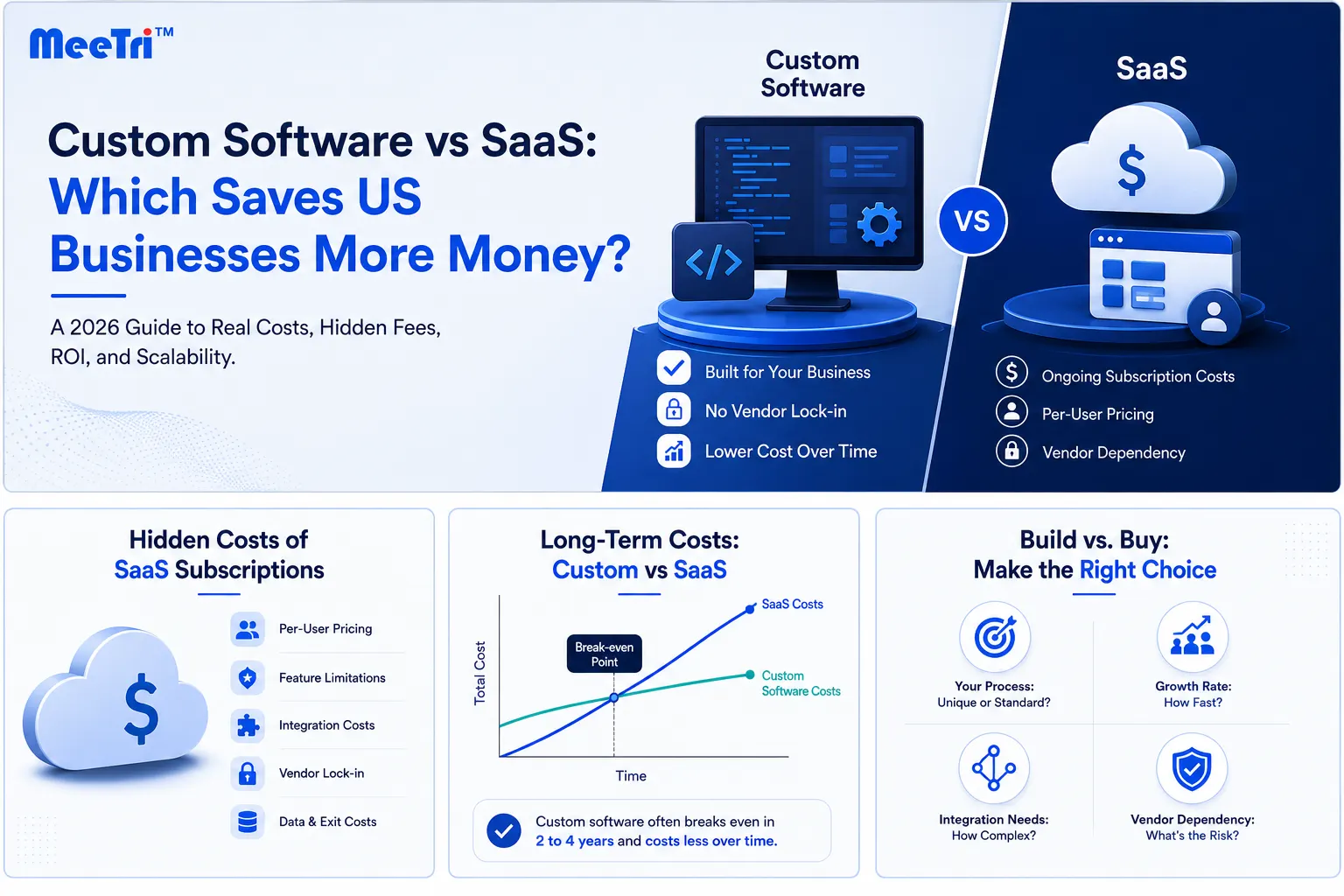
Custom Software vs SaaS: Which Saves US Money?
Compare long-term spend, hidden SaaS fees, and where custom software starts to outperform subscriptions.
How to Choose the Right Software Development Partner in 2026
See the questions and criteria that help teams choose a partner with the right process, architecture, and delivery maturity.