Get a Free Development Strategy Consultation
Tell us about your project — we'll respond within 24 hours with tailored recommendations.
A Complete Guide to Hospital Management Software Development in the US
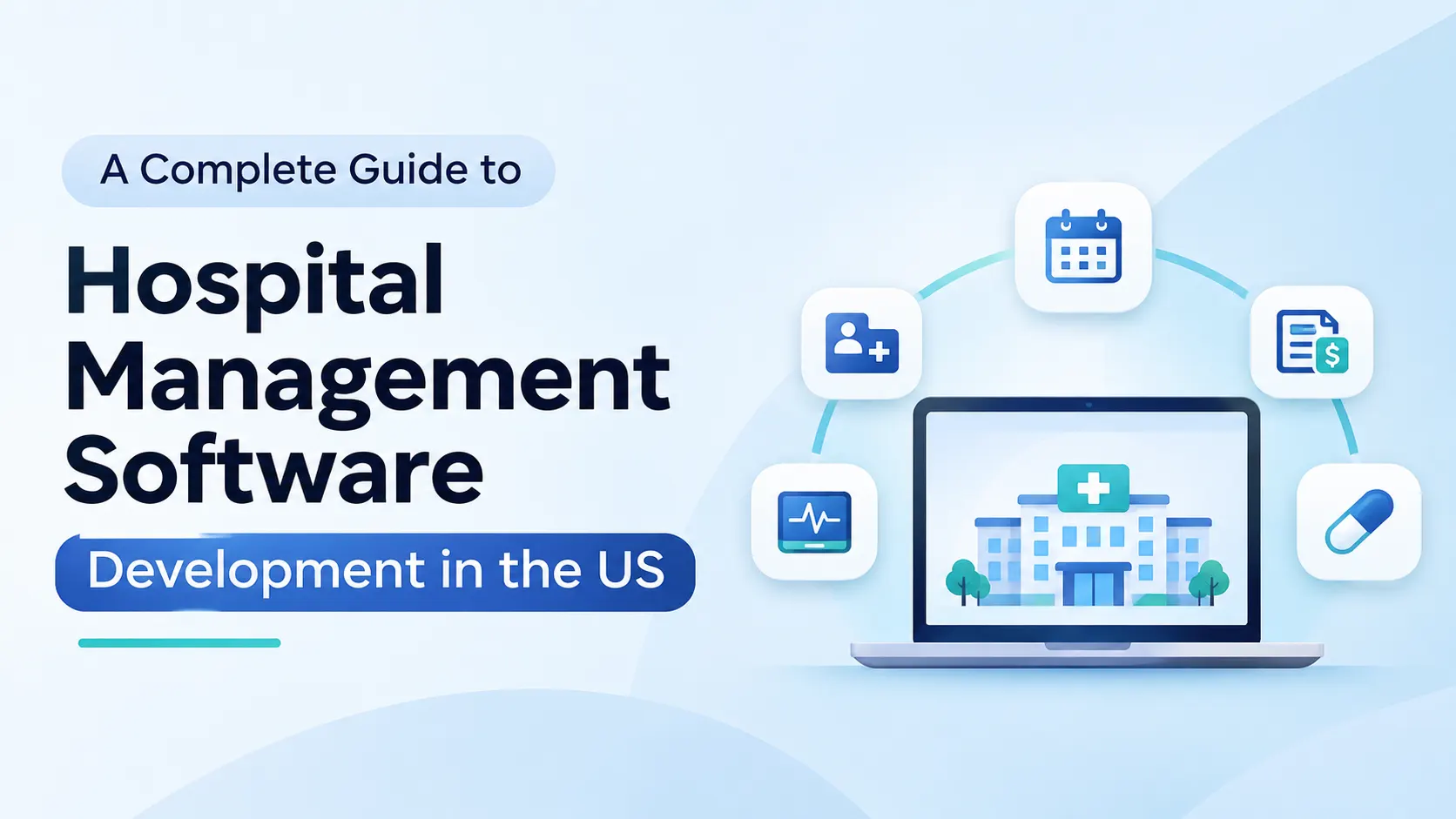
Hospitals across the United States manage complex clinical, administrative and financial operations. From patient registration and appointment scheduling to electronic health records, billing, pharmacy management and reporting, these activities require accurate information and coordinated workflows. When different departments rely on disconnected systems, information silos, manual processes and data inconsistencies can affect operational efficiency and the quality of patient care.
This is why healthcare organisations are investing in modern hospital management software solutions that connect essential operations through a unified digital platform. Working with an experienced Software Development Company can help hospitals plan and build software around their operational requirements, integration needs and long-term technology goals. A well-designed platform can also support Digital Transformation in Healthcare by connecting clinical, administrative and financial workflows instead of simply digitising individual processes.
Quick Answer: What Is Hospital Management Software Development?
Hospital management software development is the process of designing, building, integrating and maintaining digital systems that help hospitals manage patient information, clinical workflows, appointments, billing, inventory and administrative operations. A hospital management system (HMS) can combine these functions into one platform or connect existing applications through secure integrations.
A typical development process includes requirements analysis, workflow mapping, solution architecture, interface design, development, system integration, testing, deployment and ongoing maintenance. The right approach depends on the hospital's size, existing technology infrastructure, regulatory responsibilities and operational priorities.
What Is Hospital Management Software Development?
Hospital management software development involves creating a digital platform that supports the day-to-day operations of a healthcare organisation. It may include modules for patient registration, appointment management, electronic health records, billing, laboratory operations, pharmacy management, inventory and reporting.
A Hospital Information Management System can centralise information and help authorised users access relevant data across departments. Depending on the hospital's requirements, the system may be developed as a unified application or as a collection of connected modules.
The objective is not simply to replace paper-based processes. Effective Hospital Management should improve how information moves between departments, reduce repetitive administrative work and give staff access to accurate information when they need it.
Why Do US Healthcare Organisations Need Modern Hospital Management Software?
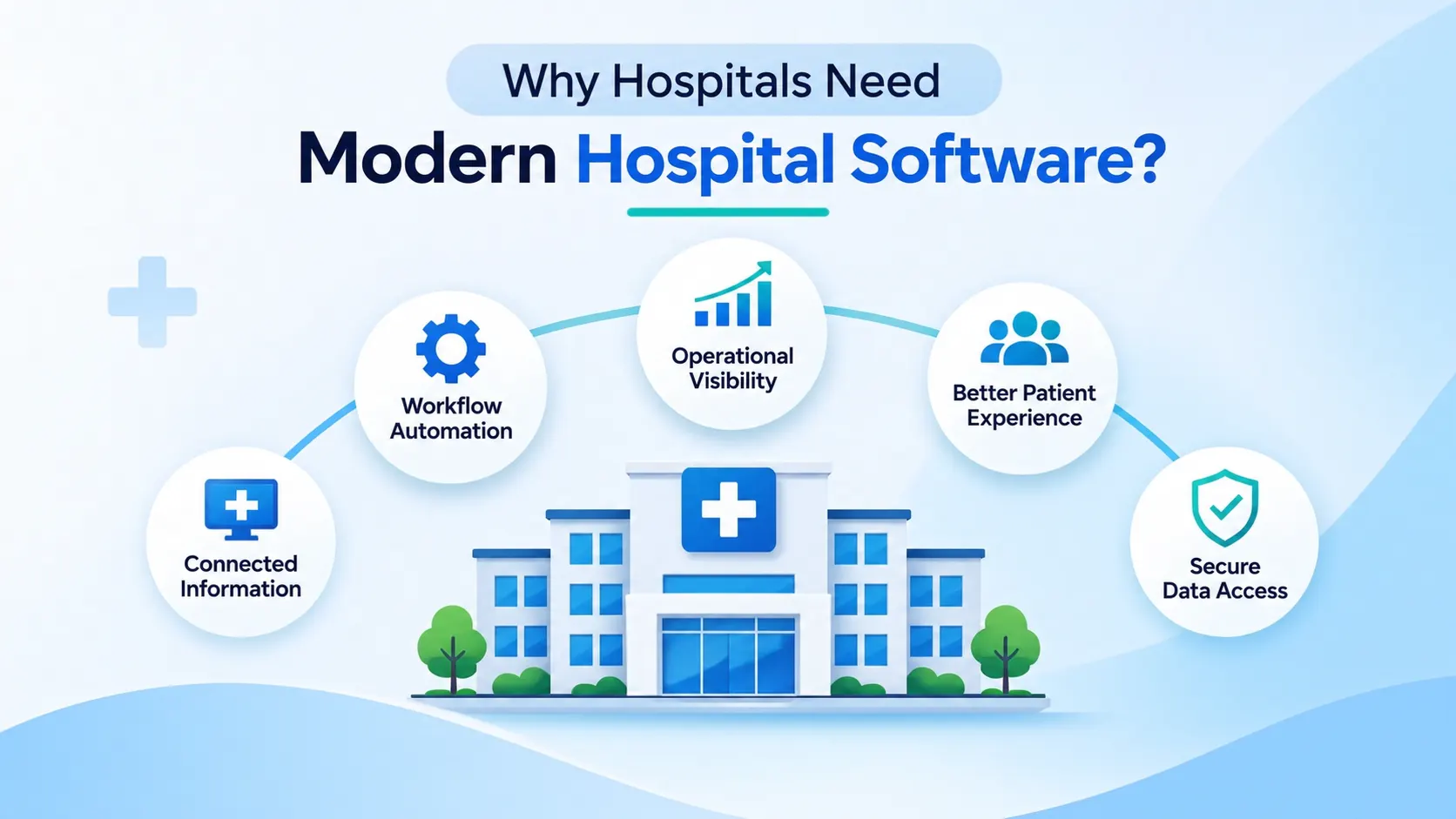
Healthcare organisations operate in an environment where operational efficiency, data protection, interoperability and patient experience are important considerations. Legacy applications and disconnected systems can make it difficult to coordinate activities across departments.
Modern Hospital Management Software Solutions can address several operational challenges:
- Disconnected information: Centralised records and integrations can reduce the need to retrieve the same information from multiple systems.
- Administrative workload: Workflow automation can reduce repetitive tasks such as appointment scheduling, registration and billing.
- Limited operational visibility: Dashboards and reporting tools can help administrators monitor activities, resource utilisation and operational performance.
- Patient experience: Digital appointment management, patient portals and access to relevant information can make interactions more convenient.
- Data accessibility: Role-based access can help authorised staff retrieve relevant information while supporting appropriate security controls.
Hospitals should evaluate the expected Healthcare Automation ROI through measurable indicators such as administrative processing time, billing accuracy, staff productivity, resource utilisation and the reduction of repetitive manual work. Establishing these measures before development makes it easier to assess the operational value of the investment.
Essential Hospital Management Software Features and Modules
The required Hospital Management Software Features depend on the hospital's size, specialities, existing systems and workflows. However, several modules commonly form the foundation of an HMS.
1. Patient Registration and Management
This module manages patient registration, demographic details, contact information, admission records and visit history. It should help authorised staff retrieve patient information without repeatedly entering the same details.
A well-designed registration workflow can also support patient identification and reduce administrative duplication.
2. Appointment and Scheduling Management
Appointment management allows staff to schedule, reschedule and cancel consultations. It can also support doctor availability, department schedules, reminders and appointment status tracking.
Integration with calendars and patient-facing applications can make scheduling more accessible while helping hospitals manage appointment capacity.
3. Electronic Health Records and Medical Records
Electronic health records help authorised healthcare professionals access relevant patient information, such as medical history, diagnoses, medication records, clinical notes and test results.
Hospitals should define how the HMS will interact with existing EHR or EMR applications before development begins. In some cases, extending an existing system through Custom EHR Software Development may be more appropriate than rebuilding the entire record-management infrastructure.
4. Billing and Financial Management
Billing functionality can support invoice generation, payment tracking, service charges, insurance information and financial reporting. The system should reflect the hospital's billing workflows and integrate with relevant financial or revenue-cycle applications where required.
Automating parts of the billing process can reduce repetitive data entry, but the workflows still need validation to minimise errors and support accurate financial records.
5. Pharmacy and Inventory Management
Pharmacy and inventory modules help hospitals manage medicines, medical supplies, stock levels, purchase records and expiry dates.
Useful capabilities include stock alerts, inventory tracking, supplier records and usage reports. Integration with relevant clinical and billing workflows can also help maintain consistency across departments.
6. Laboratory and Diagnostic Management
Laboratory management functionality can support test requests, sample tracking, result entry and report availability. The system should connect with laboratory information systems and diagnostic equipment where required.
Integration requirements should be established early because different devices and applications may use different data formats and communication standards.
7. Reporting and Analytics
Reporting tools help administrators monitor operational indicators such as appointment volumes, patient admissions, billing activity, inventory levels and resource utilisation.
Dashboards should present information relevant to each user role. Hospital leaders may need high-level operational reports, while department managers may require more specific workflow information.
How to Develop Hospital Management Software: A Step-by-Step Process
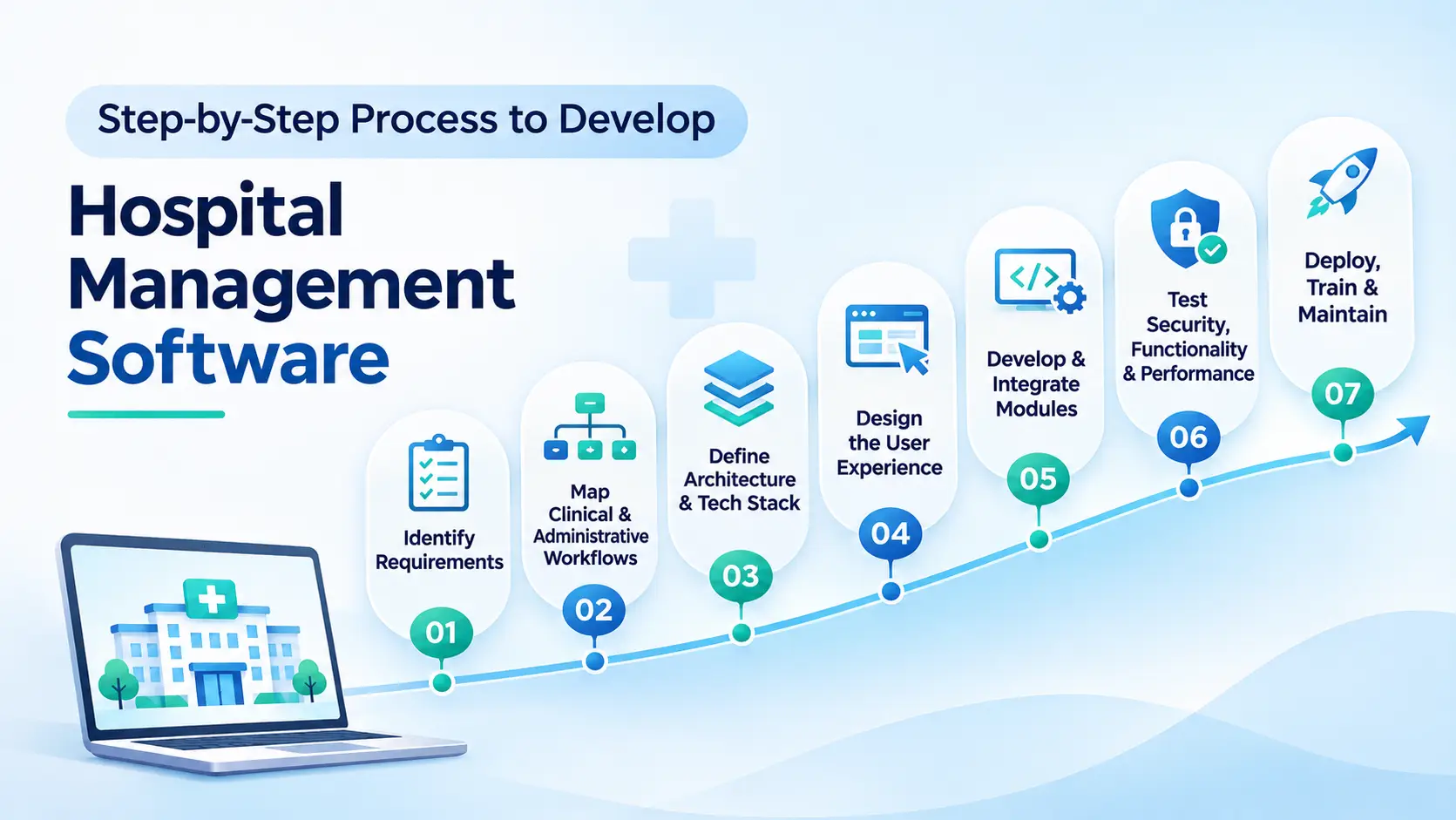
A successful Hospital Software Development Process starts with operational requirements rather than selecting technologies or building screens immediately. The following stages provide a practical approach.
Step 1: Identify Hospital Requirements
Start by understanding the hospital's existing workflows, operational challenges and technology environment. Consult administrators, doctors, nurses, finance teams, IT personnel and other relevant stakeholders.
Document the required modules, user roles, data flows, reporting needs, integration requirements and business objectives. Prioritise essential functionality for the initial release instead of attempting to build every possible feature at once.
Step 2: Map Clinical and Administrative Workflows
Map how information moves between departments, including patient registration, consultation, diagnosis, laboratory testing, pharmacy, billing and discharge.
This stage helps identify duplicated processes, manual handovers and integration dependencies. It also ensures that the software reflects how the hospital actually operates.
Step 3: Define the Architecture and Technology Stack
Choose an architecture based on expected users, system complexity, integration requirements, security needs and scalability.
A modular architecture can make it easier to maintain individual components and introduce additional functionality over time. Cloud-based, on-premises and hybrid deployment models should be evaluated against the organisation's infrastructure, security policies and operational requirements.
Technology selection should follow the architecture and requirements, not the other way around.
Step 4: Design the User Experience
Hospital software is used by people with different responsibilities and levels of technical experience. The interface should make common tasks straightforward and minimise unnecessary steps.
Design workflows around user roles, such as doctors, nurses, reception staff, administrators and finance teams. Validate prototypes with representative users before moving into full development.
Step 5: Develop and Integrate the Modules
Develop the prioritised modules and connect them with existing hospital applications. This may include EHR or EMR systems, laboratory information systems, billing applications, pharmacy platforms, imaging systems and third-party services.
Hospital Management System Integration should be planned around data ownership, interface specifications, identity matching, error handling and data synchronisation. Standards such as HL7 and FHIR may support healthcare data exchange, depending on the systems and implementation requirements.
Step 6: Test Security, Functionality and Performance
Testing should cover functional requirements, integration workflows, access permissions, data validation, performance and usability.
Security testing should assess authentication, authorisation, encryption, audit logging, vulnerability exposure and incident-handling processes. Hospitals should also validate how the system behaves when integrations fail or data cannot be synchronised.
Step 7: Deploy, Train and Maintain the System
Deployment should include data migration planning, user training, operational documentation and a clear support process. Where appropriate, hospitals can use a phased rollout to validate workflows before expanding the system across departments.
After launch, monitor performance, resolve defects, maintain integrations and update the platform as operational and regulatory requirements change.
How Does Hospital Management System Integration Work?
Hospital management software rarely operates in isolation. It often needs to exchange information with existing clinical, administrative and financial applications.
Common integration requirements include:
- EHR and EMR systems: Access relevant patient records, clinical notes and encounter information.
- Laboratory information systems: Exchange test orders and results.
- Radiology and imaging systems: Connect imaging workflows and relevant reports.
- Pharmacy applications: Support medication and prescription-related workflows.
- Billing and payment systems: Exchange invoices, payment details and financial information.
- Patient-facing applications: Connect appointment scheduling, patient information and communication workflows.
Healthcare interoperability standards such as HL7 and FHIR can support structured data exchange, but integration is not automatic simply because two applications claim to support the same standard. Compatibility depends on implementation guides, versions, data mappings, security requirements and the capabilities of each system.
Hospitals should define integration ownership, data validation rules, error handling and audit requirements before development begins.
How Do You Address HIPAA and Healthcare Data Security?
Healthcare applications that handle protected health information must be designed with appropriate privacy and security safeguards. Under HIPAA, covered entities and business associates have applicable obligations concerning the protection of electronic protected health information.
The HIPAA Security Rule establishes requirements for administrative, physical and technical safeguards. Software development should support the organisation's compliance responsibilities, but building an application does not by itself make a hospital or software product HIPAA compliant.
Important security considerations include:
- Access control: Restrict access according to user roles and responsibilities.
- Authentication: Use appropriate authentication mechanisms and strengthen access to sensitive functions.
- Encryption: Protect sensitive information during transmission and, where appropriate, at rest.
- Audit controls: Maintain records of relevant system activity and access.
- Data backup and recovery: Establish tested backup, recovery and continuity procedures.
- Risk management: Identify, assess and address security risks throughout the software lifecycle.
- Secure development: Apply code reviews, vulnerability testing, dependency management and security updates.
Hospitals should also review relevant guidance from the US Department of Health and Human Services and the National Institute of Standards and Technology Cybersecurity Framework.
Custom Hospital Management Software vs Off-the-Shelf Solutions
Hospitals can choose between purchasing an existing platform, developing a custom solution or extending their current applications. The right option depends on the organisation's workflows, budget, integration requirements and long-term technology strategy.
| Evaluation Factor | Custom Hospital Management Software | Off-the-Shelf Software |
|---|---|---|
| Workflow alignment | Can be designed around specific hospital processes | Workflows may need to adapt to available features |
| Customisation | Greater control over functionality and user experience | Limited by vendor capabilities and product roadmap |
| Integration | Can be planned around the hospital's existing systems | Depends on supported integrations and vendor APIs |
| Initial investment | Often requires a larger upfront development investment | May have lower initial implementation costs |
| Maintenance | Requires a defined development and support arrangement | Vendor generally manages core product updates |
| Scalability | Can be planned around future operational requirements | Depends on product architecture and licensing |
Custom development may be appropriate when a hospital has specialised workflows, complex integration requirements or a need for greater control over its software roadmap. Off-the-shelf software may be more suitable when existing products already meet most requirements and can integrate effectively with the current infrastructure.
The decision should be based on total cost of ownership, implementation complexity, support arrangements, data portability and long-term operational fit.
Common Challenges in Hospital Management Software Development
Even well-planned projects can encounter challenges. Identifying them early helps hospitals reduce delivery risks.
- Legacy system integration: Older applications may lack modern APIs or consistent data structures. Integration assessments and interface planning can reduce unexpected development work.
- Data migration: Inconsistent or duplicated records can affect the quality of migrated information. Data profiling, cleansing, mapping and validation should happen before migration.
- User adoption: Staff may resist unfamiliar workflows. Involving end users in design, testing and training can improve adoption.
- Security and privacy: Sensitive healthcare information requires ongoing risk assessment, access management and security maintenance.
- Project scope expansion: Adding modules and requirements during development can affect delivery timelines and budgets. A prioritised roadmap and change-control process help maintain scope.
- Interoperability limitations: Different systems may interpret or exchange data differently. Testing real workflows and validating mappings are essential.
What Are the Future Trends in Hospital Management Software?
Hospital management platforms are evolving as healthcare organisations explore new ways to improve operational coordination and access to information.
Some developments worth evaluating include:
- Artificial intelligence: AI may support selected administrative workflows, data analysis and decision support. Clinical use cases require appropriate validation, oversight and risk management.
- Cloud-based infrastructure: Cloud services can offer flexible infrastructure and support distributed access, subject to the organisation's security, contractual and operational requirements.
- Predictive analytics: Historical operational data may help hospitals forecast resource requirements, appointment demand and inventory needs.
- Connected healthcare systems: Greater interoperability can reduce information silos and improve coordination between applications.
- Patient-facing digital services: Portals and digital applications can support appointment management, access to records and communication with care teams.
Hospitals should assess these technologies against practical requirements, measurable benefits, data quality and implementation risks rather than adopting them simply because they are emerging trends.
How Can a Healthcare Software Development Partner Support Your Hospital Platform?
Building hospital management software requires more than application development. It involves understanding healthcare workflows, planning integrations, addressing security requirements and creating a platform that can be maintained over time.
A suitable development partner should be able to support requirements analysis, architecture planning, UI/UX design, application development, integration, testing, deployment and ongoing maintenance. Hospitals evaluating Healthcare Software Development Services should look for relevant technical experience, a clear delivery methodology and an understanding of healthcare data exchange requirements.
If patient engagement is part of the roadmap, selecting a Patient Portal Development Partner with experience in secure patient-facing applications can help connect appointment management, access to records and communication features with the wider hospital platform. The partner should also understand how these capabilities interact with existing EHR systems and identity-management processes.
MeeTri Infotech provides healthcare technology development capabilities for organisations planning and building digital healthcare solutions. Its Custom Software Development Services can support the development of applications around specific business requirements, integrations and operational workflows. Hospitals can discuss their requirements, technical challenges and implementation priorities before defining a development roadmap.
Discuss Your Healthcare Software Project
Talk through your hospital's requirements and development priorities with our team.
Conclusion
Hospital management software development can help healthcare organisations connect clinical, administrative and financial operations through more coordinated digital systems. However, successful implementation depends on clear requirements, practical workflow design, secure architecture, reliable integrations and ongoing maintenance.
Before starting a project, hospitals should identify their most important operational challenges, assess their existing technology infrastructure and prioritise the modules that will deliver measurable value. Working with an experienced development partner can help translate these requirements into a scalable solution that supports the organisation's long-term technology objectives.
To discuss your hospital software requirements and explore a suitable development approach, Get in Touch with us.
Frequently Asked Questions
Hospital management software development is the process of building or customising digital applications that manage hospital operations, including patient registration, appointments, clinical records, billing, inventory and reporting. The system may operate as one platform or integrate with existing hospital applications.
Common features include patient registration, appointment scheduling, EHR or EMR integration, billing, pharmacy management, inventory tracking, laboratory management, reporting and role-based access control. The required features depend on the hospital's operational needs.
The development timeline depends on the number of modules, complexity of workflows, integrations, data migration requirements, security testing and deployment approach. A focused initial release may take less time than a comprehensive hospital-wide platform. A reliable estimate requires a detailed requirements and integration assessment.
Not in every situation. Custom software may be a better fit for hospitals with specialised workflows, complex integrations or specific scalability requirements. Off-the-shelf solutions may be more practical when an existing product meets most requirements and supports the necessary integrations.
Integration can use APIs and healthcare data exchange standards such as HL7 and FHIR, depending on the systems involved. The implementation must account for data mapping, patient identity matching, permissions, synchronisation, error handling and audit requirements.
Applications that create, receive, maintain or transmit electronic protected health information may be subject to applicable HIPAA requirements depending on the organisations and services involved. Hospitals and their business associates must assess their obligations and implement appropriate safeguards. Software alone cannot guarantee HIPAA compliance.
Hospitals should evaluate healthcare technology experience, integration capabilities, security practices, development methodology, testing processes, data migration experience, documentation and post-launch support. They should also assess whether the partner can understand clinical and administrative workflows.