Get a Free Development Strategy Consultation
Tell us about your project — we'll respond within 24 hours with tailored recommendations.
What Does PDPL Compliance Actually Mean for Custom Software?

In practice, PDPL compliance means your software handles personal data the way UAE law requires, at every stage, not just in a privacy policy nobody reads.
That covers:
- How data is collected and what valid consent looks like
- Where data is stored and how it moves across borders
- How long data is kept, and how it gets deleted when it should be
- Who inside your business is accountable for each system that touches personal data
- How the business responds when something goes wrong
If any one of these is missing from your system's design, the software itself is the compliance gap, not your paperwork. A well-written privacy policy sitting next to a system with no deletion workflow doesn't protect you, it just documents the gap.
Who Does UAE PDPL Apply To?
This question trips up more businesses than any other, so it's worth answering plainly.
PDPL applies to any data controller or data processor handling the personal data of individuals in the UAE, regardless of where that business is legally based. A company registered overseas that serves UAE customers or stores their data is still in scope. Business size doesn't exempt you either.
A few scope points worth knowing:
- Both controllers (who decide why and how data is processed) and processors (who act on a controller's behalf) carry obligations
- Mainland UAE businesses and free zones without their own data protection law fall under PDPL by default
- DIFC and ADGM are the main exceptions, they run their own separate frameworks entirely
- Certain data types, government, judicial, security, and some financial and health data, sit outside PDPL and follow other legislation
If you're not sure which regime applies to your business, that's the first question to answer, before writing a single requirement document.
Why PDPL Compliance Matters for Custom Software Development in the UAE
data privacy UAE software isn't a nice-to-have anymore. The UAE Data Office has stepped up enforcement noticeably since 2025, and PDPL applies broadly to any business processing the personal data of people in the UAE, regardless of where that business is based.
For businesses commissioning secure app development UAE projects, that has real consequences:
- Non-compliant systems create ongoing legal and financial exposure
- Retrofitting compliance into live software costs more than designing it in from the start
- Enterprise and government clients often require PDPL alignment as a condition of doing business
For a fuller look at how custom builds work in general, our companion guide on custom software development UAE covers the broader process. This one stays focused on compliance.
What UAE Data Protection Law Actually Requires From Your Software
The UAE data protection law sets out clear roles and obligations, and your software needs to reflect them structurally, not just in a policy document.
If your business collects, stores or processes personal data UAE residents share with you, a few things are worth getting right:
- Know who the Data Controller is for each system, and what they're accountable for
- Build a valid Consent Form into onboarding, informed and freely given, not a pre-ticked box
- Keep your Privacy Policy accurate about how data is actually processed, not how it was processed at launch
- PDPL doesn't require a formal Data Protection Officer for every business, only for high-risk or large-scale sensitive processing, but someone should own this regardless
- Only collect data that's genuinely necessary for the stated purpose, over-collection widens your exposure for no real benefit
Software built around these roles from the start is far easier to audit and far harder to get wrong later.
PDPL vs GDPR: What It Means for Your Software
If your team has already worked with GDPR, either because you serve European customers or your development partner has, some of this will feel familiar. PDPL was shaped with international frameworks like GDPR in mind, but it isn't a copy, and the differences matter for how you build.
The breach notification expectations are broadly similar, both regimes work to a tight window once a business becomes aware of a risk to individuals, so a GDPR-ready breach response process usually translates well. Where they diverge is enforcement. GDPR sets fixed penalty caps directly in the regulation. PDPL leaves specific fine amounts to Cabinet decisions, so the practical cost of non-compliance is still being defined as enforcement matures. DIFC's own data protection law, separately from mainland PDPL, was built even closer to the GDPR model, which matters if any part of your business sits inside that free zone.
Don't assume GDPR compliance automatically satisfies PDPL, but don't rebuild everything from scratch either. A good development partner will map the overlap and only build what's genuinely different.
Data Residency, Cross-Border Transfers and Where Your Data Can Live
This is the question we get asked most, and the honest answer has some nuance to it.
Data Residency under PDPL isn't a blanket rule that all personal data must physically stay in the UAE. The law permits transfers outside the UAE where the destination country offers an adequate level of protection, or where the transfer is covered by appropriate safeguards, such as approved contracts, or falls under an exception like explicit consent. In practice, that means your architecture needs a documented answer for every place data leaves the UAE, not just a general assumption that your cloud provider "handles compliance." Certain categories, including government, judicial and security data, and personal financial and health information, sit outside PDPL entirely and follow separate UAE legislation instead. DIFC and ADGM also run under their own data protection frameworks, so businesses in those free zones follow different rules again.
Getting this wrong at the architecture stage, picking a cloud region without checking the legal basis for it, is one of the most common and costly mistakes we see. It's rarely a deliberate decision, it's usually a default setting nobody questioned during setup.
Get In Touch With Us if you're mid-way through a cloud migration and unsure whether your current setup holds up.
Get In Touch
Building Data Subject Rights Into Your Software From Day One
PDPL gives individuals real rights over their own data: to access it, correct it, request deletion, and object to certain processing. Your software needs to make these actionable, not theoretical.
That means:
- A Custom Software Development Services build should include a self-serve way for users to request their own data, not a support ticket that sits for weeks
- Automated workflows for correction and deletion, with a proper audit trail
- Response timelines tracked by the system itself, not chased manually
Businesses that build this properly rarely think about it again. Businesses that don't end up handling every request by hand, indefinitely.
Security, Breach Response and Reducing Regulatory Risk
Security and PDPL compliance overlap heavily, but they're not the same thing. You can have decent security and still fail on breach response, or the other way round, a fast, well-drilled response plan sitting on top of weak underlying security.
Baseline expectations include:
- Encryption at rest and in transit
- Role-based access controls, so only the right people see the right data
- A 72-hour window to notify the UAE Data Office once a breach that poses a risk to individuals is discovered, with affected data subjects notified too
- A documented, tested Breach Response plan, not one written once and forgotten in a shared drive
- Logging and monitoring that can actually tell you what happened, when, and to whose data
A PDPL Audit is worth running before launch, not after an incident. It's far cheaper to catch a gap in a code review than in a Regulatory Fine notice. Penalties are set out through Cabinet decisions and scale with the severity of the violation, and enforcement activity has clearly picked up since 2025.
Common PDPL Mistakes We See in Custom Software Projects
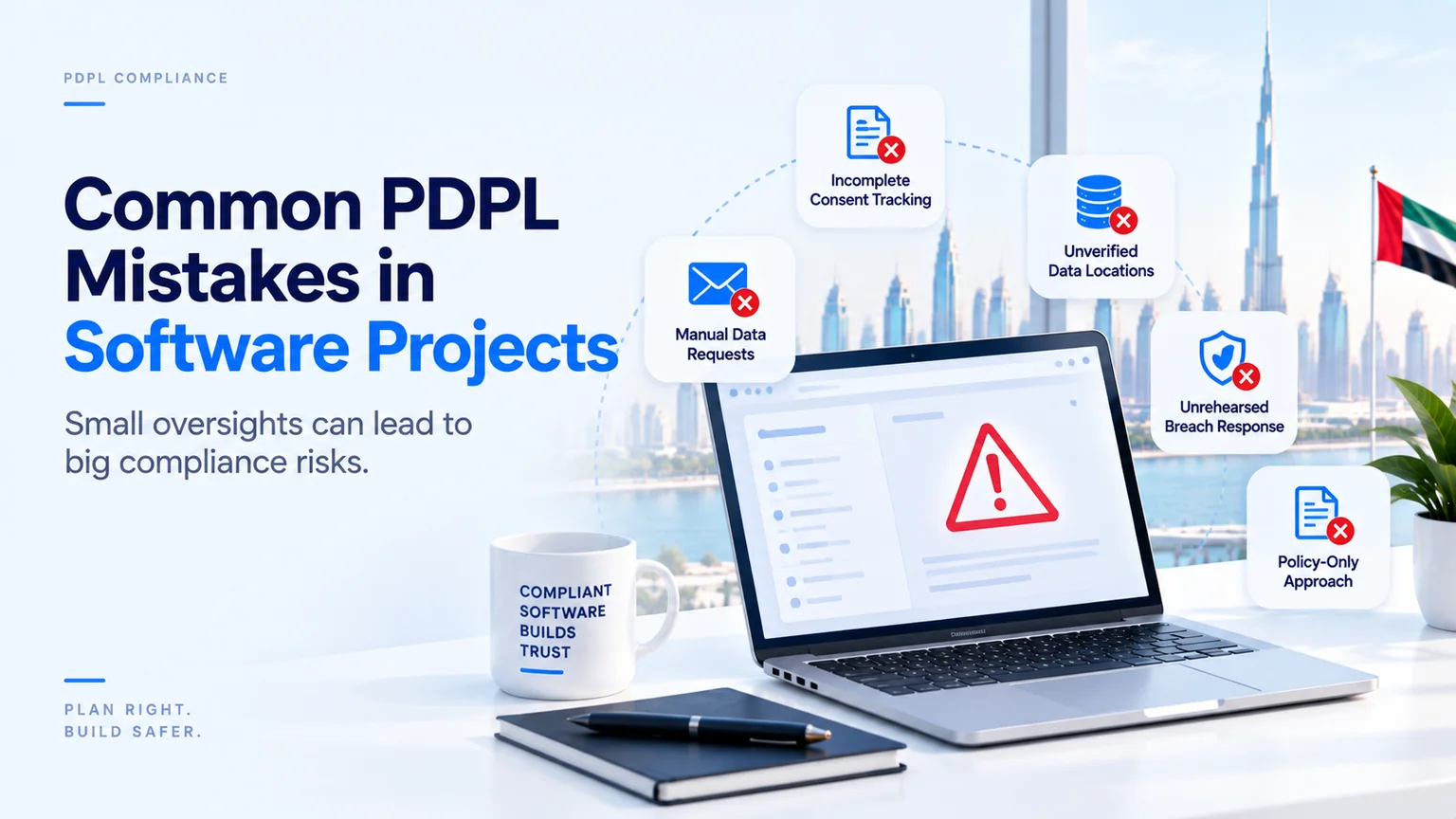
Most compliance failures aren't dramatic. They're small design decisions that quietly compound.
The patterns worth watching for:
- Storing consent as a simple yes or no, with no record of what was actually agreed to, or when it was withdrawn
- Building data subject request handling as a manual email process instead of a tracked workflow
- Choosing infrastructure or vendors before checking where data will actually flow, and under what legal basis
- Treating a breach response plan as a document exercise rather than something the team has rehearsed
- Assuming a privacy policy update covers a system that was never designed with deletion in mind
None of these are hard to avoid. They're just easy to miss when compliance is treated as a final step instead of a design constraint from the beginning.
Choosing a Software Partner Who Actually Understands PDPL
A PDPL compliance guide is only useful if the team building your software applies it. Before you commit, ask a few direct questions.
- Have they handled consent, data residency and breach response on a real project, not just in theory?
- Do they ask about your data flows before writing any code?
- Can they explain, plainly, where your data will live and why?
- Is compliance built into their process, or treated as a final checklist?
This applies whether you're hiring locally or working with an Offshore Software Development team. Location doesn't determine compliance, process does. The right Software Development Partner will raise these questions before you do.
Final Thoughts
PDPL compliance isn't a document you file once and forget. It's a set of decisions baked into how your software is built, from the first database table to the last line of code. Get it right at the start, and it barely costs you anything extra. Get it wrong, and it's the most expensive rebuild you'll ever commission.
Get In Touch With Us to talk through what compliant software actually looks like for your business, not the generic version, yours.
Frequently Asked Questions
It means your software is built to meet the obligations in Federal Decree-Law No. 45 of 2021, covering how personal data is collected, stored, processed and deleted. Consent capture, access controls, retention rules and data subject request handling need to be designed into the system, not managed afterward through spreadsheets and email.
The most reliable approach is building compliance into the architecture from the start: encrypted storage, auditable consent capture, role-based access controls, logging, and dedicated workflows for data subject requests. Retrofitting these into a live system later is almost always slower and more expensive.
Any data that identifies or can identify a person is covered, names, contact details, and other identifiers included. Health records, financial data and government-held information fall under separate UAE legislation rather than PDPL itself.
Not universally. PDPL allows cross-border transfers where the destination country offers adequate protection, or the transfer is covered by proper safeguards such as approved contracts, or falls under an exception like explicit consent. DIFC and ADGM run under their own separate frameworks.
These rights need dedicated workflows, not manual processes: a way for users to request, correct or delete their data, with the system logging the request, tracking the response timeline, and actioning it within a defined window.
Encryption at rest and in transit, role-based access controls, audit trails, and a documented breach response process that meets the 72-hour notification window are the baseline. Controls beyond that should match the sensitivity of the data involved.
Ask them to walk you through how they've actually handled consent, data residency and breach response on past projects, not just how they'd approach it in theory. A partner who understands PDPL asks about your data flows before writing a line of code.

Related Articles

Custom Software Development in the UAE
A practical guide to planning, costs, compliance and choosing the right UAE development partner.
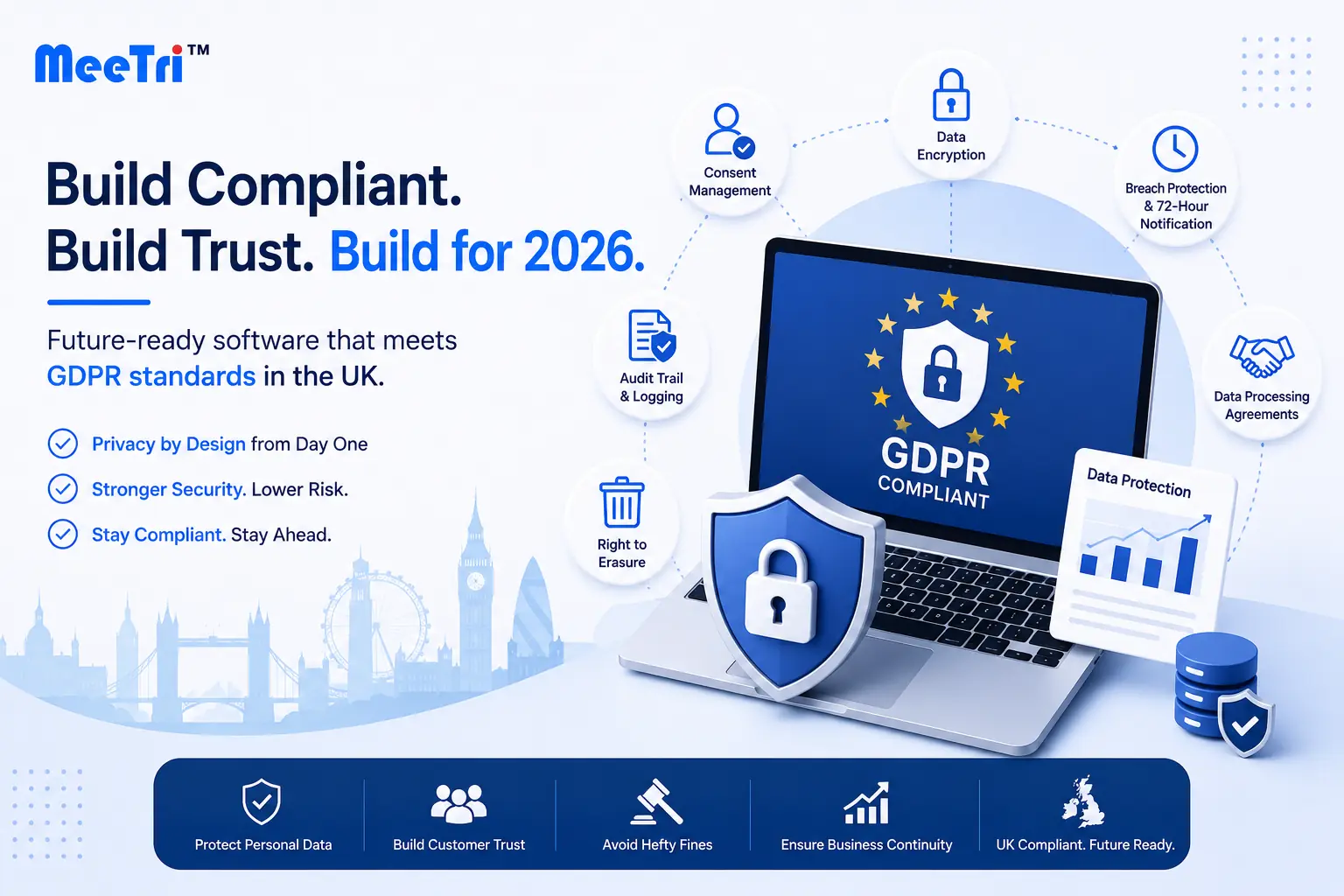
GDPR Software Development UK: What to Build in 2026
See what the ICO expects for GDPR compliant custom software and how privacy by design affects your build.

Offshore Software Development: Maximise ROI & Quality
Explore offshore development benefits, challenges, and best practices for cost-effective delivery.
How to Choose the Right Software Development Partner
Learn which questions reveal a partner's process and technical judgment.