Get a Free Development Strategy Consultation
Tell us about your project - we'll respond within 24 hours with tailored recommendations.
What's the Real Difference Between Custom Software and Off-the-Shelf?
Before diving into the signs, it helps to understand what you are actually choosing between.
Off-the-shelf software is built for the widest possible audience. It ships with features designed for hundreds of different business types, which means it fits none of them perfectly. You pay for functionality you will never use, while the features you actually need are buried under workarounds or simply missing.
Custom business software solutions, on the other hand, are built around your exact processes, your team, your data, and your growth trajectory. They do not ask your business to adapt to the software. The software adapts to your business.
That distinction matters more than most decision-makers realize until they have spent years stitching together tools that were never designed to work together.
Sign 1: You're Running the Business on Manual Workarounds
If your team is copying data between systems, exporting spreadsheets to bridge software gaps, or relying on someone's memory to catch what the tools miss, that is not a process problem. That is a software limitation problem.
Manual workarounds feel manageable at first. Then your team grows, volume increases, and the same workaround that took one person an hour now takes three people a full day. The risk of error compounds with scale.
When manual processes are the glue holding your operations together, it is a reliable indicator that your current tools have hit their ceiling.
Sign 2: Your Software Can't Grow With You
Scalability is one of the most overlooked criteria when businesses first choose tools. A platform that works well for a 10-person team often starts to crack at 50, whether that is slower performance, user limits, rising subscription costs, or features that just do not exist at the tier you need.
Software scalability issues do not always announce themselves dramatically. They show up gradually: reports that take longer to run, approval workflows that do not support a new layer of management, or pricing that jumps by 400% because you crossed a usage threshold.
If your roadmap includes geographic expansion, new service lines, or significant headcount growth, the honest question is whether your current software was built to scale with you or whether you are already borrowing time.
If you are evaluating options at this stage, speaking with a Software Development Company US that specialises in scalable architecture can help you understand what you are actually building toward.
Sign 3: Integration Failure Is Costing You Data You Need
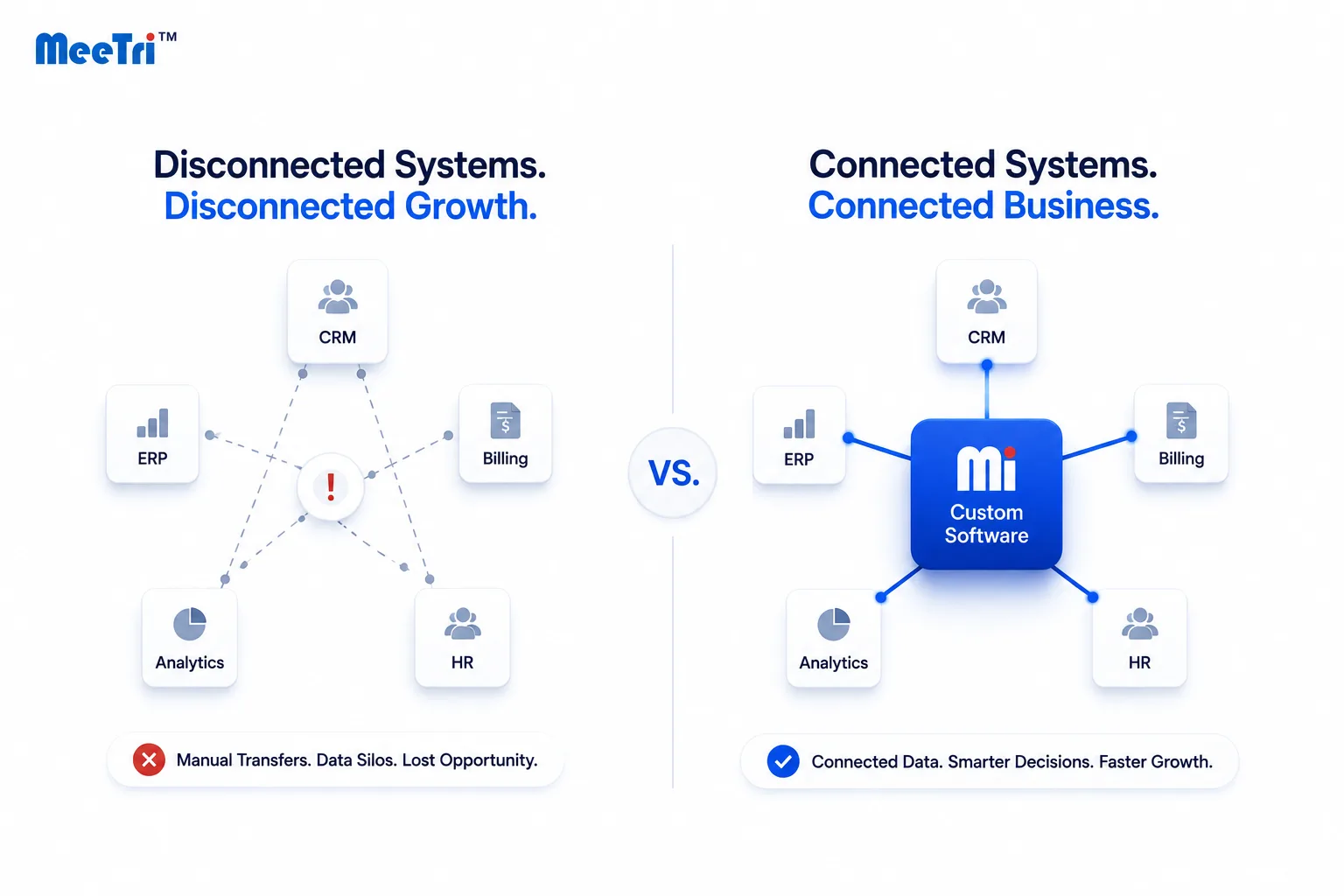
Most businesses operate across multiple platforms, a CRM here, an ERP there, a billing tool, a project management system. When these do not communicate reliably, you end up with data silos and decisions made on incomplete information.
Integration failure is one of the most expensive signs your current setup has outgrown off-the-shelf software. Every time your team manually transfers data between systems, you introduce delay, inconsistency, and risk. Over time, different departments end up working from different versions of the same truth.
Need help mapping the gap between your tools and your growth plan?
Custom software solves this by building integration into the foundation, not bolting it on after the fact. Your systems speak the same language because they were designed to.
Sign 4: You're Paying for Features You Don't Use and Missing the Ones You Need
Off-the-shelf platforms make revenue from a broad feature set that appeals to the largest number of buyers. But you are not the average buyer. You have specific needs that do not fit neatly into someone else's product roadmap.
This creates a frustrating dynamic: you are paying monthly for functionality your team will never touch, while the one workflow that would transform your operations does not exist in the tool at all, or requires an expensive add-on that only half-solves the problem.
The custom software benefits here are straightforward. You own exactly what you need, nothing more and nothing less, and your investment goes toward capability that directly serves your business rather than someone else's feature roadmap.
Sign 5: Security and Compliance Requirements Have Outgrown Generic Tools
For businesses operating in healthcare, finance, legal, or any regulated sector, generic software creates real exposure. Standard platforms are built to a baseline compliance standard, which may not meet your contractual obligations, your clients' requirements, or your own risk tolerance.
This matters beyond regulated industries too. As data privacy expectations rise, especially for US businesses handling customer data across state lines, the ability to control your data architecture, access controls, and audit trails becomes genuinely important.
Bespoke software development allows you to build compliance and security into the structure of the system from the start, rather than relying on a vendor's roadmap to eventually catch up to your requirements.
Sign 6: Your Competitors Are Moving Faster Than You Can
Workflow bottlenecks caused by software limitations do not just slow your team down. They slow your ability to respond to the market. If a competitor can launch a new service, onboard a client, or close a deal faster because their systems support it and yours do not, that is a competitive disadvantage with a compounding cost.
Business process automation, when built around your specific workflows, removes those bottlenecks by design. Approvals that require three manual touchpoints get automated. Client onboarding that took a week gets compressed into hours. Reporting that required a senior team member now runs on schedule without anyone touching it.
Speed, when it comes from software, is sustainable. Speed that depends entirely on people working harder is not.
If you would like to explore what Custom Software Development Services US can actually deliver for your specific workflows, a discovery conversation is usually the clearest starting point.
Sign 7: The Total Cost of Staying With What You Have Exceeds What You Think
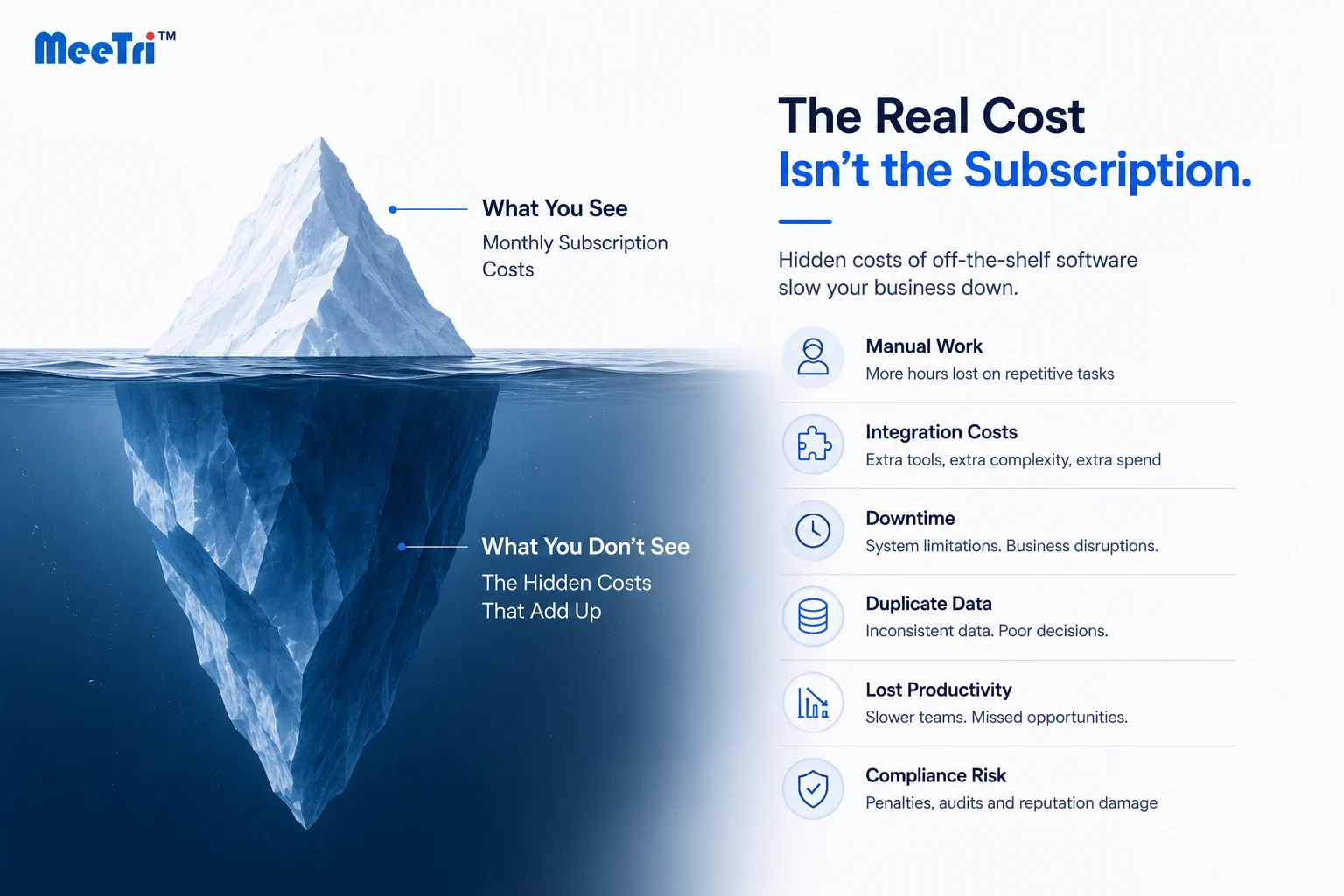
This is the sign that surprises most decision-makers. When you add up the monthly subscription costs across every tool in your stack, the hours spent on manual workarounds, the cost of errors that result from poor data quality, the productivity lost to slow or disconnected systems, and the opportunity cost of not being able to move as fast as the market requires, the number is often larger than the investment in a purpose-built solution.
Is custom software worth the investment for growing businesses? For most businesses that have crossed the threshold where off-the-shelf tools are visibly slowing them down, the answer is yes. But the timing, scope, and approach matter enormously.
Working with a Dedicated software development team rather than a generalist vendor typically delivers better outcomes here, because the team understands your domain and builds toward your actual growth signals rather than a generic feature list.
How Much Does Custom Software Development Cost for a US Business?
This is one of the most common questions, and the honest answer is that it depends on scope, complexity, integration requirements, and the engagement model you choose.
A rough framework:
- Smaller tools with limited integrations can be delivered for $20,000 to $80,000
- Mid-complexity platforms with multiple integrations and user roles typically range from $80,000 to $250,000
- Enterprise-grade systems with deep automation, compliance requirements, and long-term support are scoped individually
The more useful comparison is not custom software cost vs zero. It is Custom Software vs SaaS over a three to five year horizon, factoring in licence fees, integration costs, workaround time, and the value of capability you currently cannot access.
Understanding the full Custom Software Cost USA picture, including what you are currently spending and what you are losing to limitations, usually shifts the conversation significantly.
Can Custom Software Integrate With Your Existing Business Systems?
Yes, and it is actually one of the strongest arguments for going custom. A well-built custom solution is designed from the ground up to connect with your existing CRM, ERP, billing systems, data warehouses, and whatever else sits at the centre of your operations.
The key is choosing a development partner who does integration architecture properly at the discovery phase, not as an afterthought during delivery. When integration is designed in, it works cleanly. When it is bolted on later, it creates exactly the kind of data silos and manual bridges you were trying to escape.
The Business Software Upgrade Decision: What to Do Next
If three or more of the signs above apply to your business, you are likely past the point where off-the-shelf adjustments will solve the underlying problem. The question shifts from whether to build to how to approach it wisely.
Start by documenting the specific workflows where your current software falls short. Identify the data that is currently siloed or manually transferred. Estimate the time your team spends on workarounds each week. That baseline gives you a real foundation for a scoping conversation rather than a speculative one.
A phased approach often makes the most sense for US businesses: solving the highest-impact workflow first, validating the approach, then extending from there. This reduces risk, demonstrates value early, and builds internal confidence in the direction.
The right development partner will not push you toward unnecessary complexity. They will help you identify the minimum viable architecture that solves your real problems and scales with your actual growth signals.
Frequently Asked Questions
You need custom software when your current tools require significant manual workarounds, cannot scale with your growth, fail to integrate with your other systems, or no longer meet your compliance and security requirements. If more than two of these are true, it is worth a serious evaluation.
The clearest signs are manual data transfers between systems, rising subscription costs without corresponding value, workflows your software cannot support, integration failures, and an inability to report on the data that actually drives your decisions.
Off-the-shelf software is built for a broad audience and requires your business to adapt to its constraints. Custom software is built specifically for your workflows, data, and growth requirements. You own it, control it, and it evolves with you.
Yes, for businesses that have outgrown their current tools. The combined cost of licences, workarounds, and lost productivity usually exceeds a custom build within two to three years. Custom software is an asset, not an ongoing expense.
Yes. Custom software is designed to connect with your existing CRM, ERP, and other platforms from the start. Unlike off-the-shelf tools that rely on third-party connectors, custom integrations are built in, so your data flows cleanly across every system.
Custom software in the US typically costs between $20,000 and $250,000 depending on complexity and integrations. Simple tools start lower, while enterprise platforms with automation and compliance requirements cost more. The right comparison is total cost over three to five years, not upfront spend alone.

Related Articles
Custom Software Development for US Enterprises
See how US businesses plan, scope, and deliver custom software built around real operational needs.

Custom Software Development Cost in 2026
Break down the factors that shape project budgets, from scope and integrations to long-term support.
How to Build Scalable Software Products
Learn how architecture and integrations shape products that can grow without constant rework.