Get a Free Development Strategy Consultation
Tell us about your project — we'll respond within 24 hours with tailored recommendations.
Pharmacy Management Software Development in UAE: Features and Key Requirements

Pharmacy operations involve much more than processing prescriptions and recording medicine sales. Healthcare businesses need to manage stock accurately, monitor medicine expiry dates, coordinate dispensing workflows, process payments and connect different healthcare applications. Working with an experienced Software Development Company can help pharmacy groups build a connected platform around these operational requirements instead of relying on disconnected tools.
For organisations considering Pharmacy Management Software Development UAE, the objective is to create a system that supports daily pharmacy operations while addressing local healthcare requirements, pharmaceutical traceability and data protection. The platform should also accommodate different users, from pharmacists and inventory teams to finance departments and business administrators.
A well-designed solution can improve information flow, reduce repetitive administrative work and provide management with a clearer view of operational performance. This guide explores the features, integrations, architecture, development process and business considerations involved in building pharmacy management software for the UAE market.
Quick Answer: What Is Pharmacy Management Software Development?
Pharmacy management software development is the process of designing and building digital applications that manage prescription processing, medicine dispensing, inventory, purchasing, billing, reporting and pharmacy administration.
A custom platform connects these activities through a central system, allowing pharmacy groups, healthcare providers and hospital operators to coordinate workflows across different locations. Depending on the organisation's requirements, it may also connect with electronic health records, insurance systems, healthcare information exchanges and pharmaceutical traceability platforms.
The purpose is not simply to digitise paperwork. It is to create a reliable operational environment in which information moves between relevant departments and systems without unnecessary duplication.
Why Do UAE Healthcare Businesses Need Pharmacy Management Software?

Pharmacies handle large volumes of transactions and sensitive information. When prescription records, stock information, billing and purchasing operate separately, employees may need to enter the same details multiple times. This increases administrative effort and makes it difficult to maintain an accurate view of operations.
A connected system can address these challenges by linking pharmacy activities. For example, when a pharmacist completes a dispensing transaction, the application can update the relevant stock record, maintain dispensing history and send information to connected billing or reporting modules.
The main business benefits include:
- Centralised operations: Manage prescriptions, inventory, billing and reporting through connected modules.
- Improved stock visibility: Monitor available, reserved, damaged and near-expiry medicines across locations.
- Consistent workflows: Standardise processes while allowing branches to retain appropriate operational control.
- Better financial oversight: Track sales, purchasing, payment records and applicable insurance workflows.
- Reduced administrative work: Automate repetitive stock updates, reconciliation and reporting activities.
- Improved decision-making: Use consolidated information to identify stock problems, operational delays and changing demand.
These improvements are part of wider Digital Transformation in Healthcare, where connected applications help healthcare organisations improve coordination, information access and operational efficiency.
For organisations modernising their existing healthcare technology, Healthcare Software Development Services can support the development of connected applications, secure data exchange and workflows designed around specific operational requirements.
Essential Pharmacy Management System Features for UAE Businesses
The right Pharmacy Management System Features depend on the organisation's size, operating model and existing technology. However, most business-focused solutions require several core modules.
1. Prescription Management and Medication Dispensing
A Prescription Management System should support prescription capture, patient identification, medicine selection, dosage information, pharmacist verification and dispensing history.
The application should allow authorised pharmacists to review relevant prescription details before completing a transaction. Where appropriate, it can also support refill management, prescription status tracking and controlled medicine approval workflows.
Every important action should have an identifiable record, including who processed the prescription, what changes were made and when the medicine was dispensed. This creates a more reliable audit trail and helps organisations investigate discrepancies.
Where electronic prescribing is applicable, the platform should exchange structured prescription information with the relevant connected healthcare systems.
2. Pharmacy Inventory and Expiry Management
Pharmacy Inventory Management Software helps organisations monitor medicine availability across branches, warehouses and dispensing locations.
Core capabilities should include:
- Medicine and product catalogue management.
- Batch, lot, serial number and expiry-date tracking where applicable.
- Stock transfers between locations.
- Supplier and purchase-order management.
- Reorder thresholds and low-stock alerts.
- Damaged, recalled and quarantined stock records.
- Inventory adjustments and movement history.
- Near-expiry notifications and stock reconciliation.
Effective Pharmacy Inventory Tracking should show where products are stored, how stock changes and which medicines require attention. A multi-branch system should also support centralised visibility without removing local control over individual locations.
For medicines with expiry dates, first-expiry-first-out processes can help prioritise stock appropriately. However, the software must also account for product-specific handling rules and authorised stock adjustments.
3. Billing, Payments and Insurance Claims
A pharmacy billing module should manage sales transactions, invoices, discounts, returns, payment records and applicable tax information.
For organisations processing insured transactions, additional capabilities may include eligibility verification, prior authorisation, claim submission, remittance processing and rejection tracking. The exact requirements depend on payer arrangements and the relevant emirate's healthcare processes.
Pharmacy Billing Software Development should account for the complete transaction lifecycle rather than simply generating receipts. A completed dispensing transaction should be linked to the relevant billing record and inventory movement.
The system should also make rejected or incomplete transactions visible to authorised users. This helps teams investigate recurring errors rather than repeatedly correcting individual claims without addressing their underlying causes.
4. Multi-Branch and Supplier Management
Pharmacy groups need a consistent view of operations across their locations. A central administration module should provide authorised users with access to branch-level stock, sales, purchases, transfers and performance reports.
Supplier management is equally important. The platform should maintain supplier records, purchase orders, delivery information, pricing details and goods-received records.
When stock arrives, the receiving workflow should support product verification and the appropriate batch, serialisation and expiry information. This helps keep procurement records aligned with actual inventory.
5. Reporting and Business Analytics
Reporting helps management teams understand how the pharmacy operates and where improvements are needed.
Useful reports include:
- Stock movement and inventory turnover.
- Near-expiry and expired medicine records.
- Sales and purchasing trends.
- Prescription and dispensing volumes.
- Branch-level financial performance.
- Supplier and procurement activity.
- Claim acceptance and rejection trends, where applicable.
- Stock-out frequency and product demand.
These reports can support better purchasing decisions, inventory planning and operational reviews. The most useful dashboards allow managers to investigate the underlying transactions rather than presenting totals without context.
UAE Regulatory and Integration Requirements to Consider
Regulatory and integration planning is one of the most important stages of pharmacy software development. The UAE has federal healthcare requirements as well as emirate-level systems and policies. A pharmacy operating in Dubai may have different integration considerations from a facility in Abu Dhabi or another emirate.
Tatmeen and Pharmaceutical Traceability
Tatmeen is the UAE's pharmaceutical track-and-trace platform, established to support the tracking of pharmaceutical products through the supply chain.
Its framework uses GS1-based identification, including 2D DataMatrix barcodes. This makes product identification, serialised stock records and applicable reporting workflows important considerations when designing pharmacy inventory and dispensing modules.
A system may need to capture relevant product identifiers during receiving and dispensing, maintain traceability information and exchange the required events with the platform.
The exact integration responsibilities should be confirmed against current Tatmeen guidance and the organisation's role in the pharmaceutical supply chain. A development team should not assume that every pharmacy has identical reporting obligations.
Healthcare Information Exchanges
Healthcare information exchange requirements should be assessed according to the pharmacy's location, licence and facility classification.
Relevant UAE platforms include:
- NABIDH: Dubai's health information exchange, governed by Dubai Health Authority standards.
- Malaffi: Abu Dhabi's health information exchange.
- Riayati: The UAE's national unified medical record platform.
These platforms should not be treated as interchangeable integration projects. The development team needs to identify which connections are applicable, what information must be exchanged, which technical specifications apply and what access approvals are required.
Healthcare Data Protection and Security
Pharmacy platforms may process patient identities, prescriptions, medication histories and other sensitive information. Security must therefore be considered during architecture planning rather than added shortly before launch.
Relevant UAE legislation includes Federal Law No. 2 of 2019 concerning the use of information and communication technology in health fields and the Personal Data Protection Law, subject to their respective scope and applicable exceptions.
A secure architecture should consider:
- Role-based access controls for pharmacists, administrators and other users.
- Encryption in transit and at rest.
- Secure authentication and session management.
- Audit logs for access to sensitive records.
- Protected API connections.
- Data backup and disaster recovery.
- Data retention and deletion procedures.
- Security monitoring and incident response.
Data hosting and cross-border processing should be reviewed against applicable healthcare requirements. Selecting a cloud provider does not automatically make a pharmacy platform compliant.
UAE E-Invoicing and Financial System Readiness
The UAE Ministry of Finance is introducing electronic invoicing through a phased implementation programme. Its published guidance sets out implementation dates, scope and exclusions for affected businesses.
Pharmacy groups should assess whether their business-to-business transactions, supplier invoices and connected financial processes fall within the programme. Where applicable, the software architecture should support the required invoice data exchange through an accredited service provider.
The development team should verify the latest Ministry of Finance requirements during project discovery rather than hard-code assumptions about future implementation dates.
How Pharmacy Software Integration Connects Business Operations
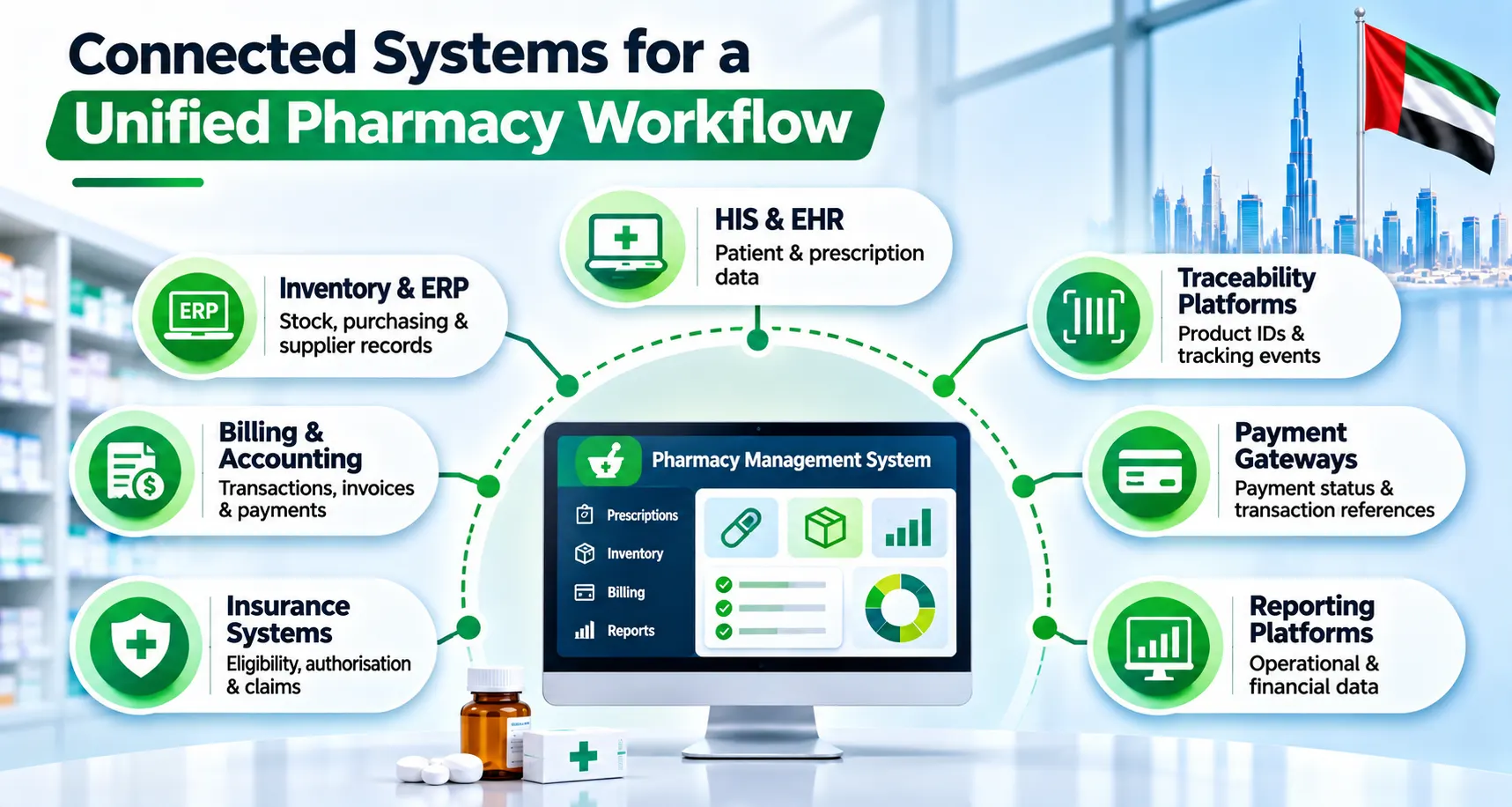
A pharmacy application becomes more valuable when it works with the systems already used by the organisation.
Pharmacy Software Integration should be planned around actual business workflows rather than a list of available APIs.
| Integration | Information exchanged | Business purpose |
|---|---|---|
| HIS and EHR | Patient and prescription information | Coordinate clinical and pharmacy workflows |
| Inventory and ERP | Stock, purchasing and supplier records | Improve procurement and financial visibility |
| Billing and accounting | Transactions, invoices and payment records | Support reconciliation and financial reporting |
| Insurance systems | Eligibility, authorisation and claim information | Manage applicable insurance workflows |
| Traceability platforms | Product identifiers and relevant events | Support pharmaceutical tracking |
| Payment gateways | Payment status and transaction references | Process and reconcile payments |
| Reporting platforms | Operational and financial data | Support management decisions |
The integration design should define how the system handles failed requests, duplicate messages, unavailable services and inconsistent data.
For example, if a connected insurance service becomes unavailable, the application should record the failed request and provide an appropriate process for retrying or reviewing the transaction. It should not silently treat an unsuccessful response as a completed claim.
Technical standards such as HL7 and FHIR may be relevant to healthcare information exchange, but using a standard does not automatically make an integration compatible. Data mapping, terminology, patient matching, authentication and error handling still need to be tested against the actual systems involved.
Pharmacy Software Architecture for Scalable Operations
A scalable pharmacy platform should separate its main business functions so that changes to one area do not unnecessarily disrupt the rest of the application.
A practical architecture can include four layers:
- Presentation layer: Interfaces for pharmacists, administrators, inventory teams and management users. Each role should see the functions and information relevant to its responsibilities.
- Application layer: Business logic for prescriptions, dispensing, inventory movement, billing, purchasing and reporting. These workflows should share consistent records so that a single transaction updates the appropriate modules.
- Data layer: Secure storage for medicine catalogues, inventory records, transactions, user permissions and audit logs. Data access should follow defined retention and protection requirements.
- Integration layer: Dedicated connections to external healthcare systems, insurance services, payment providers, ERP applications and traceability platforms. Keeping integrations separate makes it easier to update individual connectors when external requirements change.
Two additional considerations matter for multi-location operations. First, the system should define how branches continue essential activities during network interruptions and how transactions are synchronised afterwards. Second, new locations should be added through configuration wherever possible, rather than requiring a separate application deployment for each branch.
Custom Pharmacy Software vs Ready-Made Solutions
Not every pharmacy needs a completely custom application. The decision should depend on the organisation's workflows, integration requirements and plans for growth.
| Evaluation area | Ready-made software | Custom pharmacy software |
|---|---|---|
| Initial deployment | Usually faster | Requires discovery and development |
| Standard workflows | Often suitable | Can be tailored to specific needs |
| Unique integrations | Depends on vendor support | Can be designed for required systems |
| Feature changes | Limited by product roadmap | Greater control over development |
| Multi-branch requirements | Depends on available modules | Can be designed around business structure |
| Long-term flexibility | Depends on vendor | Greater control over technology roadmap |
Ready-made software may be appropriate for organisations with straightforward operations and supported integrations. Custom development becomes more relevant when existing products cannot support the required workflows, business rules or connections.
A hybrid approach is also possible. An organisation can retain an existing pharmacy application while developing additional modules or integration services around it. This can be useful when the existing system handles core transactions adequately but lacks reporting, patient-facing functionality or connections to other applications.
When the requirements involve unique workflows or multiple connected systems, Custom Software Development Services can help build a solution around the organisation's operational needs instead of forcing the business to adapt to a standard product.
Discuss Your Custom Pharmacy Software Requirements
How to Develop Custom Pharmacy Software: A Practical Process
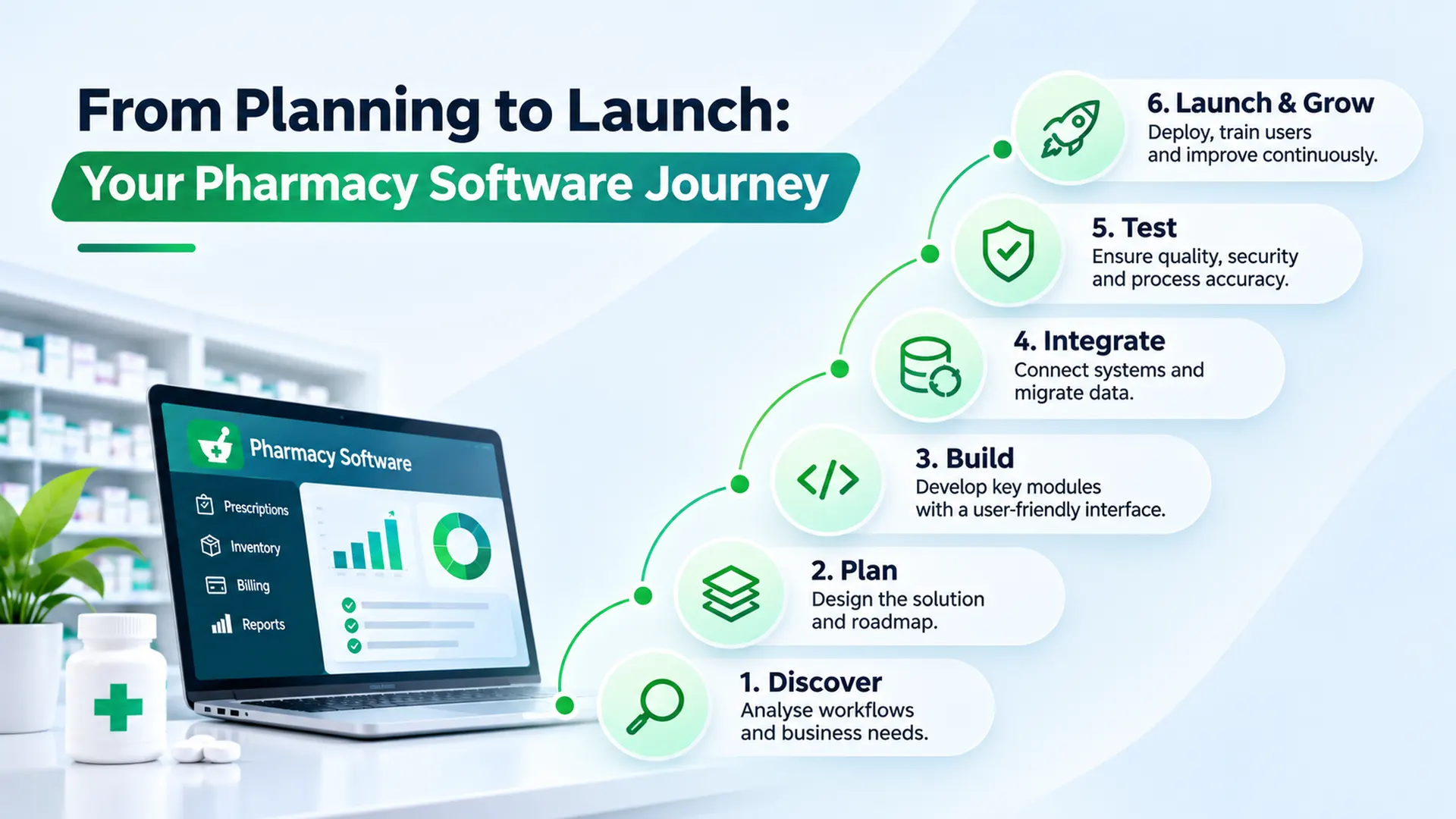
A structured development process reduces uncertainty and helps businesses make important decisions before development begins.
Step 1: Business and Technical Discovery
Document the organisation's pharmacy workflows, user roles, existing applications and business objectives. Identify where manual processes create delays and which operational problems the new system must address.
The discovery stage should also identify regulatory considerations, integration dependencies and the data that needs to be migrated.
Step 2: Solution Architecture and Planning
Define the application architecture, database structure, user permissions, integration approach and hosting requirements. Document the responsibilities of each system and how information should move between them.
This stage should also establish project scope, acceptance criteria, delivery milestones and dependencies on external providers.
Step 3: UI/UX Design and Core Development
Design interfaces around the tasks performed by pharmacists, administrators, inventory teams and management users.
Development can begin with essential modules such as prescription management, inventory, billing and branch administration. The priority should be reliable workflows before optional features are introduced.
Step 4: API Integration and Data Migration
Connect the required external applications and prepare existing records for migration.
Data migration should include validation of medicine catalogues, stock records, supplier information, pricing and patient information where applicable. Duplicate and incomplete records should be identified before migration, not simply transferred into the new system.
Step 5: Quality Assurance and Security Testing
Test complete workflows rather than checking each module independently. A dispensing test, for example, should verify that prescription information, stock movement, billing records and audit history remain consistent.
Testing should also cover user permissions, failed integrations, duplicate requests, network interruptions, backup recovery and security vulnerabilities.
Step 6: Deployment and Ongoing Improvement
Deploy the system in a controlled manner, train relevant users and monitor performance after launch.
A pilot at one selected location can help identify workflow problems before wider deployment. After rollout, the organisation should monitor system performance, resolve issues and plan maintenance and security updates.
Responsible AI Opportunities in Pharmacy Management
AI can improve selected pharmacy operations, particularly where organisations handle large volumes of historical data. However, it should support qualified staff rather than replace clinical judgement.
Potential applications include:
- Demand forecasting: Analyse historical sales and dispensing patterns to help predict stock requirements.
- Expiry-risk identification: Highlight products that may approach expiry before they can be used or sold.
- Document processing: Extract relevant information from prescription documents for pharmacist review.
- Operational reporting: Identify unusual inventory movements or recurring transaction errors.
- Procurement support: Help prepare purchase recommendations based on stock levels and demand patterns.
Clinical checks, including allergy and drug-interaction decisions, require validated clinical data and appropriate professional oversight. AI-generated recommendations should not independently authorise dispensing or replace a pharmacist's responsibility.
Before introducing AI, organisations should assess data quality, privacy, model performance, auditability and the consequences of incorrect outputs.
How to Measure Pharmacy Automation ROI
Software investment should be evaluated against measurable business outcomes rather than the number of features delivered.
A practical Healthcare Automation ROI assessment can consider:
- Reduction in expired and written-off inventory.
- Changes in stock-out frequency.
- Time spent on manual stock reconciliation.
- Reduction in duplicate data entry.
- Changes in billing and claim-processing errors.
- Faster access to operational reports.
- Staff time saved through automated workflows.
Businesses should establish a baseline before implementation. Useful measures include the value of expired stock per quarter, inventory turnover, first-pass claim acceptance where applicable, dispensing turnaround time and the number of manual stock adjustments.
A simple measurement approach is:
Annual net benefit = Inventory savings + Recovered revenue + Staff-time savings - Annual operating costs
Payback period = Initial implementation investment ÷ Annual net benefit
These calculations should use the organisation's actual figures. Generic ROI percentages or vendor estimates are not reliable substitutes for a business-specific assessment.
Evaluate Your Pharmacy Automation Opportunities
Extending Pharmacy Platforms with Patient and Clinical Applications
Pharmacy management software may form part of a wider healthcare technology ecosystem. Organisations can connect it with patient-facing applications, electronic health records, appointment systems and other clinical platforms.
A patient portal, for example, can provide access to prescription history, medicine information, refill requests, order status and relevant notifications. The features available should reflect the organisation's clinical processes, consent arrangements and access policies.
Organisations planning this type of ecosystem may benefit from working with a Patient Portal Development Partner that understands secure patient-facing workflows as well as integration with existing healthcare applications.
Similarly, Custom EHR Software Development may be relevant when pharmacy records need to connect with broader patient records and clinical workflows. These systems should be designed with appropriate data permissions, interoperability and auditability from the beginning.
What Should You Look for in a Pharmacy Software Development Partner?
Choosing a technical partner involves more than reviewing a portfolio or comparing development estimates. The organisation needs a team that understands healthcare workflows, integration dependencies, data security and the importance of reliable post-launch support.
Before making a decision, assess the following:
- Healthcare experience: Can the team demonstrate experience building applications involving sensitive records and multiple user roles?
- Integration capability: Can it explain how the proposed solution will connect with existing pharmacy, clinical and financial systems?
- Security approach: Are access control, encryption, audit logs and data protection included in the architecture?
- Data migration: How will existing medicine, inventory and transaction records be validated?
- Testing process: Will the team test complete workflows and integration failures rather than only individual screens?
- Scalability: Can the architecture support additional branches, modules and transaction volumes?
- Ownership and support: Are source-code ownership, documentation, maintenance responsibilities and service expectations clearly defined?
A capable development partner should explain its technical decisions in business terms, including project risks, external dependencies and long-term implications.
Discuss Your Healthcare Software Project
Conclusion: Building Pharmacy Management Software for Long-Term Growth
Pharmacy management software is no longer just a tool for recording sales and tracking stock. For growing pharmacy groups and healthcare organisations, it can become an important part of their wider operational infrastructure.
A well-designed platform connects prescription processing, medication dispensing, inventory, billing, procurement and reporting. It also gives management teams better visibility into branch performance and helps reduce the manual work associated with disconnected applications.
However, successful development requires more than selecting a list of features. Businesses must assess their operating model, existing technology, integration requirements, data protection responsibilities and future expansion plans before deciding on the right solution.
For UAE organisations, particular attention should be given to applicable Tatmeen requirements, healthcare information exchange connections and relevant financial processes. These considerations need to be addressed during discovery and architecture planning, not left until deployment.
The most effective approach is to build around measurable business needs, validate important integrations, maintain reliable data and establish performance indicators before implementation. This creates a stronger foundation for operational efficiency, better inventory control and sustainable digital growth.
If your organisation is planning a new pharmacy platform or modernising an existing system, begin by identifying the operational challenges you want to solve and the systems you need to connect. A clearly defined scope will help establish the right development priorities and reduce avoidable changes later.
Ready to plan your pharmacy management software project? Get in Touch with us to discuss your requirements and explore a suitable development approach.
Frequently Asked Questions About Pharmacy Management Software Development in UAE
Pharmacy management software is a digital application that manages pharmacy activities such as prescription processing, medicine dispensing, inventory, purchasing, billing and reporting. It can also connect with healthcare and business applications to support coordinated operations.
The essential features include prescription management, medicine inventory tracking, batch and expiry monitoring, billing, supplier management, multi-branch administration, user permissions and reporting. Additional modules depend on the pharmacy's business model and integration requirements.
There is no single fixed development cost. The investment depends on the number of modules, complexity of workflows, integrations, data migration, security requirements, number of locations and ongoing support. A reliable estimate requires a defined project scope and technical assessment.
The timeline depends on the scope and complexity of the project. A focused application with limited integrations generally requires less time than a multi-branch platform connected to healthcare exchanges, insurance systems and enterprise applications. Discovery, external approvals, data migration and testing should all be included in the delivery plan.
Tatmeen applies to pharmaceutical supply-chain participants, including relevant dispensaries such as pharmacies and hospitals. Its guidance describes traceability and reporting activities. The exact integration and reporting responsibilities should be confirmed according to the organisation's role and current Tatmeen requirements.
Integration may be required depending on the pharmacy's location, licence, facility type and applicable data-exchange obligations. The development team should confirm the relevant platform, technical specifications, access approvals and data-exchange scope before implementation.
A pharmacy platform should consider role-based access, secure authentication, encryption, audit logging, protected APIs, data backups and incident-response processes. Data hosting and cross-border processing must also be assessed against applicable UAE healthcare and personal-data requirements.
Ready-made software provides predefined features and can be quicker to deploy for standard operations. Custom software is developed around specific business workflows, integrations and operational requirements. The right option depends on how closely existing products match the organisation's needs.
Yes. A multi-branch platform can provide centralised stock visibility, branch-level permissions, inventory transfers, consolidated reporting and central administration. The architecture should be designed to support the organisation's branch structure and future expansion.
Businesses can measure ROI by comparing operational performance before and after implementation. Useful indicators include inventory write-offs, stock-out frequency, reconciliation time, claim-processing errors, staff hours and reporting efficiency. These measurements should be compared against the full cost of development, implementation and ongoing operation.
Yes. With suitable integration design, pharmacy software can exchange relevant information with electronic health record systems and patient-facing applications. The data exchanged, user permissions and consent requirements should be defined before development.
Evaluate the company's healthcare application experience, integration capabilities, security approach, development process, testing practices and post-launch support. Ask for evidence of relevant technical work and a clear explanation of how the proposed solution will meet your operational requirements.